
For a periodic waveform, defined the following.1, frequency, 2, period 3, root mean square value
Biology
ScanSolve AI Answer
Here are the definitions for the terms related to a periodic waveform:
-
Frequency:
- Frequency is the number of cycles or oscillations that a periodic waveform completes in one second. It measures how often a repeating event occurs. The standard unit for frequency is the hertz (Hz), where equals one cycle per second.
-
Period:
- The period is the time it takes for a periodic waveform to complete one full cycle. It is the reciprocal of frequency. The standard unit for period is the second (s).
- The relationship between period () and frequency () is given by .
-
Root Mean Square (RMS) value:
- The root mean square (RMS) value of a periodic waveform (like an alternating current or voltage) is the effective value that would produce the same average power dissipation in a resistive load as a DC current or voltage of the same magnitude. For a sinusoidal waveform, the RMS value is times its peak value.
Was this helpful?
Still stuck on this one?
Ask a follow-up, and the answer starts from this question.
Got a different question?Ask your own question
More Biology Questions
QFor a periodic wave form, define the following: (i) Frequency (ii) period and (iii) Root-mean-square…QA waveform is displayed on an oscilloscope. The horizontal sensitivity is 2 ms/div, and the vertical…QCalculate the Period and its SquareQDefine periodic function, even function, and Fourier series.QCalculate the period T for one oscillation using the formula T = (t)/(10). Then, calculate the…
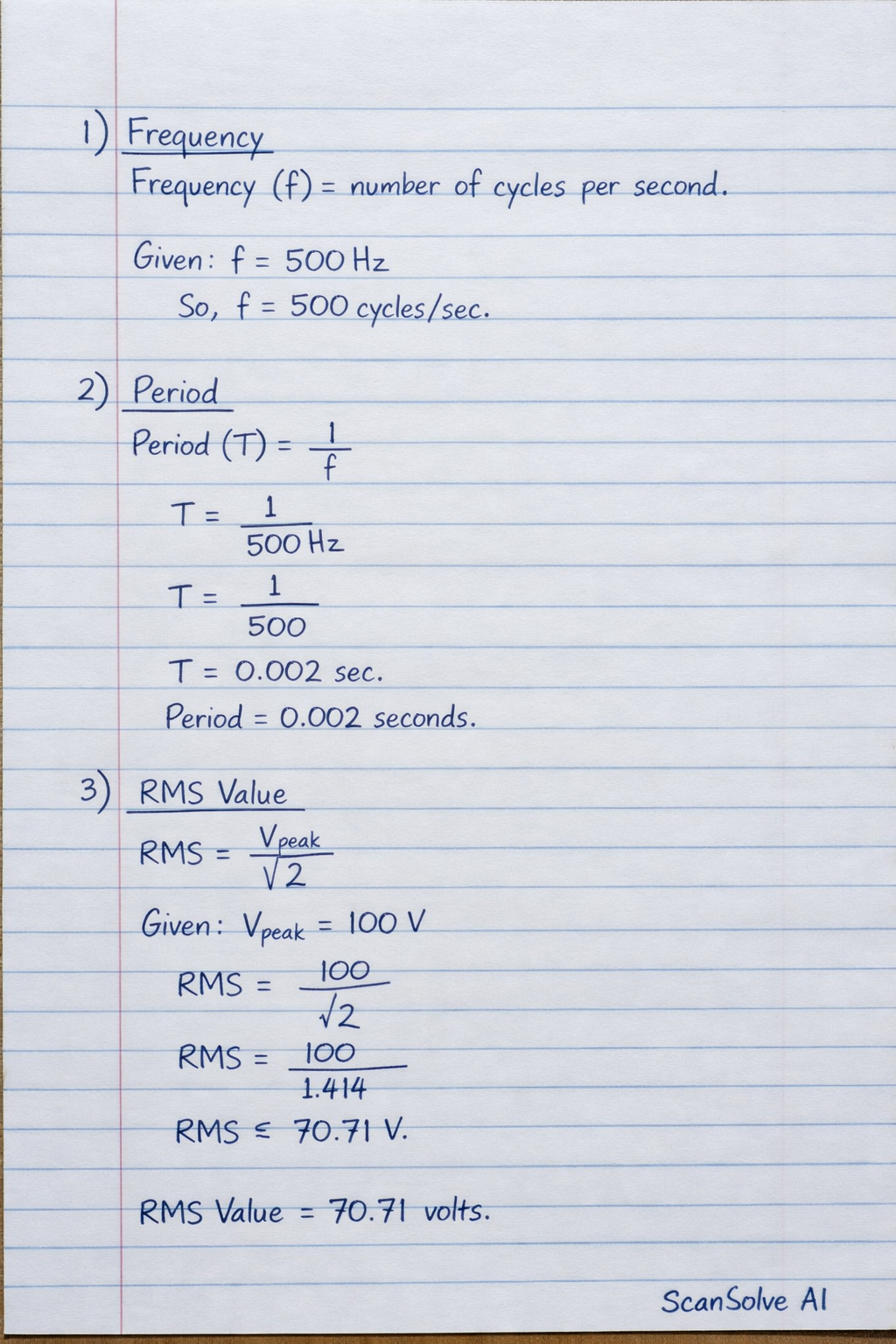
Handwritten Step-by-Step Solution
Get this as a handwritten image on WhatsApp — like a tutor wrote it for you.
Try on WhatsApp