For a periodic wave form, define the following: (i) Frequency (ii) period and (iii) Root-mean-square value
|Physics
For a periodic wave form, define the following: (i) Frequency (ii) period and (iii) Root-mean-square value
ScanSolve AI Answer
Answer
8.54\Omega
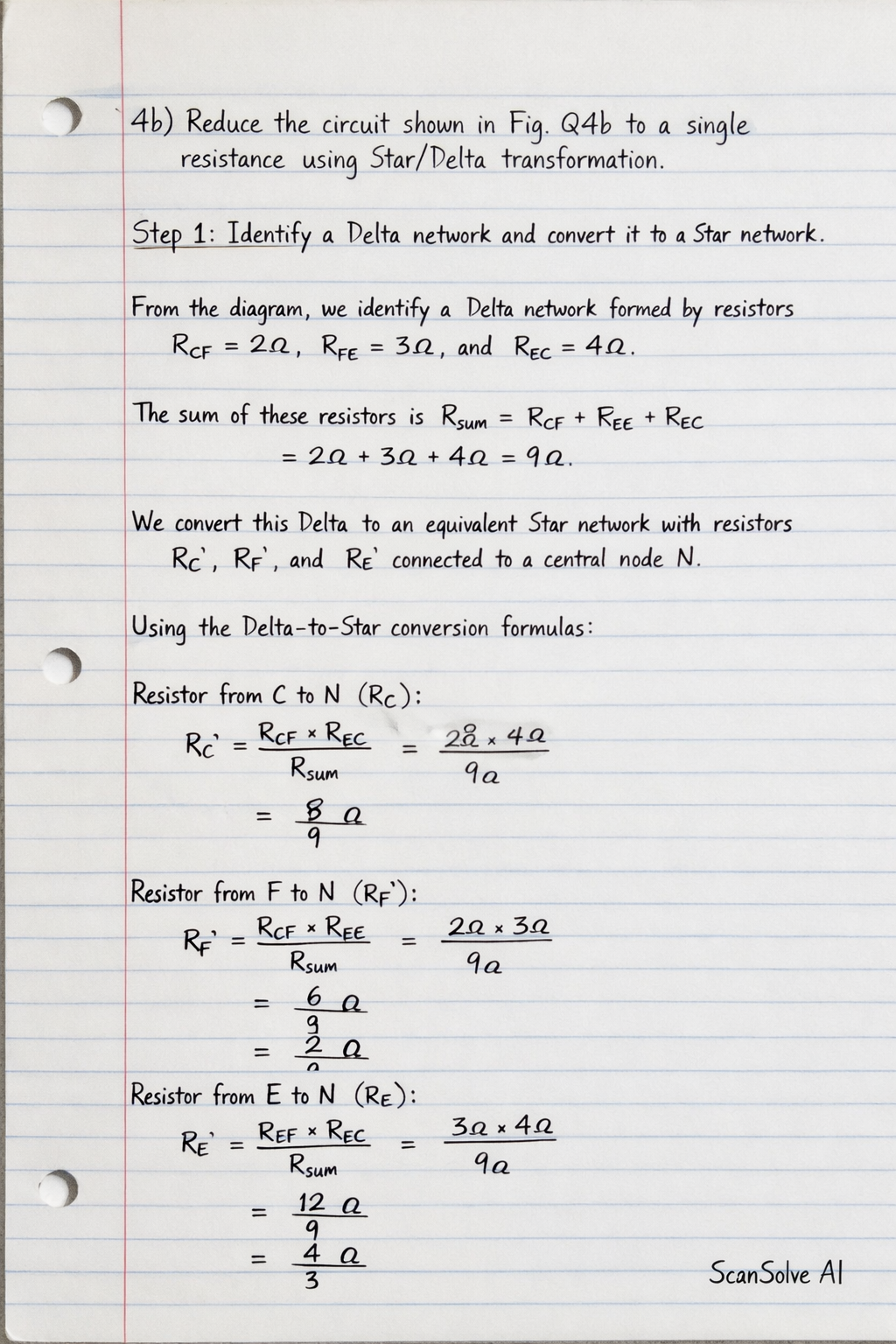
4b) Reduce the circuit shown in Fig. Q4b to a single resistance using Star/Delta transformation.
Step 1: Identify a Delta network and convert it to a Star network.
From the diagram, we identify a Delta network formed by resistors RCF=2Ω, RFE=3Ω, and REC=4Ω.
The sum of these resistors is Rsum=RCF+RFE+REC=2Ω+3Ω+4Ω=9Ω.
We convert this Delta to an equivalent Star network with resistors RC′, RF′, RE′ connected to a central node N.
Using the Delta-to-Star conversion formulas:
Resistor from C to N (RC′):
RC′=RsumRCF×REC=9Ω2Ω×4Ω=98Ω
Resistor from F to N (RF′):
RF′=RsumRCF×RFE=9Ω2Ω×3Ω=96Ω=32Ω
Resistor from E to N (RE′):
RE′=RsumRFE×REC=9Ω3Ω×4Ω=912Ω=34Ω
Step 2: Redraw the circuit and simplify series/parallel combinations.
After the Delta-to-Star conversion, the original nodes C, F, E are now connected to the central node N via RC′, RF′, RE′.
The circuit now has the following paths connected to node D:
Path from N to D via F: RF′ is in series with RFD=2Ω.
RNFD=RF′+RFD=32Ω+2Ω=32+6Ω=38Ω
Path from N to D via E: RE′ is in series with RED=2Ω.
RNED=RE′+RED=34Ω+2Ω=34+6Ω=310Ω
These two paths (RNFD and RNED) are in parallel, connected between node N and node D.
The equivalent resistance between N and D is:
RND=RNFD∥RNED=38Ω+310Ω38Ω×310Ω=318Ω980Ω=954980Ω=5480Ω=2740Ω
Step 3: Calculate the total equivalent resistance between terminals A and B.
The circuit is now a series combination of RAC, RC′, RND, and RDB.
From the diagram:
RAC=2.17Ω
RC′=98Ω
RND=2740Ω
RDB=4Ω (resistor between D and B)
The total equivalent resistance RAB is the sum of these series resistances:
RAB=RAC+RC′+RND+RDBRAB=2.17Ω+98Ω+2740Ω+4Ω
To sum these, we convert to fractions with a common denominator (2700 for 100 and 27):
RAB=100217Ω+278×3Ω+2740Ω+14ΩRAB=100217Ω+2724Ω+2740Ω+4ΩRAB=100217Ω+2764Ω+4ΩRAB=2700217×27Ω+270064×100Ω+27004×2700ΩRAB=27005859+6400+10800ΩRAB=270023059ΩRAB≈8.54Ω
2a) For a periodic wave form, define the following:
(i) Frequency
Frequency (f) is the number of complete cycles or oscillations of a periodic waveform that occur per unit of time. It is typically measured in Hertz (Hz), where 1 Hz equals one cycle per second.
(ii) Period
Period (T) is the time taken for one complete cycle of a periodic waveform to occur. It is the reciprocal of frequency (T=1/f) and is typically measured in seconds (s).
(iii) Root-mean-square (RMS) value
The Root-mean-square (RMS) value of a periodic waveform (like voltage or current) is the effective value that would produce the same average power dissipation in a resistive load as a DC voltage or current of the same magnitude. For a sinusoidal waveform, the RMS value is the peak value divided by 2.
What's next?
Was this helpful?
Need help with your own homework?
Get instant step-by-step solutions to any question. Free to start.
This physics problem tests your understanding of fundamental physical laws and their applications. The step-by-step solution below breaks down the problem using relevant equations and physical reasoning.
ScanSolve AI Answer
4b) Reduce the circuit shown in Fig. Q4b to a single resistance using Star/Delta transformation. Step 1: Identify a Delta network and convert it to a Star network. From the diagram, we identify a Delta network formed by resistors R_CF=2, R_FE=3, and R_EC=4. The sum of these resistors is R_sum = R_CF + R_FE + R_EC = 2 + 3 + 4 = 9. We convert this Delta to an equivalent Star network with resistors R_C', R_F', R_E' connected to a central node N. Using the Delta-to-Star conversion formulas: Resistor from C to N (R_C'): R_C' = R_CF × R_ECR_sum = (2 × 4)/(9) = (8)/(9) Resistor from F to N (R_F'): R_F' = R_CF × R_FER_sum = (2 × 3)/(9) = (6)/(9) = (2)/(3) Resistor from E to N (R_E'): R_E' = R_FE × R_ECR_sum = (3 × 4)/(9) = (12)/(9) = (4)/(3) Step 2: Redraw the circuit and simplify series/parallel combinations. After the Delta-to-Star conversion, the original nodes C, F, E are now connected to the central node N via R_C', R_F', R_E'. The circuit now has the following paths connected to node D: Path from N to D via F: R_F' is in series with R_FD=2. R_NFD = R_F' + R_FD = (2)/(3) + 2 = (2+6)/(3) = (8)/(3) Path from N to D via E: R_E' is in series with R_ED=2. R_NED = R_E' + R_ED = (4)/(3) + 2 = (4+6)/(3) = (10)/(3) These two paths (R_NFD and R_NED) are in parallel, connected between node N and node D. The equivalent resistance between N and D is: R_ND = R_NFD R_NED = (8)/(3) × (10)/(3)(8)/(3) + (10)/(3) = (80)/(9)(18)/(3) = (80)/(9)(54)/(9) = (80)/(54) = (40)/(27) Step 3: Calculate the total equivalent resistance between terminals A and B. The circuit is now a series combination of R_AC, R_C', R_ND, and R_DB. From the diagram: R_AC = 2.17 R_C' = (8)/(9) R_ND = (40)/(27) R_DB = 4 (resistor between D and B) The total equivalent resistance R_AB is the sum of these series resistances: R_AB = R_AC + R_C' + R_ND + R_DB R_AB = 2.17 + (8)/(9) + (40)/(27) + 4 To sum these, we convert to fractions with a common denominator (2700 for 100 and 27): R_AB = (217)/(100) + (8 × 3)/(27) + (40)/(27) + (4)/(1) R_AB = (217)/(100) + (24)/(27) + (40)/(27) + 4 R_AB = (217)/(100) + (64)/(27) + 4 R_AB = (217 × 27)/(2700) + (64 × 100)/(2700) + (4 × 2700)/(2700) R_AB = (5859 + 6400 + 10800)/(2700) R_AB = (23059)/(2700) R_AB ≈ 8.54 2a) For a periodic wave form, define the following: (i) Frequency Frequency (f) is the number of complete cycles or oscillations of a periodic waveform that occur per unit of time. It is typically measured in Hertz (Hz), where 1 Hz equals one cycle per second. (ii) Period Period (T) is the time taken for one complete cycle of a periodic waveform to occur. It is the reciprocal of frequency (T = 1/f) and is typically measured in seconds (s). (iii) Root-mean-square (RMS) value The Root-mean-square (RMS) value of a periodic waveform (like voltage or current) is the effective value that would produce the same average power dissipation in a resistive load as a DC voltage or current of the same magnitude. For a sinusoidal waveform, the RMS value is the peak value divided by sqrt(2). What's next?