
We read your photo as:
4a. Define the term resonance as applied to ac circuits. Sketch a resonance curve as applied to RC circuits and hence deduce the equation for resonant frequency.
Physics
ScanSolve AI Answer
Step-by-step solution
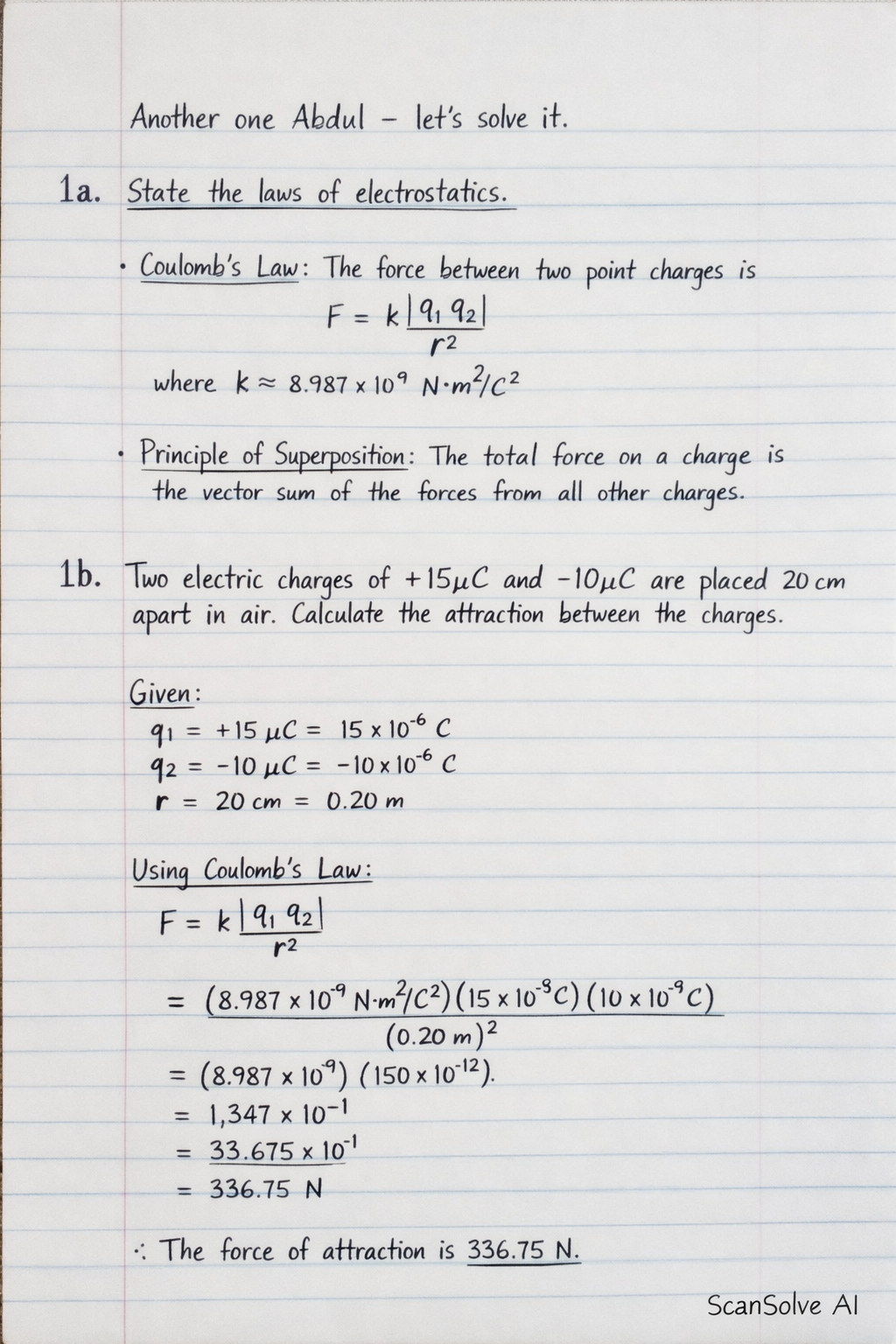
3 steps1a. State the laws of electrostatics.
The fundamental laws of electrostatics are:
- Coulomb's Law: This law states that the force between two point charges is directly proportional to the product of the magnitudes of the charges and inversely proportional to the square of the distance between them. The force acts along the line joining the two charges. Mathematically, the magnitude of the force between two charges and separated by a distance is given by: where is Coulomb's constant ().
- Principle of Superposition: This principle states that the total electrostatic force on a given charge due to a collection of other charges is the vector sum of the individual forces exerted on that charge by each of the other charges, acting independently.
1b. Two electric charges of and are placed 20cm apart in air. Calculate the attraction between the charges.
Identify the given values and convert to SI units.
- Charge 1:
- Charge 2:
- Distance:
- Coulomb's constant in air (approximately vacuum):
Apply Coulomb's Law.
The magnitude of the force between the two charges is given by:
Substitute the values and calculate the force.
Since the charges have opposite signs ( and ), the force between them is attractive.
Was this helpful?
Still stuck on this one?
Ask a follow-up, and the answer starts from this question.
Got a different question?Ask your own question
More Physics Questions
QCalculate capacitive reactance, inductive reactance, and resonance frequency given specific circuit…QA) Distinguish between frequency modulated and amplitude modulated radio transmitters. b) An RLC…QSketch a graph to show how the current in the circuit will vary when the frequency of the ac supply…QWhich of the following is a direct example of resonance?QThe problem describes a resonance tube closed at one end. For a tube closed at one end, the resonant…
Browse by topic:Electrical Engineering
Handwritten Step-by-Step Solution
Get this as a handwritten image on WhatsApp — like a tutor wrote it for you.
Try on WhatsApp