
What are the types of modulations
Physics
ScanSolve AI Answer
Answer
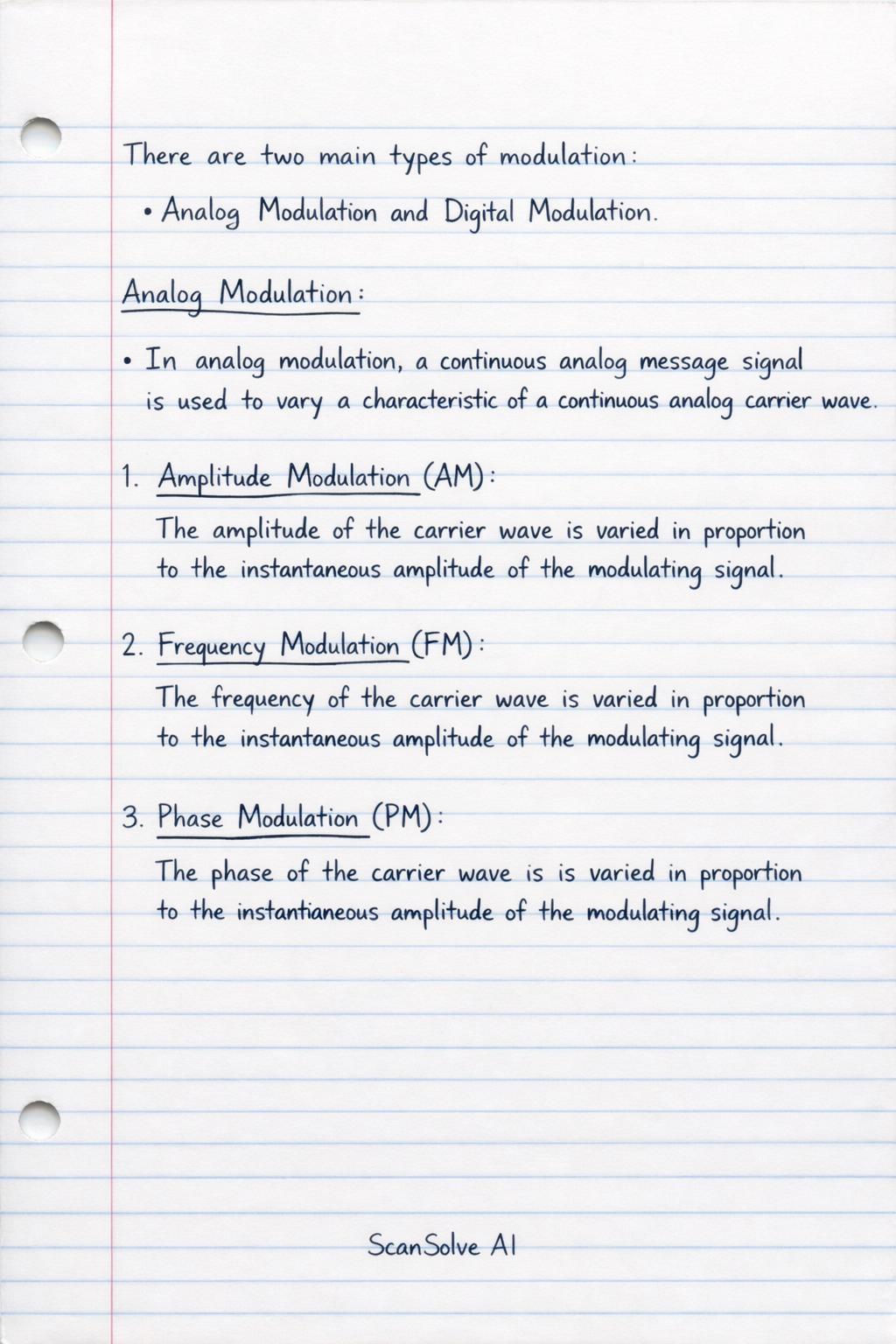
There are two main types of modulation: Analog Modulation and Digital Modulation.
-
Analog Modulation: In analog modulation, a continuous analog message signal is used to vary a characteristic of a continuous analog carrier wave.
- Amplitude Modulation (AM): The amplitude of the carrier wave is varied in proportion to the instantaneous amplitude of the modulating signal.
- Frequency Modulation (FM): The frequency of the carrier wave is varied in proportion to the instantaneous amplitude of the modulating signal.
- Phase Modulation (PM): The phase of the carrier wave is varied in proportion to the instantaneous amplitude of the modulating signal.
-
Digital Modulation: In digital modulation, a digital bit stream (discrete message signal) is used to vary a characteristic of an analog carrier wave.
- Amplitude Shift Keying (ASK): The amplitude of the carrier wave is varied to represent binary data (e.g., one amplitude for '0' and another for '1').
- Frequency Shift Keying (FSK): The frequency of the carrier wave is varied to represent binary data (e.g., one frequency for '0' and another for '1').
- Phase Shift Keying (PSK): The phase of the carrier wave is varied to represent binary data (e.g., different phase shifts for '0' and '1').
- Pulse Code Modulation (PCM): An analog signal is sampled, quantized, and then encoded into a digital bit stream.
Was this helpful?
Still stuck on this one?
Ask a follow-up, and the answer starts from this question.
Got a different question?Ask your own question
More Physics Questions
QWhat are you the type of modulation and their diagramsQWhat are the main types of molecular vibrations and their subtypes?QAn AM modulator has two inputs. The first input is a sine wave with a frequency of 500Hz and…QUnit 1.0 Pulse Analog Modulation Techniques Define sampling theorem in time-domain and discuss…QMechanical and transverse wave with three examples each
Handwritten Step-by-Step Solution
Get this as a handwritten image on WhatsApp — like a tutor wrote it for you.
Try on WhatsApp