
Unit 1.0 Pulse Analog Modulation Techniques Define sampling theorem in time-domain and discuss Nyquist criteria. Differentiate between ideal and natural sampling. Discuss aperture effect and equalization. Explain generation and detection of pulse amplitude modulation (PAM). Unit 2.0 Pulse Digital Modulation Write advantages and disadvantages of digital communication system. Describe uniform quantization and draw its diagram. Explain generation of PCM with the help of block diagram. Explain generation and detection of DPCM. Explain delta modulation (DM) with the help of block diagram. Discuss about slope-overload distortion and granular noise in delta modulation. Explain working of TDM with the help of block diagram. Unit-3.0 Digital Band Pass Modulation Techniques Describe generation of Amplitude Shift Keying (ASK) with the help of block diagram. Differentiate between coherent and non-coherent detection techniques. Explain generation and detection of BPSK with the help of block diagram. Compare the bandwidth and power requirement of ASK, FSK, and PSK. Explain concept of Binary FSK (BFSK) modulation technique. Compare between ASK, FSK, and PSK. Unit-4.0 Other Digital Modulation Techniques Explain generation and detection of DPSK with the help of block diagram. Describe generation and detection of QPSK with the help of block diagram. Explain Quadrature Amplitude Modulation (QAM) in detail. 4. Discuss Minimum Shift Keying (MSK) and its advantages. Unit-5.0 Spread Spectrum Modulation Define spread spectrum modulation. Write its advantages over fixed frequency modulation. Define FHSS and write its applications. Write key features of DSSS Describe generation and detection of DSSS. What is PN sequence? Explain generation of PN sequence with suitable diagram.
ScanSolve AI Answer
This answer stops before the end.
It was cut off when it was first written. Ask ScanSolve this question again for the full working.
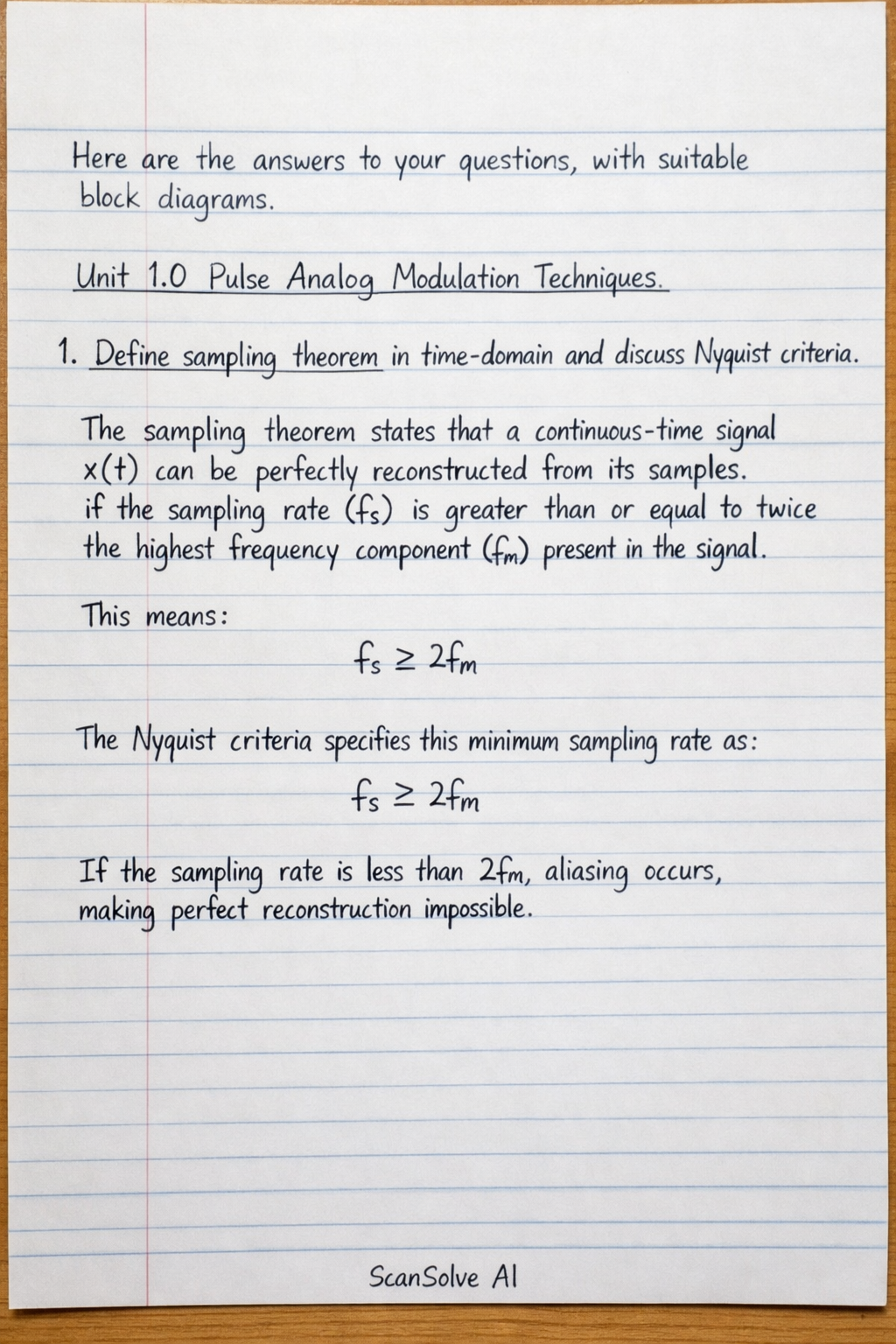
Here are the answers to your questions, with suitable block diagrams.
Unit 1.0 Pulse Analog Modulation Techniques
-
Define sampling theorem in time-domain and discuss Nyquist criteria. The sampling theorem states that a continuous-time signal can be perfectly reconstructed from its samples if the sampling rate () is greater than or equal to twice the highest frequency component () present in the signal. The Nyquist criteria specifies this minimum sampling rate, known as the Nyquist rate, as . If the sampling rate is less than , aliasing occurs, making perfect reconstruction impossible.
-
Differentiate between ideal and natural sampling.
- Ideal sampling (or instantaneous sampling) involves multiplying the continuous-time signal with an impulse train, resulting in samples that are impulses with amplitudes equal to the signal's value at the sampling instants. The samples have infinitesimal duration.
- Natural sampling involves multiplying the continuous-time signal with a train of finite-width pulses. The amplitude of each pulse varies naturally with the signal's amplitude during the pulse duration, creating a flat-top or non-flat-top pulse.
-
Discuss aperture effect and equalization.
- The aperture effect is a distortion introduced during the reconstruction of a signal that was sampled using finite-width pulses (like in natural or flat-top sampling). The finite width of the sampling pulse causes a "smearing" or averaging effect, leading to attenuation of higher frequency components in the reconstructed signal.
- Equalization is the process of compensating for the aperture effect. This is typically done by passing the reconstructed signal through an equalizer filter (often an inverse filter) that has a frequency response inverse to that of the aperture effect, thereby boosting the attenuated high-frequency components and restoring the original signal's spectrum.
-
Explain generation and detection of pulse amplitude modulation (PAM). In PAM, the amplitude of a pulse carrier is varied in proportion to the instantaneous amplitude of the message signal.
-
Generation of PAM: The message signal is fed into a sampler, which is controlled by a pulse generator. The sampler takes instantaneous samples of the message signal at regular intervals. These samples then modulate the amplitude of a train of pulses generated by the pulse generator, creating the PAM signal.
-
Detection of PAM: The received PAM signal is first passed through a low-pass filter (LPF). The LPF removes the high-frequency components introduced by the sampling process and reconstructs the original message signal.
-
Unit 2.0 Pulse Digital Modulation
-
Write advantages and disadvantages of digital communication system.
- Advantages:
- Better noise immunity and less distortion.
- Easier regeneration of signals over long distances.
- Improved security through encryption.
- Flexibility for integration with other digital systems.
- Easier multiplexing (e.g., TDM).
- Disadvantages:
- Requires significantly more bandwidth than analog systems.
- Increased complexity in transmitter and receiver design.
- Requires synchronization between transmitter and receiver.
- Higher power consumption.
- Advantages:
-
Describe uniform quantization and draw its diagram. Uniform quantization is a process where the range of analog input values is divided into a set of equally spaced discrete levels. Each analog sample within a specific range is then mapped to the nearest discrete level. The step size between these levels is constant across the entire range.
- Diagram of Uniform Quantization:
\begin{tikzpicture}[scale=0.8]
\draw[->] (-0.5,0) -- (5.5,0) node[right] {Input $x$};
\draw[->] (0,-0.5) -- (0,5.5) node[above] {Output $y$};

\foreach \x in {0,1,2,3,4} {
    \draw[dashed] (\x,0) -- (\x,\x+1);
    \draw[thick] (\x,\x) -- (\x+1,\x);
}
\draw[thick] (4,4) -- (5,4);

\node at (0.5,-0.3) {$Q_0$};
\node at (1.5,-0.3) {$Q_1$};
\node at (2.5,-0.3) {$Q_2$};
\node at (3.5,-0.3) {$Q_3$};
\node at (4.5,-0.3) {$Q_4$};

\node at (-0.3,0.5) {$L_0$};
\node at (-0.3,1.5) {$L_1$};
\node at (-0.3,2.5) {$L_2$};
\node at (-0.3,3.5) {$L_3$};
\node at (-0.3,4.5) {$L_4$};

\node at (2.5, -1) {Input $x$};
\node at (-1, 2.5) {Output $y$};
\end{tikzpicture}
This diagram shows a staircase-like input-output characteristic, where the output is quantized to discrete levels.
- Diagram of Uniform Quantization:
-
Explain generation of PCM with the help of block diagram. Pulse Code Modulation (PCM) converts an analog signal into a digital bit stream.
- Generation of PCM: The analog message signal is first sampled at a rate greater than or equal to the Nyquist rate. The discrete-time, continuous-amplitude samples are then passed through a quantizer, which converts them into discrete-amplitude values by mapping them to a finite set of levels. Finally, an encoder converts these quantized levels into binary code words, producing the digital PCM signal.
-
Explain generation and detection of DPCM. Differential Pulse Code Modulation (DPCM) exploits the redundancy in a signal by encoding the difference between the current sample and a predicted sample, rather than the sample itself.
- Generation of DPCM:
The input signal is compared with its predicted value (from a predictor). The difference is then quantized. The quantized error is encoded into a binary stream. The quantized error is also fed back to the predictor to update the predicted value for the next sample.
\boxed{
Input Signal  x(n) \longrightarrow Summer \longrightarrow Quantizer \longrightarrow Encoder \longrightarrow DPCM Signal \\
\uparrow                                                                                                                                                                                                                                                                                                                                                                                                           \text
- Generation of DPCM:
The input signal is compared with its predicted value (from a predictor). The difference is then quantized. The quantized error is encoded into a binary stream. The quantized error is also fed back to the predictor to update the predicted value for the next sample.
Still stuck on this one?
Ask a follow-up, and the answer starts from this question.
More Geography Questions
Handwritten Step-by-Step Solution
Get this as a handwritten image on WhatsApp — like a tutor wrote it for you.
Try on WhatsApp