
What are you the type of modulation and their diagrams
ScanSolve AI Answer
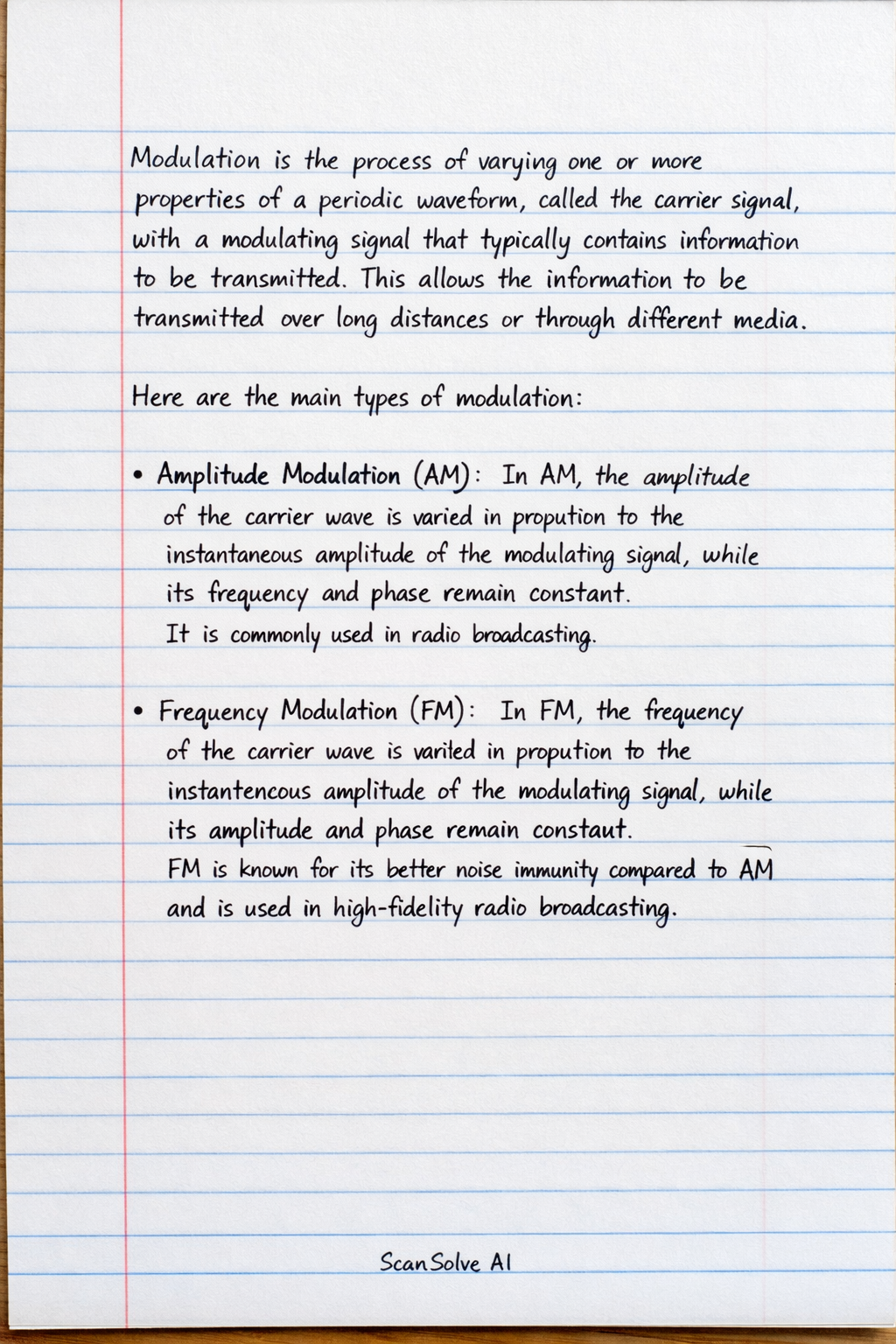
Modulation is the process of varying one or more properties of a periodic waveform, called the carrier signal, with a modulating signal that typically contains information to be transmitted. This allows the information to be transmitted over long distances or through different media.
Here are the main types of modulation:
-
Amplitude Modulation (AM): In AM, the amplitude of the carrier wave is varied in proportion to the instantaneous amplitude of the modulating signal, while its frequency and phase remain constant. It is commonly used in radio broadcasting.
-
Frequency Modulation (FM): In FM, the frequency of the carrier wave is varied in proportion to the instantaneous amplitude of the modulating signal, while its amplitude and phase remain constant. FM is known for its better noise immunity compared to AM and is used in high-fidelity radio broadcasting.
-
Phase Modulation (PM): In PM, the phase of the carrier wave is varied in proportion to the instantaneous amplitude of the modulating signal, while its amplitude and frequency remain constant. PM is closely related to FM and is often used in digital communication systems.
Still stuck on this one?
Ask a follow-up, and the answer starts from this question.
More Physics Questions
Handwritten Step-by-Step Solution
Get this as a handwritten image on WhatsApp — like a tutor wrote it for you.
Try on WhatsApp