
We read your photo as:
Here are the solutions to the questions: 1. Which of the following is not a reason for lighting a house? A. To discourage pests. B. For safety reasons. C. To read comfortably. D. For warming our bodie
ScanSolve AI Answer
Answer
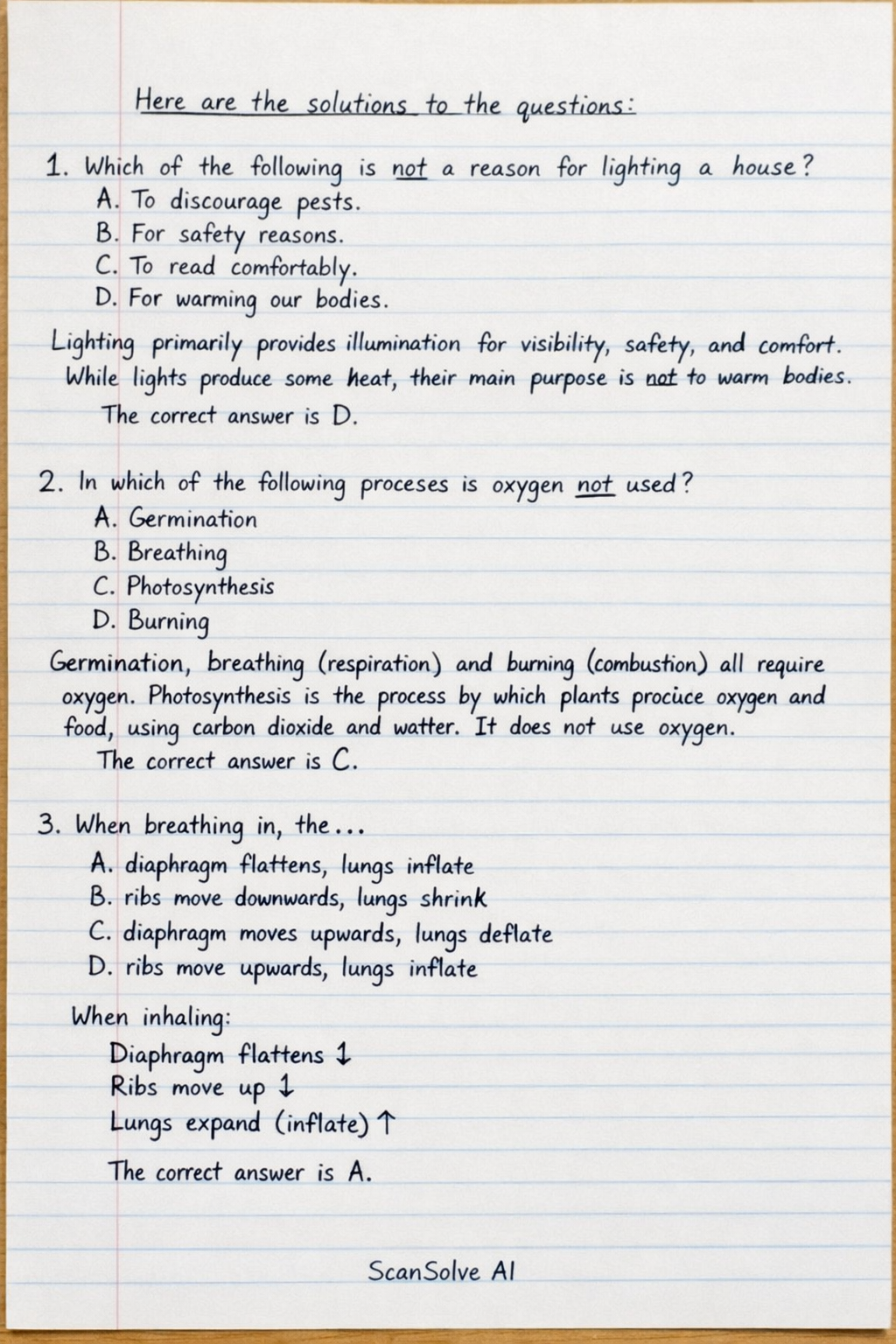
Here are the solutions to the questions:
1. Which of the following is not a reason for lighting a house?
- A. To discourage pests.
- B. For safety reasons.
- C. To read comfortably.
- D. For warming our bodies.
Lighting primarily provides illumination for visibility, safety, and comfort. While lights produce some heat, their main purpose is not to warm bodies.
The correct answer is D.
2. In which of the following processes is oxygen not used?
- A. Germination
- B. Breathing
- C. Photosynthesis
- D. Burning
Germination, breathing (respiration), and burning (combustion) all require oxygen. Photosynthesis is the process by which plants produce oxygen and food, using carbon dioxide and water. It does not use oxygen.
The correct answer is C.
3. When breathing in, the...
- A. diaphragm flattens, lungs inflate
- B. ribs move downwards, lungs shrink
- C. diaphragm moves upwards, lungs deflate
- D. ribs move upwards, lungs inflate
During inhalation, the diaphragm contracts and moves downwards (flattens), and the ribs move upwards and outwards. Both actions increase the volume of the chest cavity, causing the lungs to inflate as air rushes in.
The correct answer is A.
4. Which of the following statements is untrue about vertebrates?
- A. Reptiles and fish lay eggs.
- B. Fish and amphibians have varying body temperatures.
- C. Reptiles and birds lay fertilized eggs.
- D. Birds and amphibians have scales.
Reptiles and fish lay eggs (A - true). Fish and amphibians are cold-blooded (ectothermic), so their body temperatures vary with the environment (B - true). Reptiles and birds lay fertilized eggs (C - true). Birds have feathers (and scales on their legs/feet), while amphibians have moist skin, not scales. Therefore, statement D is untrue.
The correct answer is D.
5. Digested food materials, salt and other dissolved substances in the circulatory system are found within:
- A. White blood cells
- B. Haemoglobin
- C. Plasma
- D. Platelets
Plasma is the liquid component of blood that transports dissolved substances such as nutrients (digested food materials), salts, hormones, and waste products throughout the body.
The correct answer is C.
6. The functions of white blood cells in the blood is to:
- A. fight diseases
- B. absorb oxygen
- C. help in clotting of blood
- D. transport digested food to the cells
White blood cells (leukocytes) are a vital part of the immune system, responsible for identifying and destroying pathogens and fighting infections and diseases.
The correct answer is A.
7. What were the learners investigating? (Referring to the diagram showing a heat source below a container with smoke)
- A. Radiation
- B. Convection in gases
- C. Convection in liquids
- D. Conduction in solids
The setup with a heat source at the bottom and smoke to visualize movement demonstrates convection in gases. The heated air becomes less dense and rises, creating a current.
The correct answer is B.
8. Which of the following is not a use of poor conductors of heat?
- A. Making handles of cooking utensils.
- B. Holding hot utensils.
- C. Keeping warm during cold weather.
- D. Making utensils such as pots, kettles.
Poor conductors of heat (insulators) are used to prevent heat transfer. Options A, B, and C describe uses of poor conductors. Pots and kettles are designed to transfer heat efficiently to food or water, so they are made from good conductors of heat (e.g., metals).
The correct answer is D.
9. Which of the following fungi is used to raise dough when baking bread and 'andazi'?
- A. Yeast
- B. Penicillium
- C. Mould
- D. Mushrooms
Yeast (specifically Saccharomyces cerevisiae) is a type of fungus that ferments sugars in dough, producing carbon dioxide gas which causes the dough to rise.
The correct answer is A.
10. Which of the following statements is not true about the invertebrate? (Referring to the image of a slug)
- A. They have a single foot.
- B. Have two pair of tentacles.
- C. The foot produces a layer of slime over which they glide.
- D. Have segmented body.
The invertebrate shown is a slug, which is a mollusc. Slugs have a single muscular foot (A - true), typically two pairs of tentacles (B - true), and produce slime to glide (C - true). Molluscs have unsegmented bodies, unlike annelids or arthropods. Therefore, statement D is not true.
The correct answer is D.
Try one yourself
A new problem that tests the same skill.
Still stuck on this one?
Ask a follow-up, and the answer starts from this question.
More Biology Questions
Handwritten Step-by-Step Solution
Get this as a handwritten image on WhatsApp — like a tutor wrote it for you.
Try on WhatsApp