
We read your photo as:
In section A, question 1.a, what property of light is being demonstrated and mention two natural occurrences that could be explained by this property. In section B, question 1.b, name the types of heat transfer labelled I, II and III.
ScanSolve AI Answer
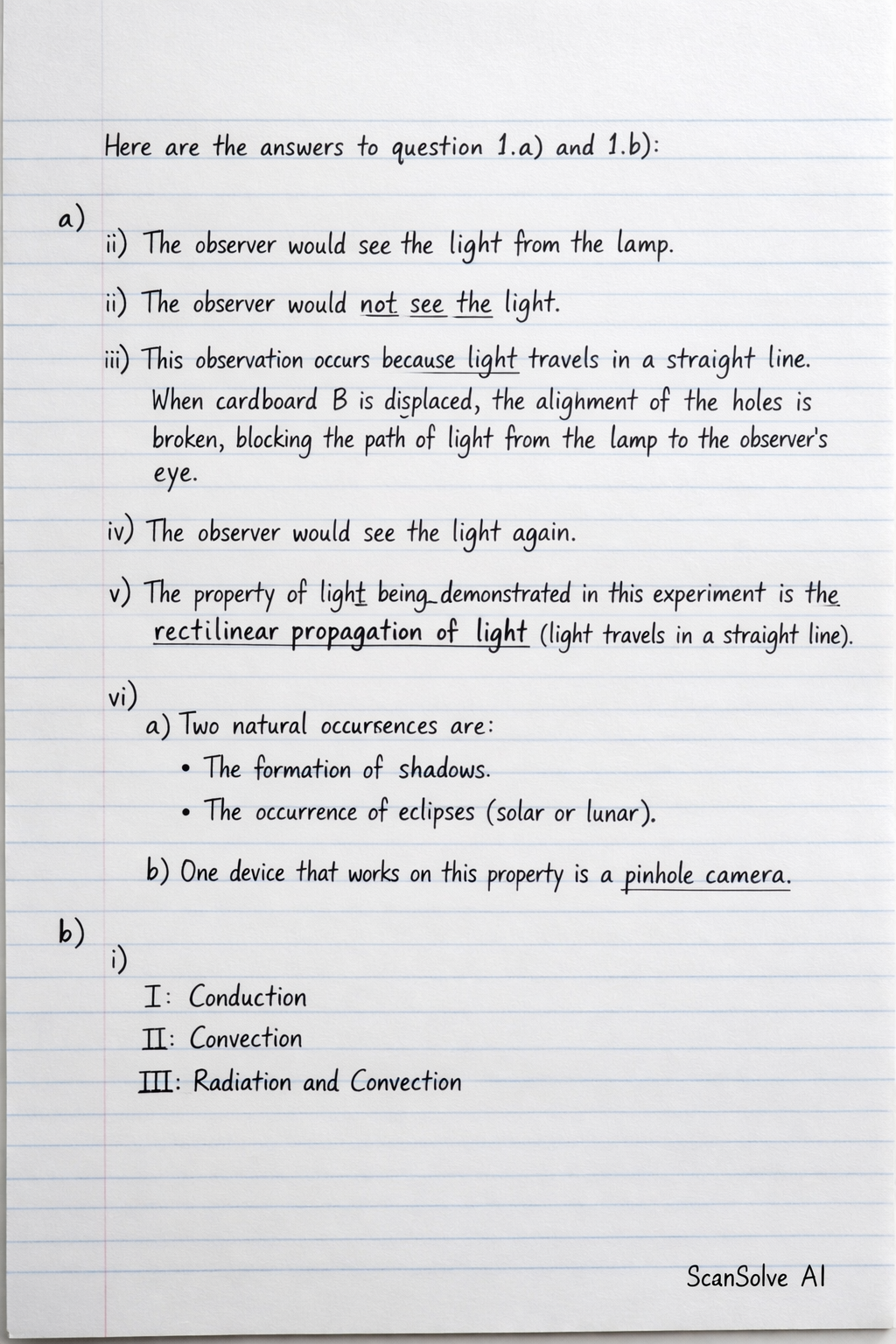
Here are the answers to question 1.a) and 1.b):
a)
i) The observer would see the light from the lamp.
ii) The observer would not see the light.
iii) This observation occurs because light travels in a straight line. When cardboard B is displaced, the alignment of the holes is broken, blocking the path of light from the lamp to the observer's eye.
iv) The observer would see the light again.
v) The property of light being demonstrated in this experiment is the rectilinear propagation of light (light travels in a straight line).
vi)
a) Two natural occurrences are:
- The formation of shadows.
- The occurrence of eclipses (solar or lunar).
b) One device that works on this property is a pinhole camera.
b)
i)
I: Conduction
II: Convection
III: Radiation and Convection
ii)
I (Conduction): Heat is transferred through the vibration and collision of particles in the solid handle.
II (Convection): Heat is transferred through the movement of heated fluid particles (water/steam) from hotter to cooler regions.
III (Radiation): Heat is transferred from the flame to the pot as electromagnetic waves (infrared radiation) without needing a medium.
III (Convection): Heat is transferred from the flame to the pot by the movement of hot gases rising from the flame.
iii) If the handle were made of wood instead of metal, the hand would not have felt as hot, or would have felt less heat.
iv) Wood is a poor conductor of heat (an insulator), so it transfers heat much slower and less effectively than metal.
Still stuck on this one?
Ask a follow-up, and the answer starts from this question.
More Physics Questions
Handwritten Step-by-Step Solution
Get this as a handwritten image on WhatsApp — like a tutor wrote it for you.
Try on WhatsApp