
We read your photo as:
SECTION B: THEORY QUESTIONS Answer any FOUR questions. 4a) What is energy transformation? (b) Explain how energy is transformed in nature.
ScanSolve AI Answer
Answer
agricultural productivity
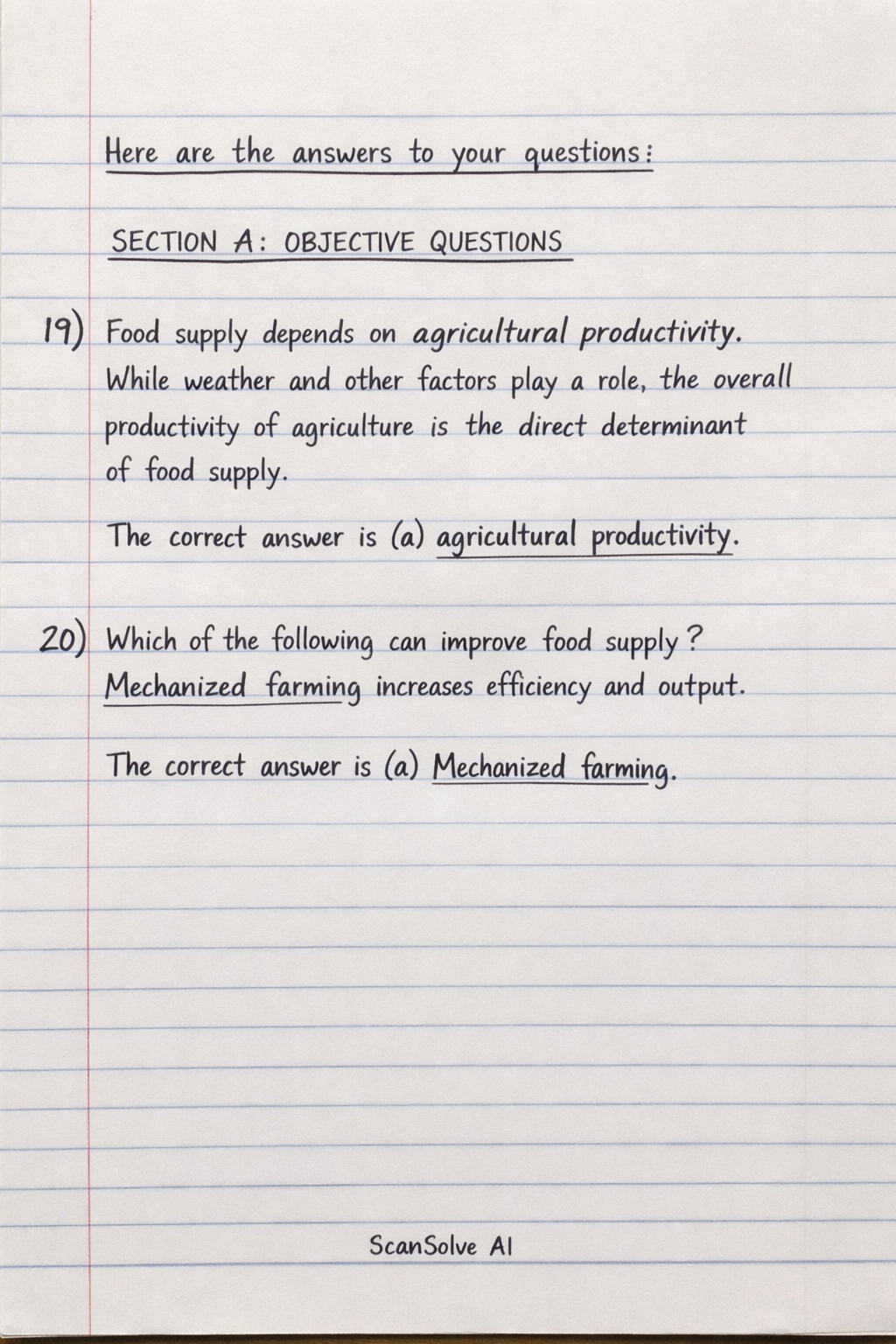
Here are the answers to your questions:
SECTION A: OBJECTIVE QUESTIONS
19) Food supply depends on agricultural productivity. While weather and other factors play a role, the overall productivity of agriculture is the direct determinant of food supply.
The correct answer is (a) agricultural productivity.
20) Which of the following can improve food supply? Mechanized farming increases efficiency and output.
The correct answer is (a) Mechanized farming.
21) Microorganisms are organisms that can be seen easily only in water. This statement is incorrect. Microorganisms are microscopic and cannot be seen easily with the naked eye, and they exist in various environments, not just water. The question asks for a characteristic, and the options are (a) can be seen easily, (b) are microscopic, (c) are always harmful, (d) live only in water. The most accurate characteristic is that they are microscopic. However, the question is phrased as "Microorganisms are organisms that that A. can be seen easily B. are microscopic C. are always harmful D. live only in water". If it's asking for a true statement, then (b) is true. If it's asking for an exception or a false statement, the phrasing is ambiguous. Assuming it's asking for a true characteristic:
The correct answer is (b) are microscopic.
22) The study of microorganisms is called Microbiology.
The correct answer is (b) Microbiology.
23) Which of the following is a bacterium? Amoeba is a protozoan, Hydra is an animal, Spirogyra is an alga. None of the options provided are bacteria. There might be a typo in the options or the question. Assuming there's a missing option or a misunderstanding of the provided ones, I cannot definitively select a bacterium from the given choices. If the question intended to list common microorganisms, none of these are bacteria.
24) Yeast belongs to the kingdom Fungi.
The correct answer is (c) Fungi.
25) Which microorganism is used in bread making? Yeast is used in bread making.
The correct answer is (b) Yeast.
26) Nitrogen fixation is carried out by some bacteria.
The correct answer is (d) bacteria.
27) Which of the following is NOT a microorganism? Reptiles are macroscopic animals, not microorganisms.
The correct answer is (d) Reptiles.
28) An aquatic habitat is a habitat found in water bodies.
The correct answer is (c) water bodies.
29) Which of the following is a freshwater habitat? A river is a freshwater habitat.
The correct answer is (c) River.
30) The salinity of seawater is generally high.
The correct answer is (c) high.
31) Organisms that live in water are called aquatic organisms.
The correct answer is (b) aquatic organisms.
32) Plankton are floating aquatic organisms.
The correct answer is (a) floating aquatic organisms.
33) A terrestrial habitat is a habitat found on land.
The correct answer is (b) land.
34) Which of the following is a terrestrial habitat? A forest is a terrestrial habitat.
The correct answer is (c) Forest.
35) Grassland is characterized by mainly grasses.
The correct answer is (b) mainly grasses.
36) The major abiotic factor in a desert habitat is scarcity of water.
The correct answer is (d) scarcity of water.
37) Organisms interact with their environment in the study of Ecology.
The correct answer is (c) Ecology.
38) A habitat is the natural home of an organism.
The correct answer is (b) the natural home of an organism.
39) Decomposers are important because they recycle nutrients.
The correct answer is (b) recycle nutrients.
40) Which of the following is a producer in an ecosystem? A green plant is a producer.
The correct answer is (c) Green plant.
SECTION B: THEORY QUESTIONS
1a) Energy Transformation: This refers to the process of changing energy from one form to another. For example, a light bulb transforms electrical energy into light and heat energy.
1b) How energy is transformed during photosynthesis:
During photosynthesis, light energy from the sun is captured by chlorophyll in green plants. This light energy is then converted into chemical energy, which is stored in the bonds of glucose (sugar) molecules. This process involves a series of reactions where water and carbon dioxide are used to produce glucose and oxygen.
1c) Four examples of energy transformations in nature: 1. Photosynthesis: Light energy to chemical energy. 2. Respiration: Chemical energy (from food) to kinetic energy (movement) and heat energy. 3. Lightning: Electrical energy to light, heat, and sound energy. 4. Volcanic Eruptions: Geothermal (heat) energy to kinetic energy (lava flow), sound, and light energy.
2a) Relevance of Biology to agriculture:
Biology is fundamental to agriculture as it provides knowledge about plant and animal life, genetics, ecosystems, and disease. This understanding allows for improved crop yields, healthier livestock, pest control, and sustainable farming practices.
2b) Five ways biological knowledge improves crop production: 1. Selective Breeding: Using genetic principles to breed crops with desirable traits like higher yield, disease resistance, or improved nutritional value. 2. Pest and Disease Control: Understanding the biology of pests and pathogens allows for the development of effective and environmentally friendly control methods, such as biological control or resistant crop varieties. 3. Soil Fertility Management: Knowledge of soil microorganisms and nutrient cycles helps in optimizing fertilizer use and maintaining soil health. 4. Crop Rotation: Biological understanding guides the practice of rotating different crops to improve soil structure, control pests, and manage nutrients. 5. Biotechnology/Genetic Engineering: Modifying crops at a genetic level to introduce new traits like herbicide tolerance or enhanced nutrient content.
2c) Importance of food preservation:
Food preservation is crucial for several reasons:
1. Reduces Spoilage: It prevents the growth of microorganisms and slows down chemical changes that cause food to spoil, extending its shelf life.
2. Ensures Food Security: Allows food to be stored and transported, making it available during off-seasons or in areas with food shortages.
3. Maintains Nutritional Value: Helps retain the vitamins, minerals, and other nutrients in food for longer periods.
4. Economic Benefits: Reduces waste for farmers and consumers, and allows for the export of perishable goods.
5. Convenience: Provides ready-to-eat or easily prepared food options.
3a) Define food production:
Food production refers to the processes involved in cultivating, raising, harvesting, and processing food resources from plants and animals for human consumption. It encompasses all stages from farming to the initial processing of raw materials.
3b) Describe three methods of food preservation: 1. Refrigeration/Freezing: Low temperatures slow down the growth of microorganisms and enzymatic activity, preserving food. Freezing stops microbial growth and significantly slows down chemical reactions. 2. Drying/Dehydration: Removing water from food inhibits the growth of bacteria, yeasts, and molds, as these microorganisms require moisture to thrive. Examples include sun-drying fruits or using dehydrators. 3. Canning: Food is sealed in airtight containers and heated to high temperatures to kill microorganisms and inactivate enzymes. The sealed container prevents recontamination.
4a) What is population growth?
Population growth is the increase in the number of individuals in a population over a specific period. It is determined by birth rates, death rates, and migration (immigration and emigration).
4b) Discuss the relationship between population growth and food supply:
There is a critical relationship between population growth and food supply. Rapid population growth, especially in developing regions, can strain existing food resources, leading to food shortages, malnutrition, and increased food prices if food production does not keep pace. Conversely, a stable or declining population can ease pressure on food systems, potentially leading to greater food security. Sustainable food production methods and effective distribution are essential to meet the demands of a growing global population.
4c) State five measures that can be taken to increase food production: 1. Improved Farming Techniques: Adopting modern agricultural practices like precision farming, crop rotation, and efficient irrigation systems. 2. Use of High-Yielding Varieties: Developing and utilizing genetically improved crop varieties and animal breeds that produce more food. 3. Pest and Disease Control: Implementing effective strategies to manage pests and diseases that reduce crop yields and livestock health. 4. Fertilizer and Soil Management: Proper use of fertilizers and organic matter to maintain and enhance soil fertility. 5. Access to Credit and Technology: Providing farmers with access to financial resources, modern machinery, and agricultural research to boost productivity.
5a) What are microorganisms?
Microorganisms, also known as microbes, are microscopic organisms that are too small to be seen with the naked eye. They include bacteria, viruses, fungi, algae, and protozoa, and they are ubiquitous in almost every environment on Earth.
5b) Classify microorganisms into major groups with examples: 1. Bacteria: Single-celled prokaryotic organisms. * Examples: Escherichia coli, Lactobacillus (used in yogurt). 2. Fungi: Eukaryotic organisms that can be single-celled (yeasts) or multicellular (molds). * Examples: Saccharomyces cerevisiae (yeast), Penicillium (mold). 3. Viruses: Non-cellular infectious agents that can only replicate inside living host cells. * Examples: Influenza virus, HIV. 4. Protozoa: Single-celled eukaryotic organisms, often motile. * Examples: Amoeba, Paramecium. 5. Algae: Diverse group of photosynthetic eukaryotic organisms, ranging from single-celled to multicellular forms. * Examples: Chlamydomonas, diatoms.
Try one yourself
A new problem that tests the same skill.
Still stuck on this one?
Ask a follow-up, and the answer starts from this question.
More Biology Questions
Handwritten Step-by-Step Solution
Get this as a handwritten image on WhatsApp — like a tutor wrote it for you.
Try on WhatsApp