
We read your photo as:
What are the answers to Section A, questions 1-6 concerning heat and expansion?
ScanSolve AI Answer
Step-by-step solution
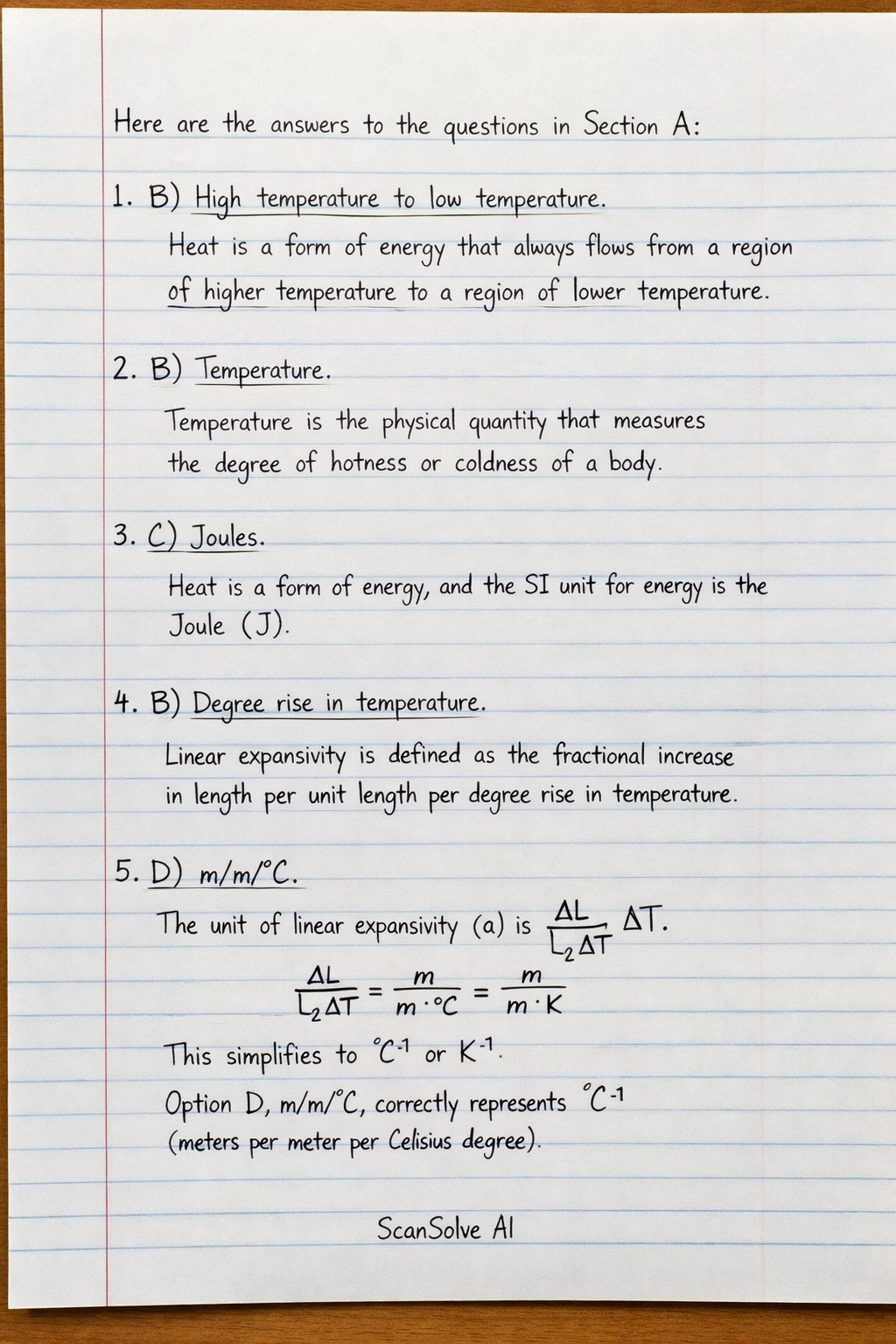
3 stepsHere are the answers to the questions in Section A:
-
B) High temperature to low temperature. Heat is a form of energy that always flows from a region of higher temperature to a region of lower temperature.
-
B) Temperature. Temperature is the physical quantity that measures the degree of hotness or coldness of a body.
-
C) Joules. Heat is a form of energy, and the SI unit for energy is the Joule (J).
-
B) Degree rise in temperature. Linear expansivity is defined as the fractional increase in length per unit length per degree rise in temperature.
-
D) m/m/c. The unit of linear expansivity () is . This simplifies to or , which is or . Option D, m/m/c, correctly represents (meters per meter per Celsius degree).
-
B) 0.002m.
Identify the given values.
Original length $L_0 = 1.0 \text{ m}$ Change in temperature $\Delta T = 100 \text{ K}$ Linear expansivity $\alpha = 2 \times 10^{-5} \text{ K}^{-1}$Use the formula for increase in length.
$$ \Delta L = L_0 \alpha \Delta T $$Substitute the values and calculate.
$$ \Delta L = (1.0 \text{ m}) \times (2 \times 10^{-5} \text{ K}^{-1}) \times (100 \text{ K}) $$ $$ \Delta L = 2 \times 10^{-3} \text{ m} $$ $$ \Delta L = 0.002 \text{ m} $$ The increase in length is $\boxed{\text{0.002 m}}$.7. C) Buckling due to expansion. Gaps are left between railway tracks to allow for thermal expansion during hot weather. Without these gaps, the tracks would expand and buckle, leading to dangerous deformations.
-
A) Vibrate faster. When a solid is heated, the kinetic energy of its constituent molecules increases, causing them to vibrate with greater amplitude and frequency (faster) about their fixed positions.
-
B) Linear expansivity. A bimetallic strip consists of two different metals bonded together. It bends when heated or cooled because the two metals have different coefficients of linear expansion, causing them to expand or contract by different amounts.
-
B) 2. For isotropic materials, the coefficient of area expansion () is approximately twice the coefficient of linear expansion (). So, .
-
Still stuck on this one?
Ask a follow-up, and the answer starts from this question.
More Physics Questions
Handwritten Step-by-Step Solution
Get this as a handwritten image on WhatsApp — like a tutor wrote it for you.
Try on WhatsApp