
We read your photo as:
What are the answers to questions 17-20 regarding hypothermia, heat transfer, and decompression sickness?
ScanSolve AI Answer
here are the answers to the remaining questions:
Multiple Choice Questions:
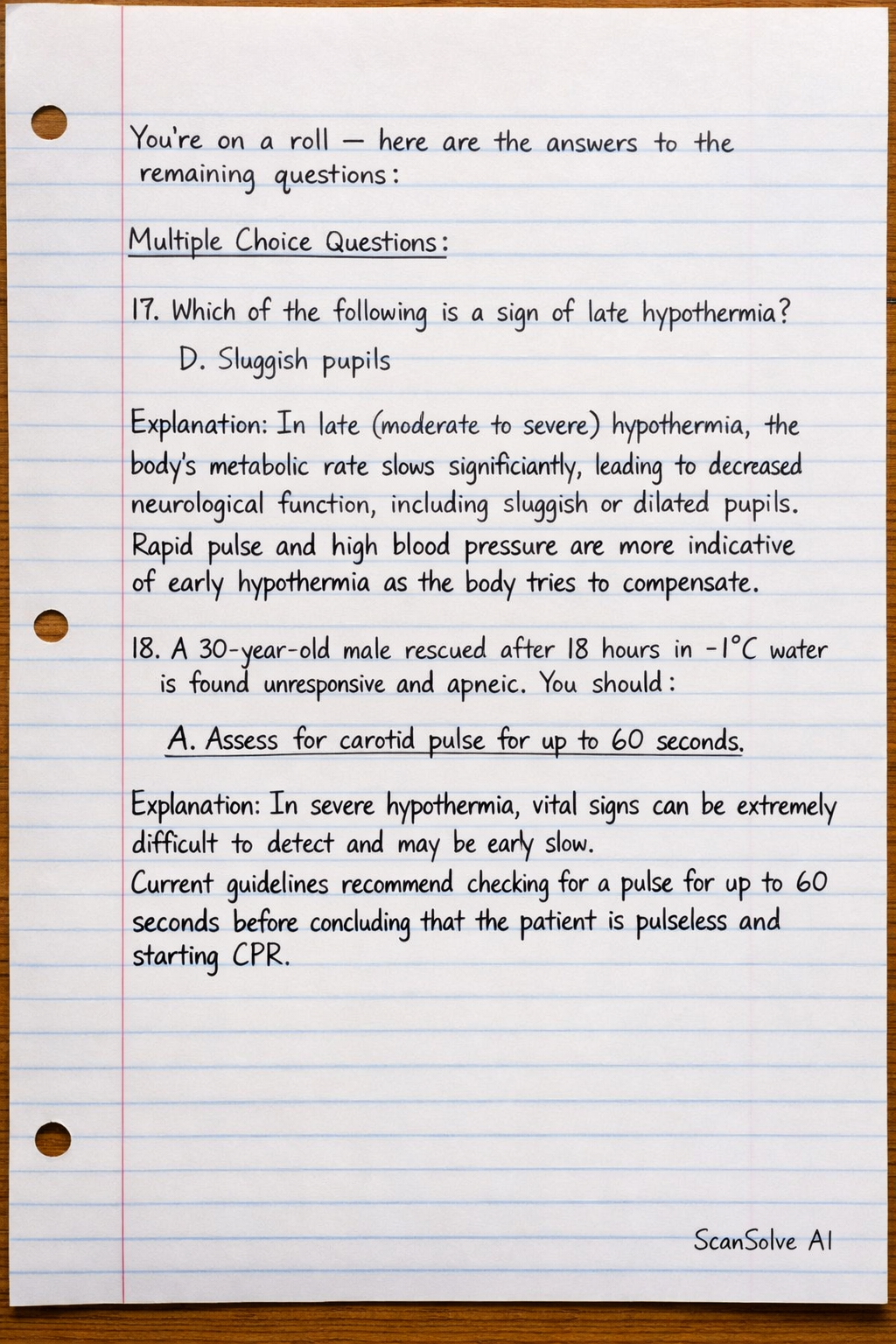
17. Which of the following is a sign of late hypothermia?
D. Sluggish pupils
Explanation: In late (moderate to severe) hypothermia, the body's metabolic rate slows significantly, leading to decreased neurological function, including sluggish or dilated pupils. Rapid pulse and high blood pressure are more indicative of early hypothermia as the body tries to compensate.
18. A 30-year-old male rescued after 18 hours in water is found unresponsive and apneic. You should:
A. Assess for carotid pulse for up to 60 seconds
Explanation: In severe hypothermia, vital signs can be extremely difficult to detect and may be very slow. Current guidelines recommend checking for a pulse for up to 60 seconds before concluding that the patient is pulseless and starting CPR.
19. The body heat transfer from a warm hand into water is through:
D. Conduction
Explanation: Conduction is the direct transfer of heat between objects that are in physical contact with each other, such as a hand in water.
20. The most prominent symptom of decompression sickness is:
A. Abdominal or joint pain
Explanation: The most common symptom of decompression sickness (DCS), often called "the bends," is deep, aching pain in the joints, particularly the large joints. Abdominal pain can also occur.
Short Answered Questions:
21. Briefly explain the effects of carbon monoxide poisoning and the appropriate prehospital interventions (5 marks)
Carbon monoxide (CO) poisoning occurs when CO binds to hemoglobin in red blood cells, forming carboxyhemoglobin. This prevents oxygen from being transported to tissues and organs, leading to cellular hypoxia. Prehospital interventions include immediately removing the patient from the source of CO and administering 100% oxygen via a non-rebreather mask.
22. Outline the management of a hypothermic patient who is unresponsive. (5 marks)
Management of an unresponsive hypothermic patient involves:
- Gentle handling to prevent cardiac arrhythmias.
- Removing wet clothing and insulating the patient with dry blankets.
- Passive external rewarming by moving to a warm environment.
- Active external rewarming with heat packs to the torso, armpits, and groin.
- Active internal rewarming using warmed intravenous fluids and warmed humidified oxygen.
- Continuous cardiac monitoring.
23. List 5 common types of environmental emergencies EMTs encounter. (5 marks)
- Heat-related emergencies (e.g., heat stroke, heat exhaustion)
- Cold-related emergencies (e.g., hypothermia, frostbite)
- Drowning or submersion incidents
- Lightning strikes
- Bites and stings (e.g., snake bites, insect stings)
24. Describe the immediate management of a drowning victim. (5 marks)
Immediate management of a drowning victim involves:
- Safe removal from the water.
- Assessing airway, breathing, and circulation (ABCs).
- Initiating CPR immediately if the patient is unresponsive, apneic, and pulseless, starting with rescue breaths.
- Managing hypothermia by removing wet clothing and insulating.
- Rapid transport to a medical facility.
25. Outline the indications for cooling in hyperthermic patients. (5 marks)
Cooling is indicated in hyperthermic patients, primarily for heat stroke, which is characterized by a core body temperature typically above () accompanied by central nervous system dysfunction (e.g., altered mental status, confusion, seizures). The goal is to rapidly lower the core body temperature to prevent organ damage.
26. State the different ways in which the body loses heat. (5 marks)
The body loses heat through four primary mechanisms:
- Conduction: Direct transfer of heat from the body to a cooler object or surface in contact.
- Convection: Transfer of heat away from the body by air or water currents moving across the skin.
- Radiation: Transfer of heat from the body to cooler objects in the environment without direct contact.
- Evaporation: Loss of heat as sweat or other moisture on the skin turns into vapor.
27. Enumerate 5 risk factors for environmental emergencies. (5 marks)
- Age: Very young (infants, toddlers) and very old individuals are more vulnerable.
- Pre-existing medical conditions: Such as cardiovascular disease, respiratory illness, diabetes, or neurological disorders.
- Medications: Certain drugs (e.g., diuretics, beta-blockers, anticholinergics) can impair the body's ability to regulate temperature.
- Alcohol or drug use: Can impair judgment, increase heat loss, or reduce awareness of environmental dangers.
- Lack of acclimatization: Not being accustomed to extreme temperatures or altitudes.
28. What are the signs of anaphylaxis following an insect sting? (5 marks)
Signs of anaphylaxis following an insect sting can include:
- Skin reactions: Hives (urticaria), widespread rash, itching, flushing, and swelling (angioedema) of the lips, face, or throat.
- Respiratory distress: Difficulty breathing, wheezing, shortness of breath, tightness in the chest, or hoarseness.
- Cardiovascular symptoms: Dizziness, lightheadedness, rapid or weak pulse, a sudden drop in blood pressure (hypotension), or loss of consciousness.
- Gastrointestinal symptoms: Nausea, vomiting, abdominal pain, or diarrhea.
- Neurological symptoms: Confusion, anxiety, or a feeling of impending doom.
Still stuck on this one?
Ask a follow-up, and the answer starts from this question.
More Biology Questions
Handwritten Step-by-Step Solution
Get this as a handwritten image on WhatsApp — like a tutor wrote it for you.
Try on WhatsApp