
We read your photo as:
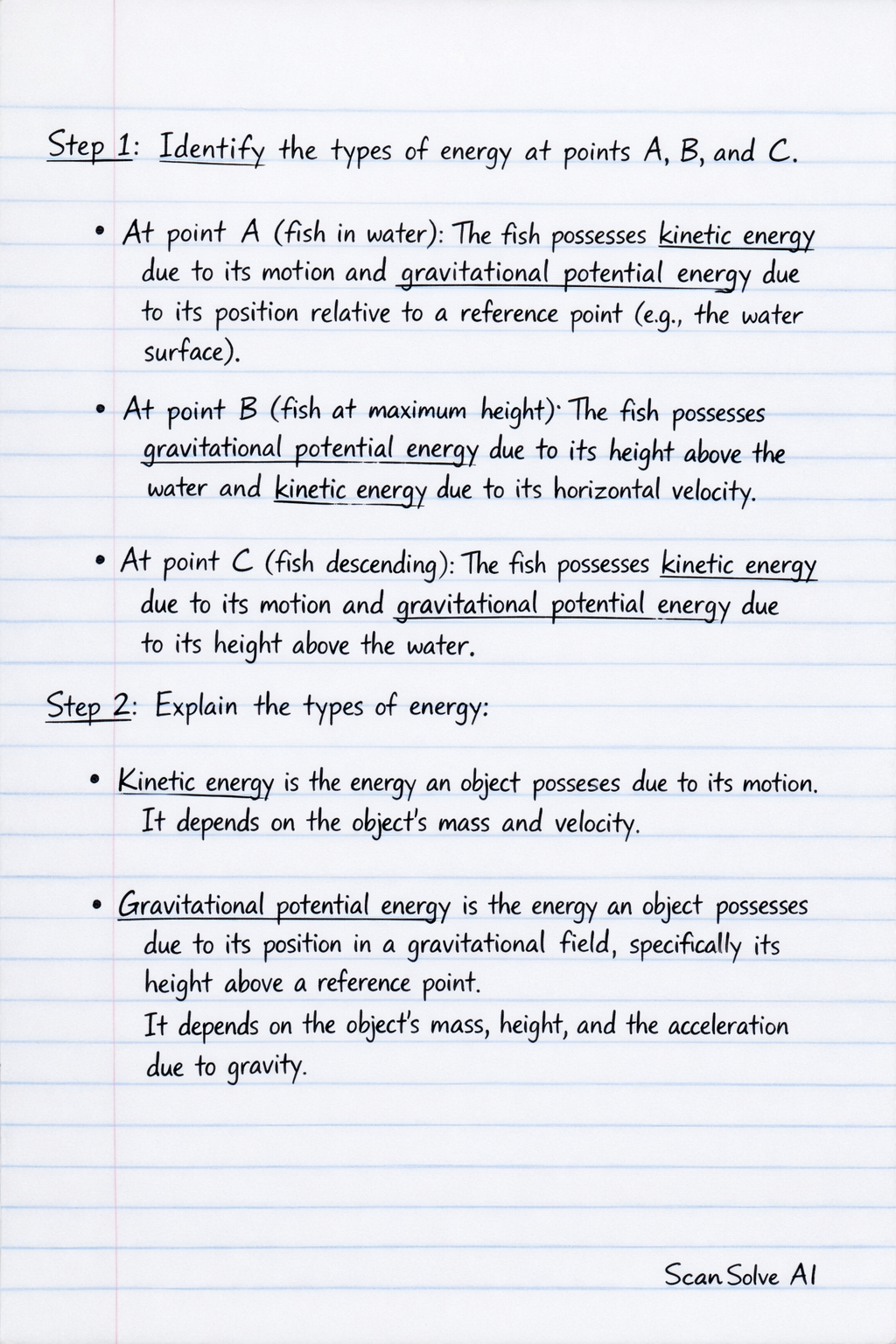
Identify the types of energy at points A, B, and C.
ScanSolve AI Answer
Step-by-step solution
4 stepsIdentify the types of energy at points A, B, and C.
- At point A (fish in water, possibly moving upwards or horizontally): The fish possesses kinetic energy due due to its motion and gravitational potential energy due to its position relative to a reference point (e.g., the water surface).
- At point B (fish at maximum height): The fish possesses gravitational potential energy due to its height above the water and kinetic energy due to its horizontal velocity.
- At point C (fish descending): The fish possesses kinetic energy due to its motion and gravitational potential energy due to its height above the water.
Explain the types of energy.
- Kinetic energy is the energy an object possesses due to its motion. It depends on the object's mass and velocity.
- Gravitational potential energy is the energy an object possesses due to its position in a gravitational field, specifically its height above a reference point. It depends on the object's mass, height, and the acceleration due to gravity.
Name two factors affecting energy at point B.
At point B, the fish has both kinetic and gravitational potential energy.
Factors affecting kinetic energy are mass and velocity.
Factors affecting gravitational potential energy are mass, height, and acceleration due to gravity.
Two factors are:- Mass of the fish
- Height of the fish above the water (or velocity of the fish)
Calculate the magnitude of energy at point B.
Given:
Mass,
Height,
Velocity,
Acceleration due to gravity,Calculate Gravitational Potential Energy (GPE):
Calculate Kinetic Energy (KE):
The question asks for "the type of energy possessed by the fish at points B". Since it has both, we calculate both and the total.
Total Mechanical Energy (TME) at B:The magnitude of the gravitational potential energy is and the magnitude of the kinetic energy is . The total mechanical energy is .
2a) Briefly describe the carbon cycle in terms of:
i) photosynthesis.
Photosynthesis is the process by which green plants and other organisms use sunlight to synthesize foods from carbon dioxide and water. It removes carbon dioxide from the atmosphere and converts it into organic compounds (glucose).ii) respiration.
Respiration is the process by which living organisms break down organic compounds (like glucose) to release energy, producing carbon dioxide and water as byproducts. This process releases carbon dioxide into the atmosphere.iii) decomposition.
Decomposition is the process where decomposers (like bacteria and fungi) break down dead organic matter and waste products. This process releases carbon dioxide into the atmosphere and returns carbon to the soil.iv) burning.
Burning (combustion) of organic materials, such as fossil fuels or biomass, releases large amounts of carbon dioxide into the atmosphere. This process rapidly transfers carbon from stored forms to the atmosphere.2b) Madam Margaret Fosua used rice cooker to prepare cooked rice for her family last night. She connected the rice cooker to the mains. of energy was transferred to the rice cooker but only was used to cook the rice. Use the above information to answer the following questions.
i) Explain what happened to the rest of the energy.
The rest of the energy, , was converted into other forms, primarily heat and sound, and dissipated into the surroundings. This energy was not used for cooking and represents energy loss due to inefficiency.ii) What energy conversion occurred during the cooking?
Electrical energy from the mains was converted primarily into heat energy (thermal energy) to cook the rice. Some energy was also converted into sound and light.iii) How can the family reduce the amount of unused energy when cooking with rice cooker?
The family can reduce unused energy by:- Using a well-insulated rice cooker to minimize heat loss to the surroundings.
- Ensuring the lid is properly sealed during cooking to trap heat inside.
- Cooking the appropriate amount of rice for the cooker's capacity to optimize energy use.
2c) You are given samples of the following mixtures, state the method that you will use to practically separate and recover the components of each mixture:
i) Crude.
Fractional distillationii) Ethanol and water.
Fractional distillationiii) Dyes from ink.
Chromatography (e.g., paper chromatography)iv) Iron fillings and sulphur.
Magnetic separation
Still stuck on this one?
Ask a follow-up, and the answer starts from this question.
More Physics Questions
Handwritten Step-by-Step Solution
Get this as a handwritten image on WhatsApp — like a tutor wrote it for you.
Try on WhatsApp