
We read your photo as:
Identify and explain the roles of the adrenal gland and adrenaline in the fight-or-flight response, including effects on heartbeat, pupil dilation, and glucose/oxygen supply to muscles.
ScanSolve AI Answer
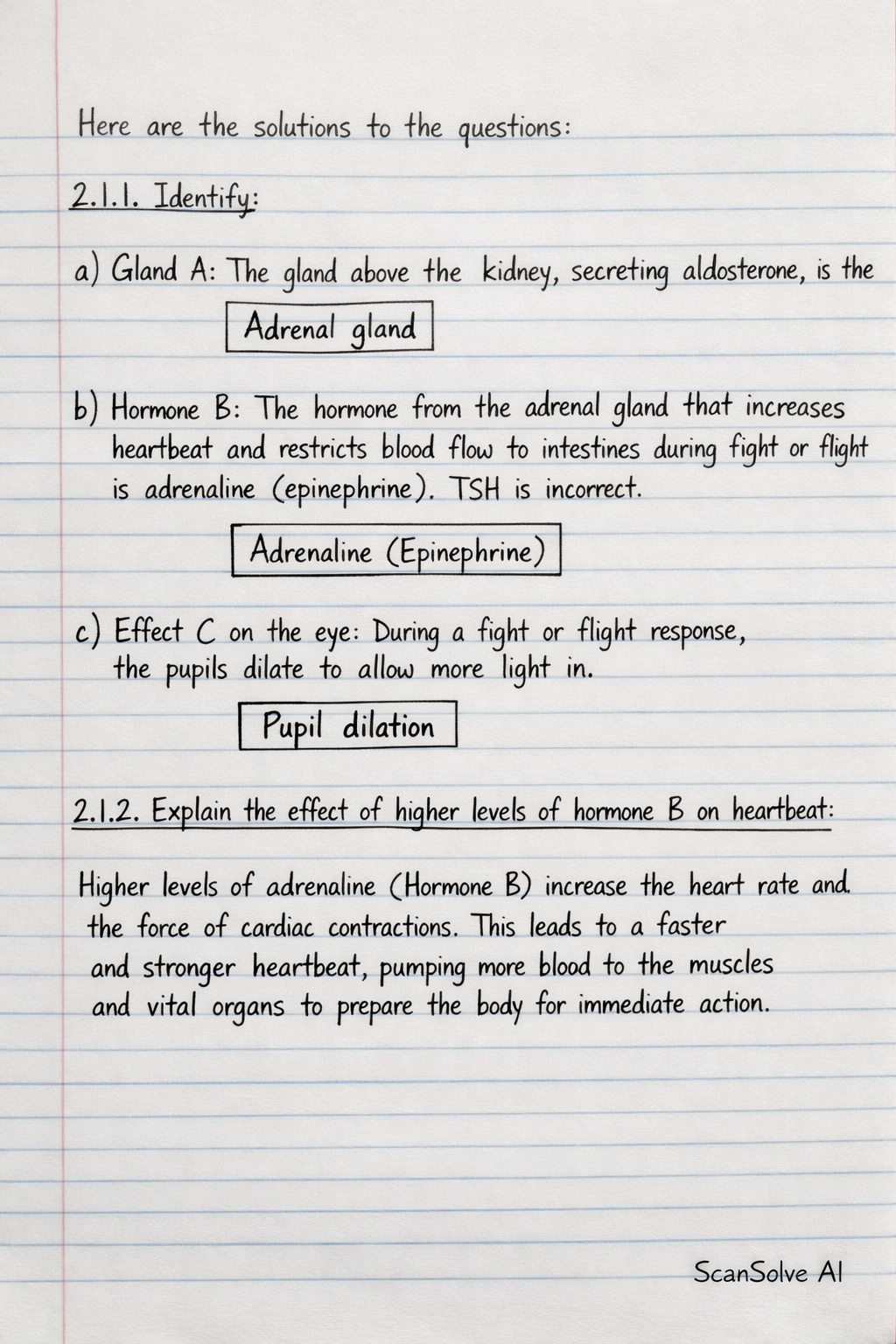
Here are the solutions to the questions:
2.1.1. Identify:
- a) Gland A: The gland shown above the kidney, secreting aldosterone, is the adrenal gland.
- b) Hormone B: The hormone from the adrenal gland that increases heartbeat and restricts blood flow to intestines during fight or flight is adrenaline (epinephrine). The handwritten "TSH" is incorrect in this context.
- c) Effect C on the eye: During a fight or flight response, the pupils dilate to allow more light in.
2.1.2. Explain the effect of higher levels of hormone B on heartbeat.
Higher levels of adrenaline (Hormone B) increase the heart rate and the force of cardiac contractions. This leads to a faster and stronger heartbeat, pumping more blood to the muscles and vital organs to prepare the body for immediate action.
2.1.3. Describe how gland A may increase glucose and oxygen supply to skeletal muscles in an emergency.
Gland A (adrenal gland) secretes adrenaline. Adrenaline increases the breakdown of glycogen into glucose in the liver, raising blood glucose levels for energy. It also increases heart rate and blood pressure, and causes vasodilation in skeletal muscles, increasing their blood supply and thus oxygen delivery. Simultaneously, it causes vasoconstriction in non-essential organs like the intestines, diverting blood flow to the muscles.
2.1.4. Due to a tumour growing in the frontal lobe of the brain, excess levels of growth hormone (GH) may be secreted.
- a) Which part of the brain is responsible for secreting growth hormone?
- Growth hormone is secreted by the pituitary gland.
- b) Name ONE condition that excess levels of growth hormone would cause in adults.
- Excess growth hormone in adults causes acromegaly.
- c) Name TWO other hormones secreted by the gland mentioned in Q 2.1.4. a.
- The pituitary gland secretes many hormones. Two examples are Thyroid Stimulating Hormone (TSH) and Follicle-Stimulating Hormone (FSH).
Still stuck on this one?
Ask a follow-up, and the answer starts from this question.
More Biology Questions
Handwritten Step-by-Step Solution
Get this as a handwritten image on WhatsApp — like a tutor wrote it for you.
Try on WhatsApp