
We read your photo as:
Identify structures E and F. Which neuron (A, B, C) represents the type shown in diagram 2? Which is damaged if one feels but cannot respond? Give the letter and name of the part ensuring one-directio
ScanSolve AI Answer
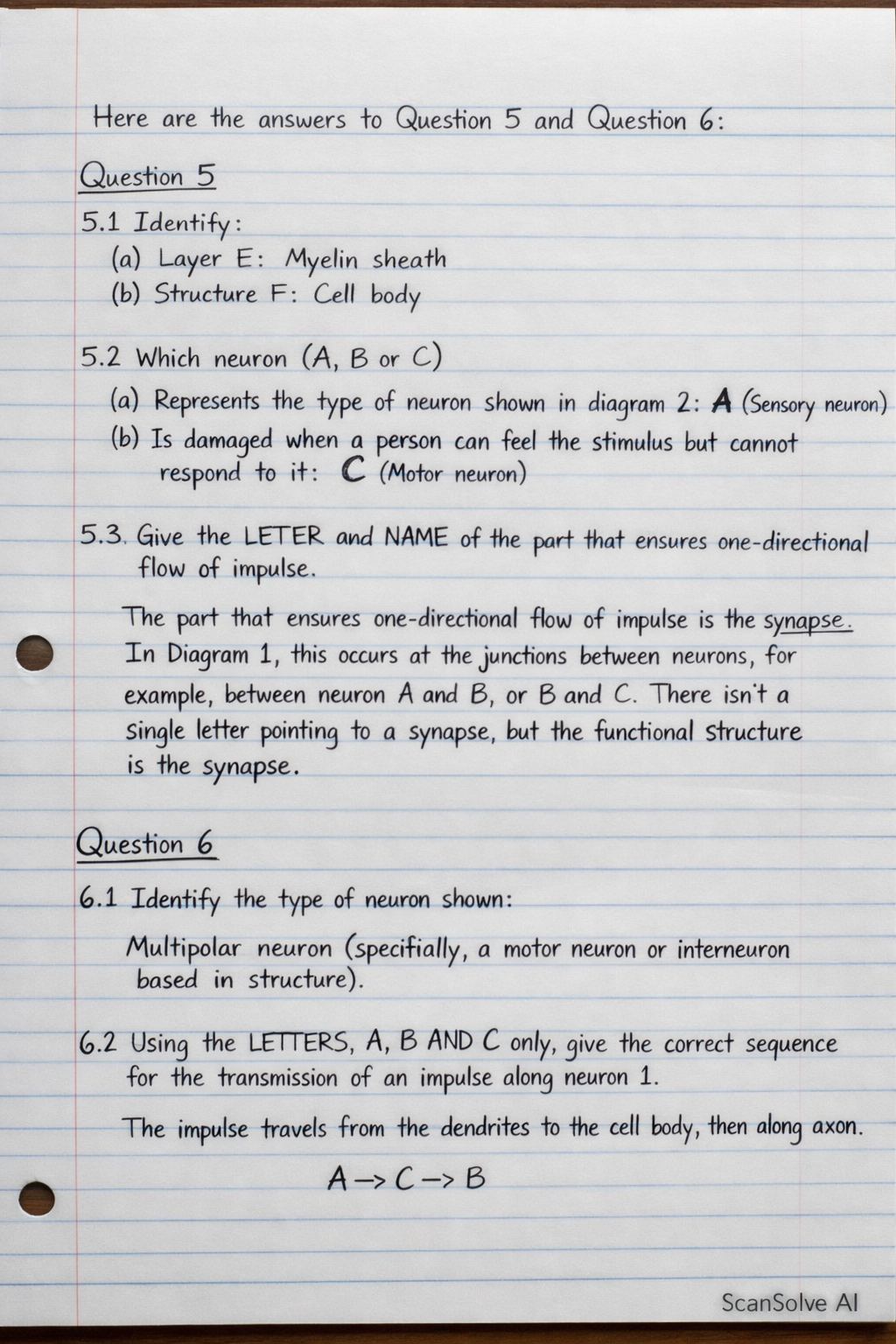
Here are the answers to Question 5 and Question 6:
Question 5
5.1 Identify:
- (a) Layer E: Myelin sheath
- (b) Structure F: Cell body
5.2 Which neuron (A, B or C)
- (a) Represents the type of neuron shown in diagram 2: A (Sensory neuron)
- (b) Is damaged when a person can feel the stimulus but cannot respond to it: C (Motor neuron)
5.3 Give the LETTER and NAME of the part that ensures one-directional flow of impulse.
- The part that ensures one-directional flow of impulse is the synapse. In Diagram 1, this occurs at the junctions between neurons, for example, between neuron A and B, or B and C. There isn't a single letter pointing to a synapse, but the functional structure is the synapse.
Question 6
6.1 Identify the type of neuron shown.
- Multipolar neuron (specifically, a motor neuron or interneuron based on structure).
6.2 Using the LETTERS A, B AND C only, give the correct sequence for the transmission of an impulse along neuron 1.
- The impulse travels from the dendrites to the cell body, then along the axon.
6.3 Explain how the speed of transmission of impulses will differ for neuron 1 and neuron 2.
- Neuron 1 is myelinated (has myelin sheath B), while Neuron 2 is unmyelinated. Impulses travel much faster in Neuron 1 due to saltatory conduction, where the impulse jumps between nodes of Ranvier. In Neuron 2, the impulse travels continuously along the axon, which is a slower process.
6.4 Explain why a person will feel the stimulus but will not be able to respond if only type of neuron is damaged.
- If a person can feel the stimulus, it means the sensory neurons and interneurons are intact, allowing the impulse to reach the brain for perception. If they cannot respond, it indicates damage to the motor neurons. Motor neurons are responsible for transmitting impulses from the central nervous system to the effector muscles, causing a response.
Still stuck on this one?
Ask a follow-up, and the answer starts from this question.
More Biology Questions
Handwritten Step-by-Step Solution
Get this as a handwritten image on WhatsApp — like a tutor wrote it for you.
Try on WhatsApp