

This biology question covers important biological concepts and processes. The step-by-step explanation below helps you understand the underlying mechanisms and reasoning.
ScanSolve AI Answer
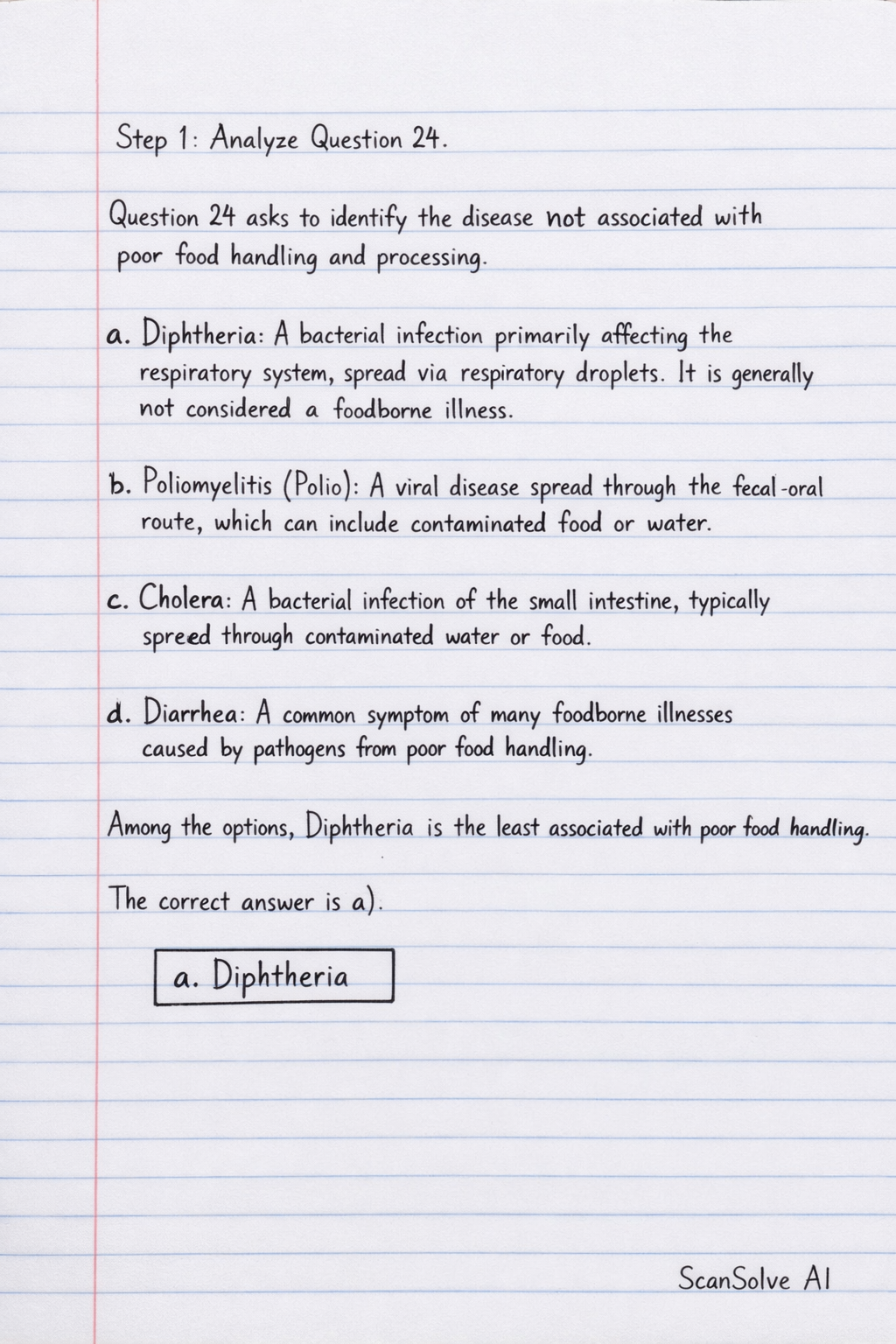
Step 1: Analyze Question 24. Question 24 asks to identify the disease not associated with poor food handling and processing. a. Diphtheria: A bacterial infection primarily affecting the respiratory system, spread via respiratory droplets. It is generally not considered a foodborne illness. b. Poliomyelitis (Polio): A viral disease spread through the fecal-oral route, which can include contaminated food or water. c. Cholera: A bacterial infection of the small intestine, typically spread through contaminated water or food. d. Diarrhea: A common symptom of many foodborne illnesses caused by pathogens from poor food handling. Among the options, Diphtheria is the least associated with poor food handling. The correct answer is a). a. Diphtheria Step 2: Analyze Question 25. Question 25 asks how an Environmental Health Office can punish public health offenders. a. Prosecution: This is a legal action taken against an offender, leading to penalties or imprisonment, which is a form of punishment. b. Serving of abatement notice: This is a legal order to stop an activity causing a nuisance or hazard. Non-compliance can lead to prosecution and punishment. c. Educating the offenders: This is a preventive or corrective measure, not a form of punishment. d. Use of warrant and order: These are legal instruments for enforcement, which can lead to prosecution and punishment. Prosecution is a direct method of punishment. The correct answer is a). a. Prosecution Step 3: Analyze Question 26. Question 26 asks to identify what is not a source of air pollution. a. Radiation of Ozone layer: The ozone layer absorbs UV radiation; it does not radiate pollution. While ozone itself can be a pollutant at ground level, "radiation of ozone layer" is not a source of air pollution. b. Smoke and dust: These are particulate matter and common air pollutants. c. Cooking fire and stove: Combustion from cooking (especially with inefficient stoves or biomass) releases various air pollutants. d. Industry and Generators: These are major sources of industrial emissions and exhaust fumes, contributing significantly to air pollution. "Radiation of Ozone layer" is not a source of air pollution. The correct answer is a). a. Radiation of Ozone layer Step 4: Analyze Question 27. Question 27 asks about the components of the environment associated with the lithosphere. The lithosphere* is the rigid, outermost shell of a terrestrial-type planet or natural satellite. On Earth, it includes the crust and the uppermost mantle, primarily consisting of rocks and soil. a. Water and Air: These are components of the hydrosphere and atmosphere, respectively. b. Rocks and Soil: These are the primary components of the lithosphere. c. Biological and Aquatic: Biological refers to the biosphere, and aquatic refers to the hydrosphere. d. All of the above: Incorrect, as only rocks and soil are directly associated with the lithosphere. The correct answer is b). b. Rocks and Soil Step 5: Analyze Question 28. Question 28 asks for the best definition of Environmental Health hazards. Environmental health hazards are typically categorized into three main types: physical, chemical, and biological. a. Toxic waste and Radiation: These are specific examples* of chemical and physical hazards, respectively, but not a comprehensive definition of the categories. b. Air contaminants & Diseases: Air contaminants are a type of hazard, but diseases are an outcome* of hazards, not the hazards themselves. c. Physical & Chemical: These are two of the three major categories of environmental health hazards (the third being biological). This option describes the types* of hazards. d. Heavy metals: These are specific examples* of chemical hazards. Among the given options, "Physical & Chemical" best describes broad categories of environmental health hazards.