
We read your photo as:
Identify the key biological processes, hormones, structures, and variations described in the provided text.
ScanSolve AI Answer
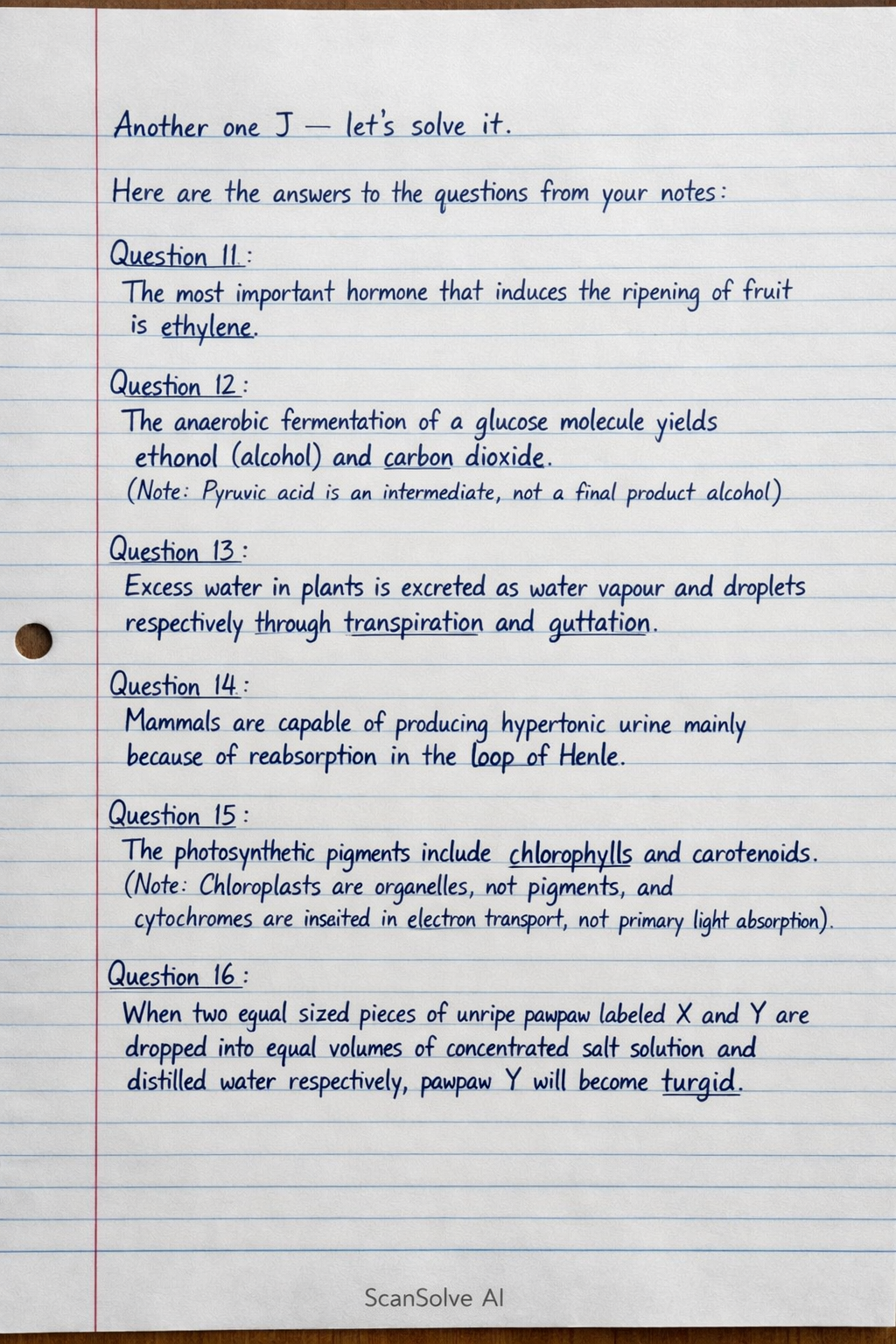
Here are the answers to the questions from your notes:
Question 11:
The most important hormone that induces the ripening of fruit is ethylene.
Question 12:
The anaerobic fermentation of a glucose molecule yields ethanol (alcohol) and carbon dioxide. (Note: Pyruvic acid is an intermediate, not a final product alongside alcohol).
Question 13:
Excess water in plants is excreted as water vapour and droplets respectively through transpiration and guttation.
Question 14:
Mammals are capable of producing hypertonic urine mainly because of reabsorption in the loop of Henle.
Question 15:
The photosynthetic pigments include chlorophylls and carotenoids. (Note: Chloroplasts are organelles, not pigments, and cytochromes are involved in electron transport, not primary light absorption).
Question 16:
When two equal sized pieces of unripe pawpaw labelled X and Y are dropped into equal volumes of concentrated salt solution and distilled water respectively, pawpaw Y will become turgid.
Question 17:
The diseases listed above (Onchocerciasis, Schistosomiasis, and Salmonellosis) are associated with poor sanitation and contaminated water.
Question 18:
Dilute solution of phenylthiocarbamide tastes bitter to some people and it is tasteless to others. This is an example of discontinuous variation.
Still stuck on this one?
Ask a follow-up, and the answer starts from this question.
More Biology Questions
Handwritten Step-by-Step Solution
Get this as a handwritten image on WhatsApp — like a tutor wrote it for you.
Try on WhatsApp