
We read your photo as:
In relation to plants: i) Name the structure labelled L. ii) Name the micro-organism contained in structure L. iii) What is the significance of the micro-organism named in (ii) above.
ScanSolve AI Answer
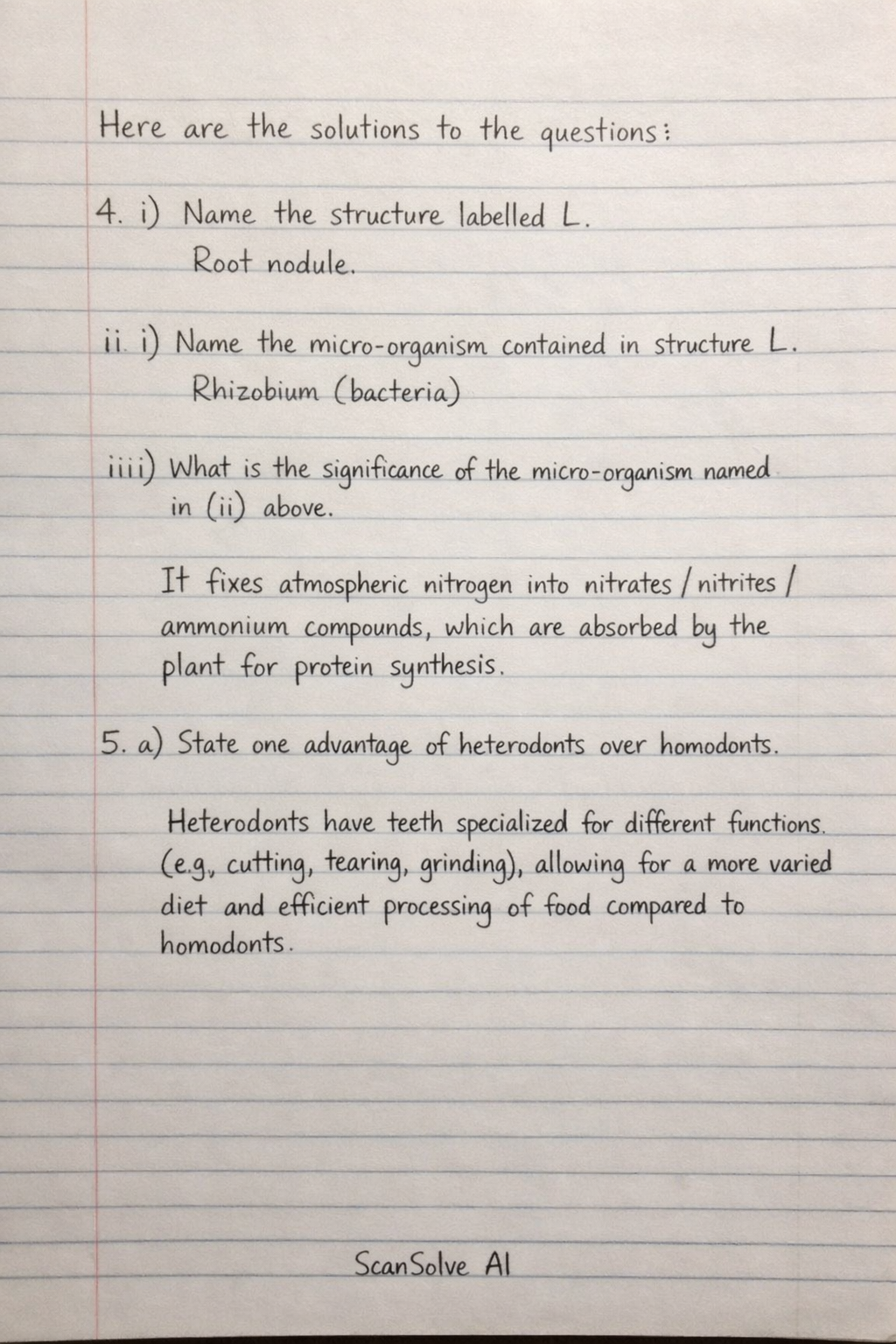
Here are the solutions to the questions:
4. i) Name the structure labelled L.
Root nodule
ii) Name the micro-organism contained in structure L.
Rhizobium (bacteria)
iii) What is the significance of the micro-organism named in (ii) above.
It fixes atmospheric nitrogen into nitrates/nitrites/ammonium compounds, which are absorbed by the plant for protein synthesis.
5. a) State one advantage of heterodonts over homodonts.
Heterodonts have teeth specialized for different functions (e.g., cutting, tearing, grinding), allowing for a more varied diet and efficient processing of food compared to homodonts.
b) A certain animal was found to have the following number of teeth on the upper jaw: - six molars, six pre molars, no canines and incisors; and on the lower jaw: - six incisors, two canines, six pre molars and six molars.
i) Write the dental formular of the above animal.
Upper jaw (half): Incisors = 0, Canines = 0, Premolars = , Molars =
Lower jaw (half): Incisors = , Canines = , Premolars = , Molars =
ii) What is the likely diet of the animal?
Herbivorous
6. a) Suggest two ways in which gaseous exchange systems contribute to problems of dehydration and hypothermia (low body temperature) in mountaineers.
- Dehydration: During exhalation, water vapor from the moist surfaces of the lungs is lost to the dry atmospheric air, leading to significant water loss.
- Hypothermia: Inhaled cold air is warmed by the body before exhalation. This process causes heat loss from the body, contributing to a drop in body temperature.
b) State the importance of the thin film of water on the skin of frogs.
The thin film of water allows oxygen from the atmosphere to dissolve and then diffuse across the skin into the bloodstream, and carbon dioxide to diffuse out, facilitating cutaneous respiration.
Still stuck on this one?
Ask a follow-up, and the answer starts from this question.
More Biology Questions
Handwritten Step-by-Step Solution
Get this as a handwritten image on WhatsApp — like a tutor wrote it for you.
Try on WhatsApp