
We read your photo as:
In what ways can scientific knowledge be applied that leads to environmental damage?
ScanSolve AI Answer
Step-by-step solution
4 steps1. When an organism transfers pollen grains from the anther of a flower to the stigma of another flower on another plant of the same species, it is described as cross-pollination. This involves two different plants of the same species.
- B. cross-pollination
2. Dicotyledons have two cotyledons, while monocotyledons have one. Mango, avocado, and orange seeds are dicotyledons. Oil palm is a monocotyledon.
- C. Oil palm seed
3. Galvanization is the process of applying a protective zinc coating to iron or steel to prevent rusting. Zinc acts as a sacrificial metal, corroding before the iron.
- C. Galvanization
4. Macronutrients are required in large quantities by plants (e.g., Nitrogen, Phosphorus, Potassium), while micronutrients are needed in smaller amounts. Zinc is a micronutrient.
- D. Zinc
5. Humans have different types of teeth (incisors, canines, premolars, molars), which is called heterodont dentition. Homodont describes animals whose teeth are all the same shape, not a specific type of tooth.
- B. Homodont
6. The use of DDT (a harmful pesticide) to kill fish in rivers is an example of scientific knowledge being applied in a way that causes environmental damage.
- C. Use of DDT to kill fish in rivers
7. The scientific method typically begins with forming a hypothesis, which is then tested through experimentation. The results from experiments contribute to scientific knowledge.
- B. Hypothesis Experimentation Scientific knowledge
8. A fire symbol (flame pictogram) on a chemical bottle indicates that the substance is flammable, meaning it can easily catch fire.
- D. flammable
9. Fundamental quantities are independent physical quantities. Mass is a fundamental quantity, while force, volume, and weight are derived quantities.
- D. Mass
10. To find the density, divide the mass by the volume.
Identify the given values.
Apply the density formula, .
Calculate the density.
Round to two decimal places.
- A.
11. In basic science, the three commonly studied states of matter are solid, liquid, and gas. While other states like plasma exist, they are usually introduced in more advanced studies.
- A. three states of matter
Still stuck on this one?
Ask a follow-up, and the answer starts from this question.
More Biology Questions
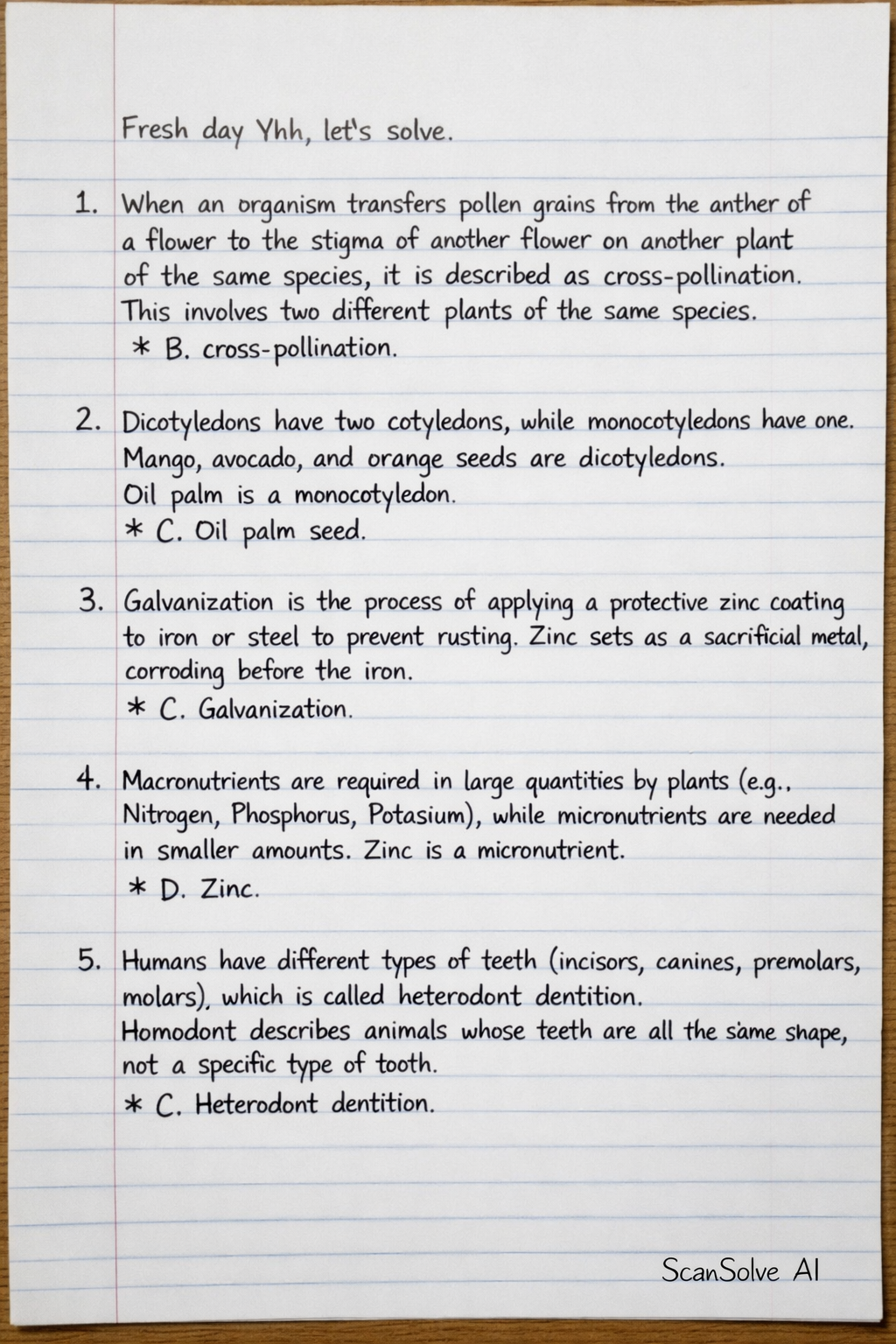
Handwritten Step-by-Step Solution
Get this as a handwritten image on WhatsApp — like a tutor wrote it for you.
Try on WhatsApp