
We read your photo as:
Explain the natural environment, environmental degradation, and their importance to humans, along with ways to protect them.
ScanSolve AI Answer
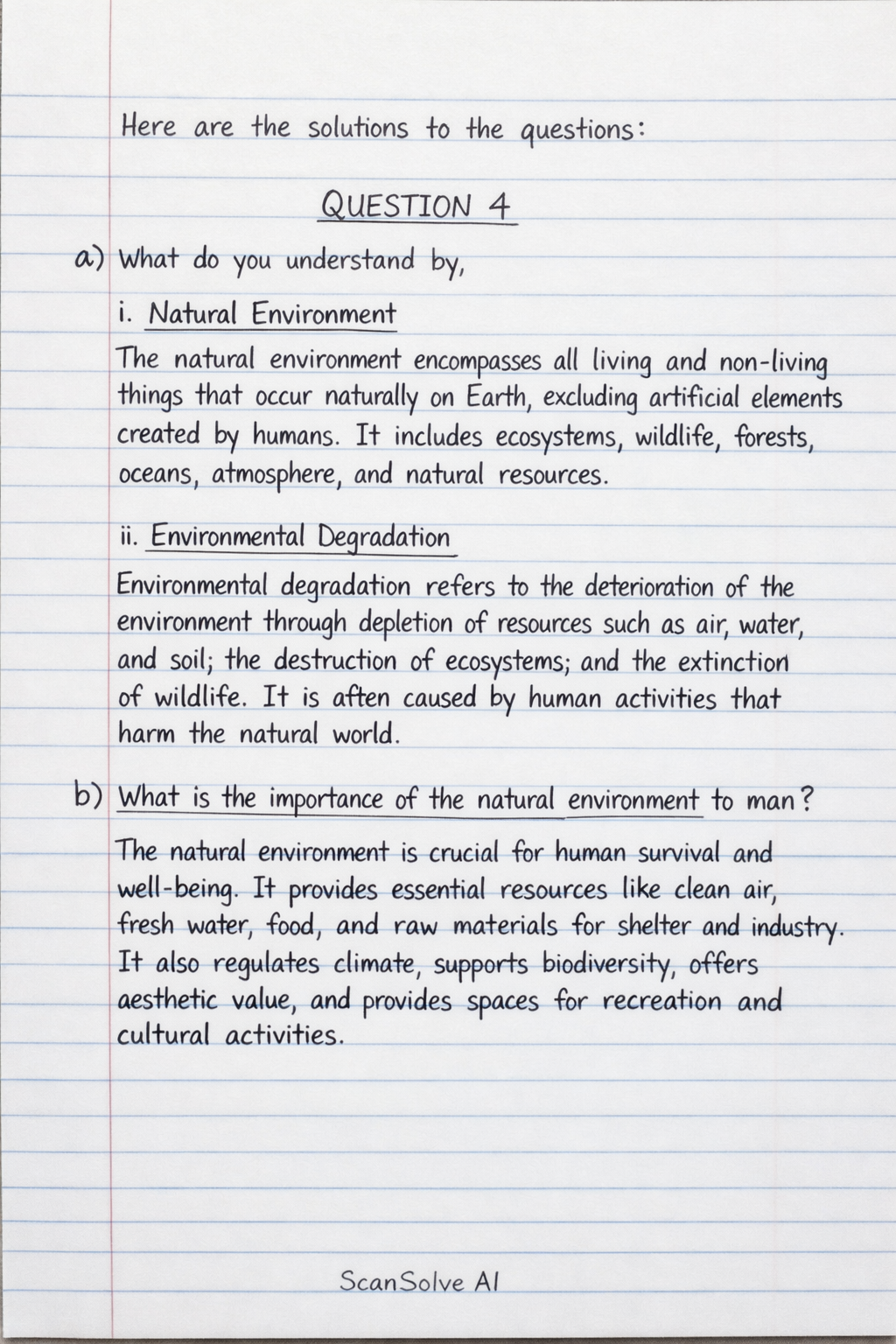
Here are the solutions to the questions:
QUESTION 4
a) What do you understand by
i. Natural Environment
The natural environment encompasses all living and non-living things that occur naturally on Earth, excluding artificial elements created by humans. It includes ecosystems, wildlife, forests, oceans, atmosphere, and natural resources.
ii. Environmental Degradation
Environmental degradation refers to the deterioration of the environment through depletion of resources such as air, water, and soil; the destruction of ecosystems; and the extinction of wildlife. It is often caused by human activities that harm the natural world.
b) What is the importance of the natural environment to man?
The natural environment is crucial for human survival and well-being. It provides essential resources like clean air, fresh water, food, and raw materials for shelter and industry. It also regulates climate, supports biodiversity, offers aesthetic value, and provides spaces for recreation and cultural activities.
c) Outline ways in which man can protect and preserve the natural environment.
- Reduce, Reuse, Recycle: Minimizing waste generation and promoting the recycling of materials.
- Sustainable Resource Management: Using natural resources like forests, water, and minerals in a way that meets present needs without compromising the ability of future generations to meet their own needs.
- Pollution Control: Implementing measures to reduce air, water, and soil pollution from industrial, agricultural, and domestic sources.
- Conservation of Biodiversity: Protecting endangered species and their habitats, establishing national parks and reserves.
- Promoting Renewable Energy: Shifting from fossil fuels to renewable energy sources like solar, wind, and hydro power to reduce greenhouse gas emissions.
QUESTION 5
a) What are the Principles of Democracy?
The principles of democracy include popular sovereignty (rule by the people), equality before the law, protection of human rights and fundamental freedoms, free and fair elections, multi-party system, separation of powers, and accountability and transparency of government. These principles ensure that power resides with the citizens and is exercised responsibly.
b) Name some of the factors that promote national integration in Cameroon.
- Shared National Identity: A common sense of belonging to Cameroon, fostered through national symbols, history, and culture.
- Bilingualism and Multiculturalism: The official recognition of both English and French, and the celebration of diverse ethnic groups, can promote unity if managed inclusively.
- Infrastructure Development: Roads, communication networks, and public services that connect different regions and facilitate interaction.
- Education System: A unified education system that promotes common values and understanding across different regions.
- Sports and Cultural Events: National teams and cultural festivals that bring people from various backgrounds together under a common banner.
c) Outline some of the obstacles to national integration.
- Ethnic and Regional Divides: Strong loyalties to ethnic groups or regions can sometimes overshadow national identity, leading to tensions.
- Economic Disparities: Uneven distribution of wealth and development across regions can create feelings of marginalization and resentment.
- Political Exclusion and Corruption: Perceptions of unfairness in governance, lack of representation, and corruption can erode trust in national institutions.
- Language Barriers: While bilingualism is promoted, practical challenges and perceived dominance of one language over another can create divisions.
- Historical Grievances: Unresolved historical issues or perceived injustices can fuel separatist sentiments and hinder national cohesion.
QUESTION 6
a) Identify and describe three (09) different type of elections organized by the State in Cameroon.
- Presidential Elections: These are held to elect the President of the Republic, who serves as the Head of State and Government. The President is elected by direct universal suffrage for a seven-year term, renewable.
- Legislative Elections (Parliamentary Elections): These elections are for members of the National Assembly, the lower house of the Cameroonian Parliament. Deputies are elected to represent constituencies and legislate laws.
- Municipal Elections: These elections are held to elect municipal councilors who then choose mayors and their deputies. They are responsible for local governance and development within communes.
- Senatorial Elections: These are indirect elections for members of the Senate, the upper house of Parliament. Senators are elected by an electoral college composed of municipal councilors.
- Regional Council Elections: These are indirect elections for members of Regional Councils, which are decentralized territorial collectivities. They are elected by an electoral college comprising municipal councilors and traditional rulers.
b) Explain the weaknesses of the Cameroon electoral system.
The Cameroonian electoral system faces several weaknesses, including a lack of full independence and transparency of the electoral body (ELECAM), which can lead to perceptions of bias. There are often concerns about the fairness of voter registration processes, the compilation of electoral lists, and the handling of electoral disputes. Additionally, the high cost of campaigns and limited access to state media for opposition parties can create an uneven playing field.
c) What are the effects of electoral malpractice?
Electoral malpractice has severe effects on a country's political landscape and democratic legitimacy. It undermines public trust in the electoral process and government institutions, leading to voter apathy and disengagement. It can result in the election of illegitimate leaders, fostering political instability, protests, and even violence. Furthermore, it can perpetuate corruption, hinder good governance, and ultimately stifle democratic development and economic progress.
QUESTION 7
a) What do you understand by
i. Economic growth;
Economic growth refers to an increase in the production of economic goods and services in a country over a specific period, typically measured by the percentage rate of increase in real Gross Domestic Product (GDP). It signifies an expansion in the economy's capacity to produce goods and services.
ii. Explain consequences of tax evasion in an economy
Tax evasion has several negative consequences for an economy. It reduces government revenue, limiting the state's ability to fund essential public services like infrastructure, education, healthcare, and security. This can lead to underdevelopment and a decline in public welfare. It also creates an unfair burden on honest taxpayers, distorts competition by giving an unfair advantage to evaders, and can foster a culture of lawlessness and corruption within the economy.
iii. Which body is economic growth may not lead to economit development. (Interpreted as: Why might economic growth not lead to economic development?)
Economic growth may not lead to economic development if the benefits of growth are not equitably distributed among the population. This can happen when growth is concentrated in a few sectors, leading to increased income inequality, or when it is not accompanied by improvements in social indicators such as education, healthcare, and poverty reduction. Furthermore, growth that is environmentally unsustainable or does not create sufficient employment opportunities may also fail to translate into genuine development.
QUESTION 9
a) What are the favorable conditions necessary for peace to reign in a country?
Favorable conditions for peace in a country include good governance characterized by transparency, accountability, and the rule of law. Economic equity and opportunities for all citizens help reduce grievances and social tensions. Respect for human rights and fundamental freedoms, alongside inclusive political participation, ensure that all voices are heard. Additionally, effective conflict resolution mechanisms, social cohesion, and a strong sense of national identity contribute significantly to lasting peace.
b) Describe some of the problems that are peculiar to women as a result of their gender.
Women often face unique problems due to their gender, including gender-based violence such as domestic abuse, sexual assault, and harmful traditional practices. They frequently experience economic discrimination, leading to lower wages, limited access to property, and fewer opportunities for career advancement. Limited access to education and healthcare can also be more pronounced for women, particularly in rural areas. Furthermore, women are often underrepresented in political leadership and decision-making roles, hindering their ability to influence policies that affect them.
c) What measures have been put in place by the government to fight against gender inequality?
Governments implement various measures to combat gender inequality. These include enacting anti-discrimination laws to ensure equal rights and opportunities for women in employment, education, and property ownership. They establish national gender policies and ministries dedicated to promoting women's empowerment and addressing gender-specific issues. Initiatives like affirmative action in education or political representation, campaigns to raise awareness about gender-based violence, and programs supporting women's economic empowerment (e.g., microfinance) are also common strategies.
QUESTION 10
a) What is globalization?
Globalization is the process of increasing interconnectedness and interdependence among countries worldwide, driven by the integration of economies, cultures, technologies, and governance. It involves the free flow of goods, services, capital, information, and people across national borders, leading to a more integrated global system.
b) State and explain the main in features of globalization.
- Economic Integration: This involves the liberalization of trade, investment, and financial markets, leading to increased cross-border transactions and the rise of multinational corporations.
- Technological Advancement: Rapid advancements in communication and information technology (e.g., internet, mobile phones) facilitate instant global communication and data exchange, shrinking distances.
- Cultural Homogenization and Hybridization: The spread of cultural products, ideas, and lifestyles across borders, sometimes leading to a global culture, but also to the blending of local and global cultures.
- Political Interdependence: Increased cooperation among states on global issues like climate change, terrorism, and pandemics, often through international organizations.
- Increased Mobility: Greater movement of people (migration, tourism), goods, and services across national boundaries.
c) Outline the advantages and disadvantages of globalization in the world.
Advantages:
- Economic Growth: Globalization can stimulate economic growth by expanding markets, increasing competition, and facilitating the transfer of technology and capital.
- Increased Trade and Investment: It allows countries to specialize in what they produce best, leading to greater efficiency, lower prices for consumers, and increased foreign direct investment.
- Cultural Exchange: It promotes the exchange of ideas, values, and cultural products, fostering greater understanding and diversity.
- Technological Diffusion: Rapid spread of new technologies and innovations across the globe, benefiting developing countries.
Disadvantages:
- Increased Inequality: Globalization can exacerbate income inequality within and between countries, as some benefit more than others.
- Job Displacement: Industries in developed countries may face job losses due to outsourcing to countries with lower labor costs.
- Cultural Erosion: The dominance of certain global cultures can threaten local traditions and languages.
- Environmental Degradation: Increased industrialization and transportation associated with globalization can lead to higher pollution and resource depletion.
- Loss of National Sovereignty: International agreements and organizations can sometimes limit the autonomy of national governments.
Still stuck on this one?
Ask a follow-up, and the answer starts from this question.
More Geography Questions
Handwritten Step-by-Step Solution
Get this as a handwritten image on WhatsApp — like a tutor wrote it for you.
Try on WhatsApp