
We read your photo as:
Incorporate your answers to the following questions into the provided diagram.
ScanSolve AI Answer
here are the answers to your questions:
-
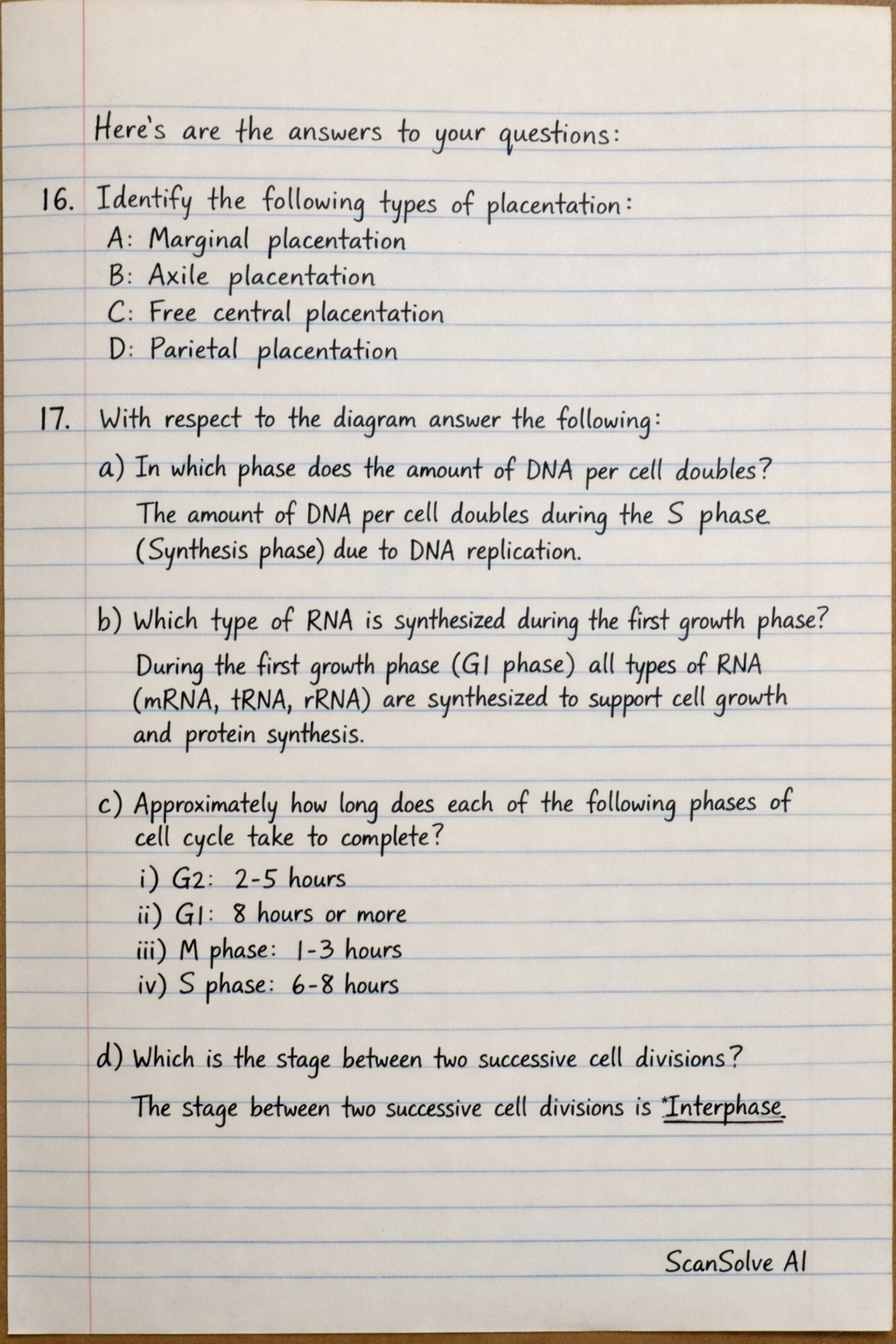
Identify the following types of placentation: * A: Marginal placentation * B: Axile placentation * C: Free central placentation * D: Parietal placentation
-
With respect to the diagram answer the following: * a) In which phase does the amount of DNA per cell doubles?
- The amount of DNA per cell doubles during the S phase (Synthesis phase) due to DNA replication. * b) Which type of RNA is synthesized during the first growth phase?
- During the first growth phase (G1 phase), all types of RNA (mRNA, tRNA, rRNA) are synthesized to support cell growth and protein synthesis. * c) Approximately how long does each of the following phases of cell cycle take to complete?
- i) G2: 2-5 hours
- ii) G1: 8 hours or more
- iii) M phase: 1-3 hours
- iv) S phase: 6-8 hours * d) Which is the stage between two successive cell divisions.
- The stage between two successive cell divisions is Interphase (which includes G1, S, and G2 phases).
-
Given below are different vertebrae. Identify them and write important characteristics for each of them. * Left image: Thoracic Vertebra
- Characteristics:
- Heart-shaped vertebral body.
- Long, slender spinous process that points inferiorly.
- Presence of costal facets (demifacets) on the vertebral body and transverse processes for articulation with the ribs. * Right image: Sacrum
- Characteristics:
- Large, triangular bone formed by the fusion of five sacral vertebrae.
- Articulates superiorly with the fifth lumbar vertebra and laterally with the ilium of the hip bone.
- Forms the posterior wall of the pelvis.
- Characteristics:
-
Given below are different vertebrae. Identify them and write important characteristics for each of them. * Left image: Axis (C2 Vertebra)
- Characteristics:
- Distinguished by a prominent superior projection called the dens (odontoid process).
- The dens articulates with the atlas (C1), allowing for the rotation of the head. * Right image: Atlas (C1 Vertebra)
- Characteristics:
- Ring-shaped and lacks a vertebral body and a spinous process.
- Has large superior articular facets that articulate with the occipital condyles of the skull, enabling nodding movements of the head.
- Characteristics:
Still stuck on this one?
Ask a follow-up, and the answer starts from this question.
More Biology Questions
Handwritten Step-by-Step Solution
Get this as a handwritten image on WhatsApp — like a tutor wrote it for you.
Try on WhatsApp