
We read your photo as:
Infectious diseases are caused by pathogenic microorganisms (like bacteria, viruses, fungi, or parasites) and can be transmitted from one person to another, from animals to humans, or through
ScanSolve AI Answer
Step-by-step solution
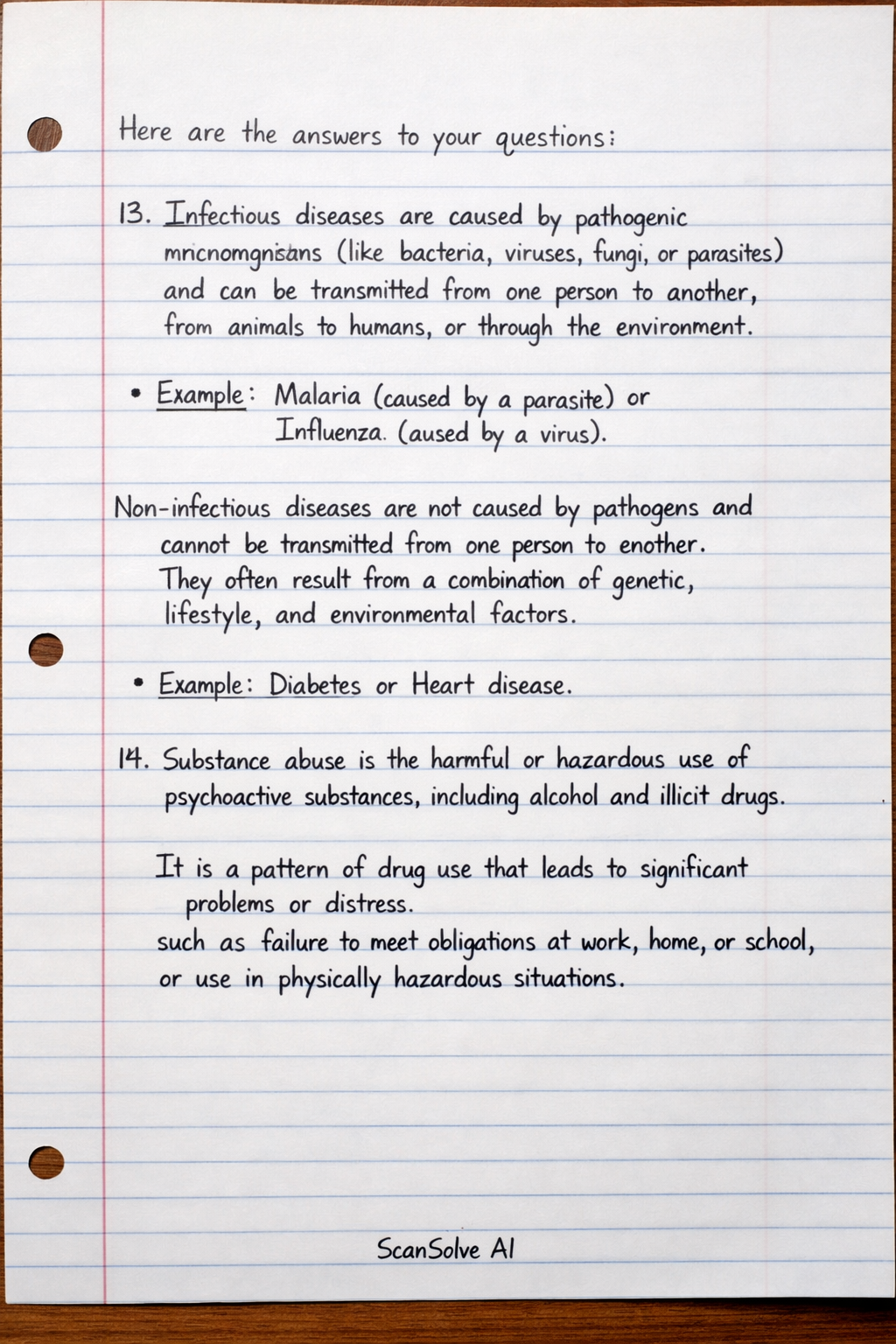
4 stepsHere are the answers to your questions:
-
Infectious diseases are caused by pathogenic microorganisms (like bacteria, viruses, fungi, or parasites) and can be transmitted from one person to another, from animals to humans, or through the environment. * Example: Malaria (caused by a parasite) or Influenza (caused by a virus). Non-infectious diseases are not caused by pathogens and cannot be transmitted from one person to another. They often result from a combination of genetic, lifestyle, and environmental factors. * Example: Diabetes or Heart disease.
-
Substance abuse is the harmful or hazardous use of psychoactive substances, including alcohol and illicit drugs. It is a pattern of drug use that leads to significant problems or distress, such as failure to meet obligations at work, home, or school, or use in physically hazardous situations.
* **Stimulants:** These are drugs that **increase** activity in the central nervous system, leading to increased alertness, energy, and attention.
    *   **Examples:** **Caffeine**, **Nicotine**, **Amphetamines**, **Cocaine**.
*   **Depressants:** These are drugs that **decrease** activity in the central nervous system, leading to relaxation, reduced anxiety, and drowsiness.
    *   **Examples:** **Alcohol**, **Opioids** (e.g., heroin, morphine), **Benzodiazepines** (e.g., Valium, Xanax).
15. To calculate the Body Mass Index (BMI), we use the formula:
Substitute the given values into the formula.
$$ \text{BMI} = \frac{90\,\text{kg}}{(1.75\,\text{m})^2} $$Calculate the square of the height.
$$ \text{BMI} = \frac{90\,\text{kg}}{3.0625\,\text{m}^2} $$Perform the division to find the BMI.
$$ \text{BMI} \approx 29.3877 $$Round the BMI to one decimal place.
$$
\text{BMI} \approx 29.4
$$

The calculated BMI is approximately 29.4.

Based on standard BMI classifications:
*   Underweight: $< 18.5$
*   Normal weight: $18.5 - 24.9$
*   Overweight: $25.0 - 29.9$
*   Obese: $\ge 30.0$

The person's BMI of 29.4 falls within the **overweight** category, not obese. Therefore, the person is **not likely to be obese**.

*   **BMI:** $\boxed{\text{29.4}}$
*   **Likely to be obese?** ❌ **No.**
*   **Why?** The calculated BMI of 29.4 falls into the **overweight** category ($25.0 - 29.9$), which is below the threshold for obesity ($\ge 30.0$).
Still stuck on this one?
Ask a follow-up, and the answer starts from this question.
More Biology Questions
Handwritten Step-by-Step Solution
Get this as a handwritten image on WhatsApp — like a tutor wrote it for you.
Try on WhatsApp