
We read your photo as:
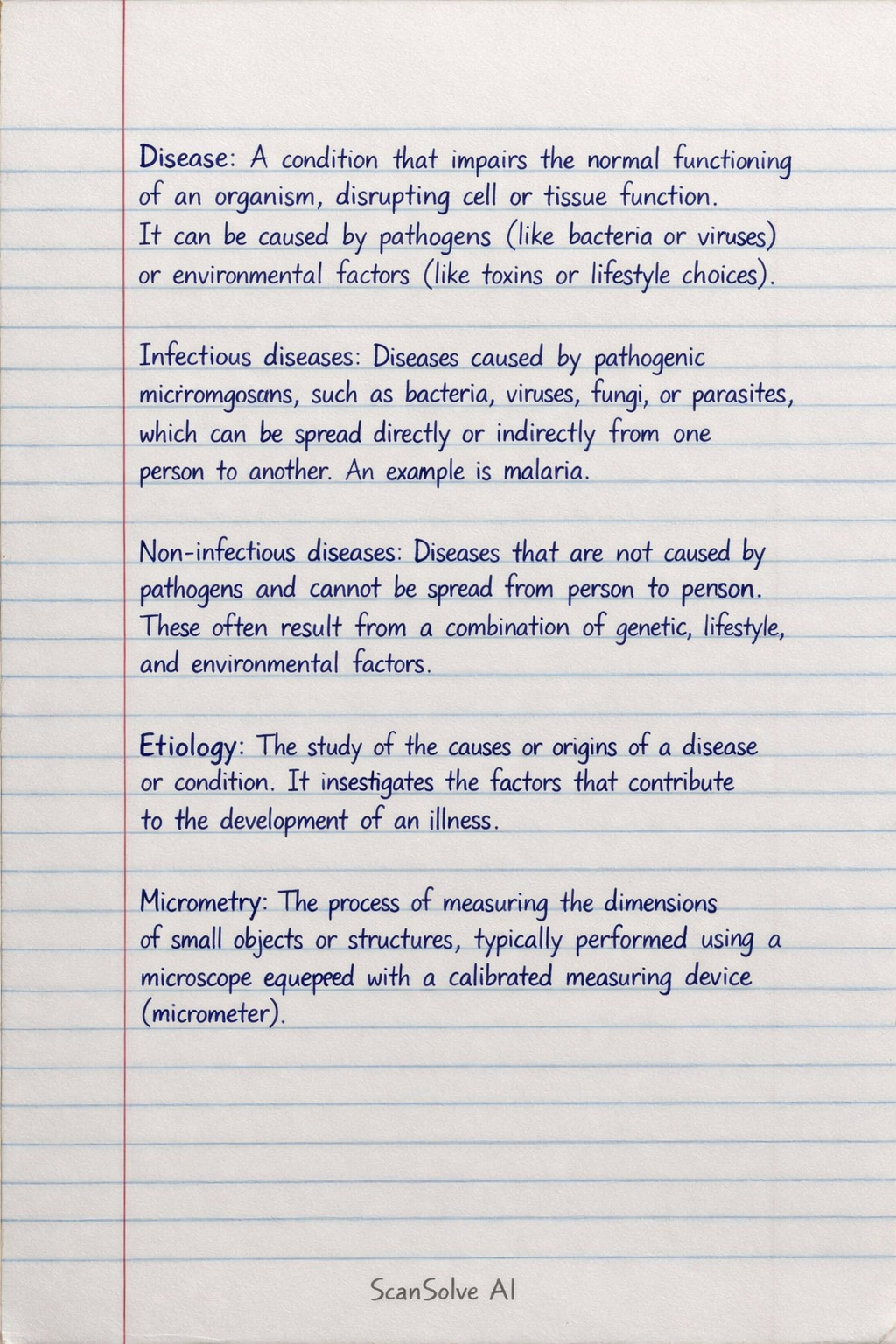
Disease: A condition that impairs the normal functioning of an organism, disrupting cell or tissue function. It can be caused by pathogens (like bacteria or viruses) or environmental factors (
ScanSolve AI Answer
Here are the definitions based on the provided image:
-
Disease: A condition that impairs the normal functioning of an organism, disrupting cell or tissue function. It can be caused by pathogens (like bacteria or viruses) or environmental factors (like toxins or lifestyle choices).
-
Infectious diseases: Diseases caused by pathogenic microorganisms, such as bacteria, viruses, fungi, or parasites, which can be spread directly or indirectly from one person to another. An example is malaria.
-
Non-infectious diseases: Diseases that are not caused by pathogens and cannot be spread from person to person. These often result from a combination of genetic, lifestyle, and environmental factors. An example is diabetes.
-
Etiology: The study of the causes or origins of a disease or condition. It investigates the factors that contribute to the development of an illness.
-
Micrometry: The process of measuring the dimensions of small objects or structures, typically performed using a microscope equipped with a calibrated measuring device (micrometer).
-
Microscopy: The science of investigating small objects and structures using a microscope. It involves the use of optical instruments to magnify images of tiny specimens, making them visible for study.
Still stuck on this one?
Ask a follow-up, and the answer starts from this question.
More Computer Science Questions
Handwritten Step-by-Step Solution
Get this as a handwritten image on WhatsApp — like a tutor wrote it for you.
Try on WhatsApp