

This biology question covers important biological concepts and processes. The step-by-step explanation below helps you understand the underlying mechanisms and reasoning.
ScanSolve AI Answer
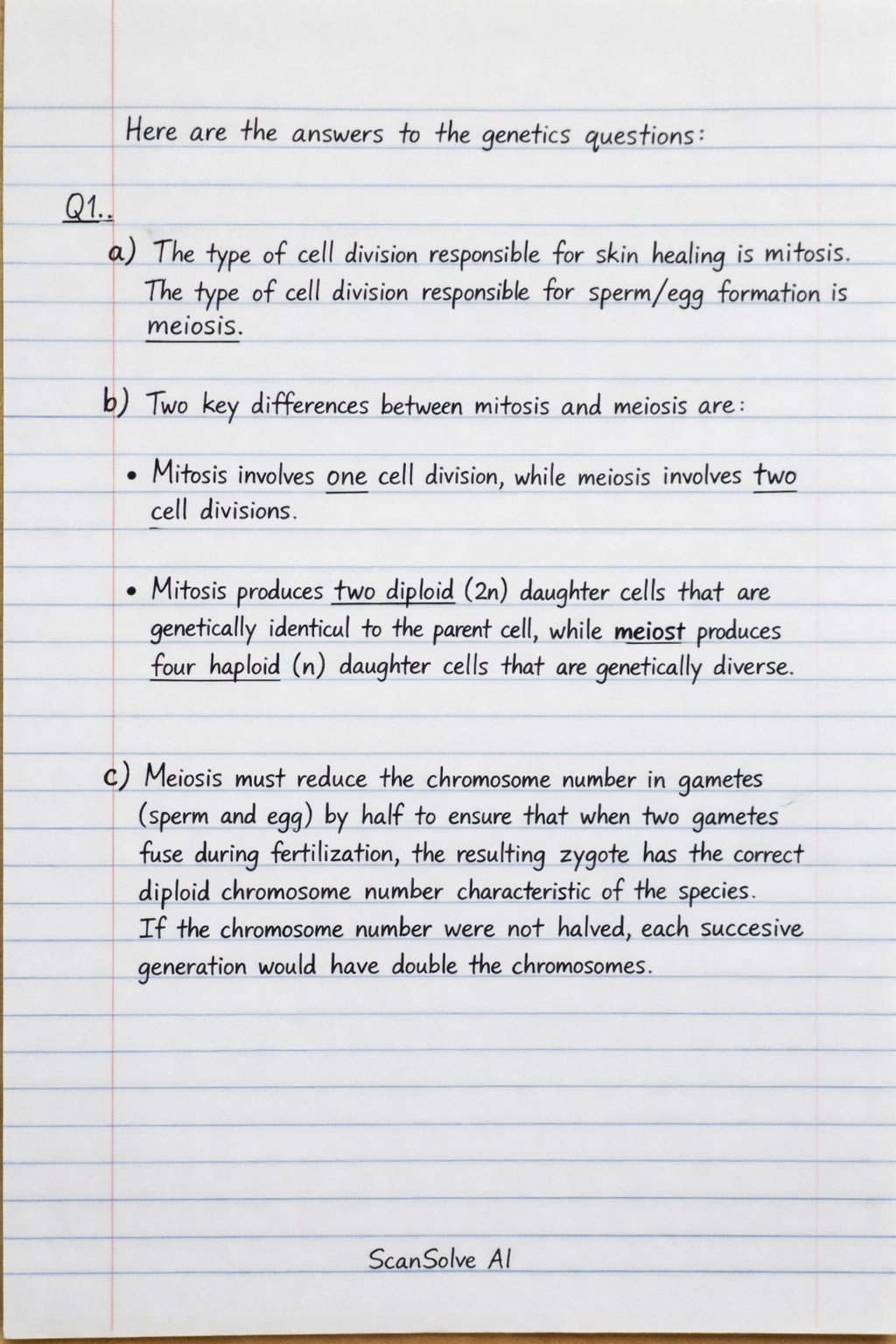
Here are the answers to the genetics questions: Q1. a) The type of cell division responsible for skin healing is mitosis. The type of cell division responsible for sperm/egg formation is meiosis. b) Two key differences between mitosis and meiosis are: • Mitosis involves one cell division, while meiosis involves two cell divisions. • Mitosis produces two diploid (2n) daughter cells that are genetically identical to the parent cell, while meiosis produces four haploid (n) daughter cells that are genetically diverse. c) Meiosis must reduce the chromosome number in gametes (sperm and egg) by half to ensure that when two gametes fuse during fertilization, the resulting zygote has the correct diploid chromosome number characteristic of the species. If the chromosome number were not halved, each successive generation would have double the chromosomes. Q2. a) Tumor suppressor genes play a critical role in cell division by regulating the cell cycle, preventing uncontrolled cell growth, and initiating programmed cell death (apoptosis) if DNA damage is irreparable. They act as "brakes" on cell proliferation. b) The difference is that tumor suppressor genes inhibit cell division and promote cell death, acting as "brakes," while oncogenes promote cell growth and division, acting as "accelerators." Oncogenes are mutated forms of proto-oncogenes, which normally regulate cell growth, but when mutated, they can lead to uncontrolled cell proliferation and cancer. c) One example of a tumor suppressor gene is p53. One example of an oncogene is Ras. Q3. a) The most likely pattern of inheritance is autosomal dominant. This is because the condition appears in every generation (grandfather, father, woman), and it is passed from an affected father to his daughter, while the mother's family is unaffected. b) Pedigrees help predict the risk of inheritance in future children by illustrating the pattern of inheritance of a trait across multiple generations. By analyzing the pedigree, geneticists can determine the mode of inheritance (e.g., autosomal dominant, recessive, X-linked) and then calculate the probability of offspring inheriting the trait based on the genotypes of the parents. c) If the disorder is X-linked and the woman has the disorder, she possesses at least one affected X chromosome. She passes one of her two X chromosomes to each son. • If she is heterozygous for an X-linked dominant disorder (e.g., X^AX^a), there is a 50% chance she will pass the affected X^A chromosome to each son, making him affected. • If she is homozygous for an X-linked recessive disorder (e.g., X^aX^a), there is a 100% chance she will pass the affected X^a chromosome to each son, making him affected. Given the ambiguity, a common answer for an affected heterozygous female is 50%. Q4. a) Punnett square for a heterozygous man (Ww) and a woman with a straight hairline (ww): |c|c|c| & W & w \\ w & Ww & ww \\ w & Ww & ww \\ The possible genotypes of their children are Ww and ww. b) Based on the Punnett square, 2 out of 4 offspring (Ww) are expected to have a widow's peak. Therefore, 50% of their children are expected to have a widow's peak. c) This example supports Mendel's Law of Segregation. The heterozygous man (Ww) produces two types of gametes (sperm carrying W and sperm carrying w) in equal proportions, demonstrating that the two alleles for hairline separate during gamete formation. Similarly, the woman (ww) produces only gametes carrying w. When these gametes combine, the alleles from each parent segregate and then recombine to produce offspring with distinct genotypes (Ww and ww) and phenotypes (widow's peak and straight hairline) in predictable ratios, showing that each parent contributes only one allele for each trait to their offspring.