

This biology question covers important biological concepts and processes. The step-by-step explanation below helps you understand the underlying mechanisms and reasoning.
ScanSolve AI Answer
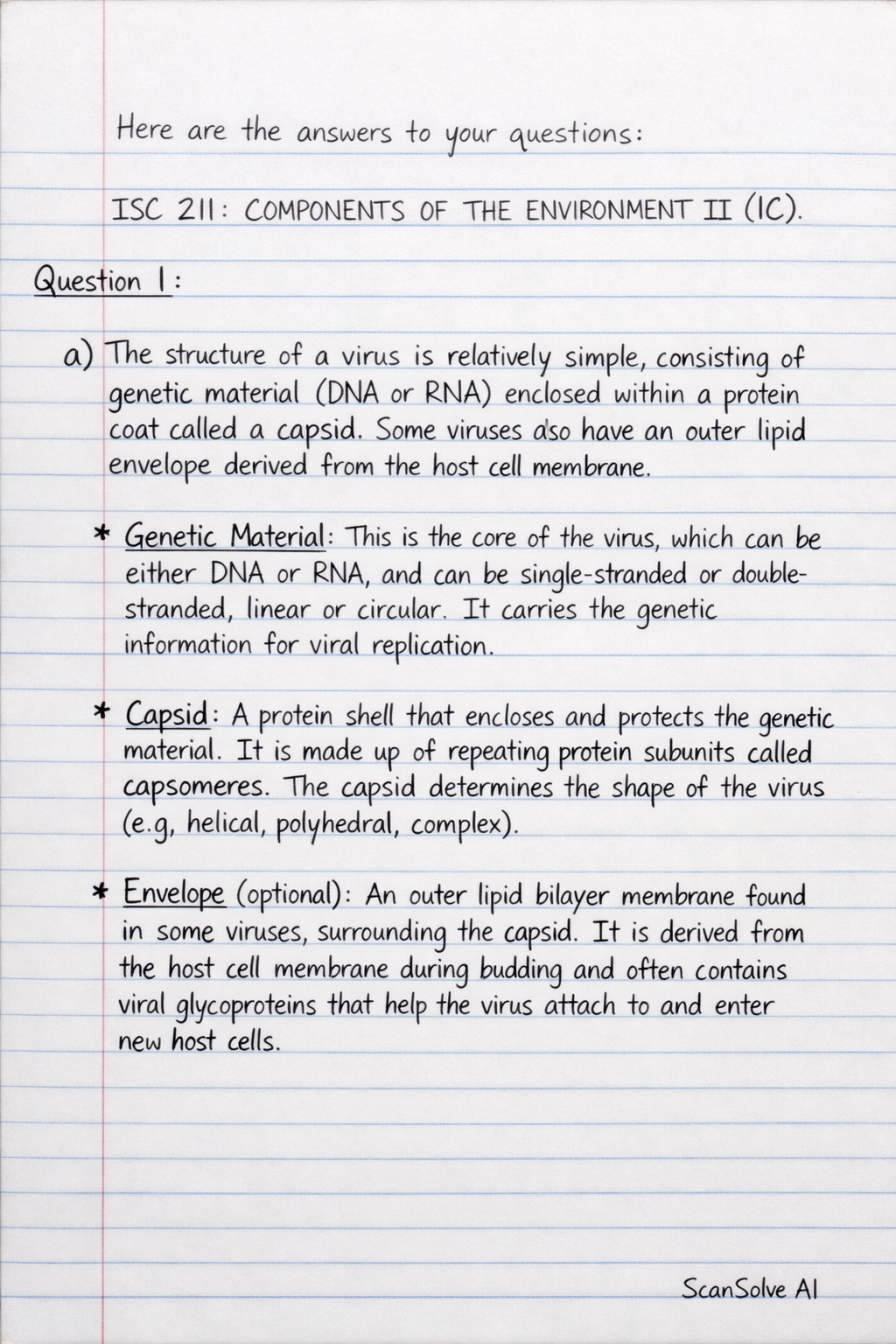
Here are the answers to your questions: ISC 211: COMPONENTS OF THE ENVIRONMENT II (1C) Question 1: a) The structure of a virus is relatively simple, consisting of genetic material (DNA or RNA) enclosed within a protein coat called a capsid. Some viruses also have an outer lipid envelope derived from the host cell membrane. Genetic Material: This is the core of the virus, which can be either DNA or RNA, and can be single-stranded or double-stranded, linear or circular. It carries the genetic information for viral replication. Capsid: A protein shell that encloses and protects the genetic material. It is made up of repeating protein subunits called capsomeres. The capsid determines the shape of the virus (e.g., helical, polyhedral, complex). Envelope (optional): An outer lipid bilayer membrane found in some viruses, surrounding the capsid. It is derived from the host cell membrane during budding and often contains viral glycoproteins that help the virus attach to and enter new host cells. Spikes (optional): Glycoprotein projections extending from the envelope (or capsid in non-enveloped viruses) that aid in attachment to host cells. b) Five characteristics of a virus: 1. Obligate Intracellular Parasites: Viruses can only replicate inside living host cells. 2. Acellular Structure: They lack cellular organelles and a true cellular structure. 3. Genetic Material: They contain either DNA or RNA as their genetic material, but never both. 4. Protein Coat (Capsid): Their genetic material is enclosed within a protective protein coat. 5. Small Size: Viruses are extremely small, typically much smaller than bacteria, and can only be seen with an electron microscope. c) Eight step methods for classifying species (Taxonomic Hierarchy): 1. Domain 2. Kingdom 3. Phylum 4. Class 5. Order 6. Family 7. Genus 8. Species Question 2: a) A generalized life cycle of Fungi involves both asexual and sexual reproduction, though the specifics vary greatly among different fungal groups. Asexual Reproduction: Fungi produce asexual spores (e.g., conidia, sporangiospores) by mitosis. These spores are dispersed (by wind, water, or animals). Upon landing in a suitable environment, the spores germinate, forming hyphae. The hyphae grow and develop into a new mycelium (a network of fungal threads). Sexual Reproduction: Two compatible haploid hyphae (n) from different mating types fuse in a process called plasmogamy, where their cytoplasms merge, but their nuclei remain separate, forming a dikaryotic (n+n) stage. The dikaryotic mycelium grows, and eventually, the two haploid nuclei within each cell fuse in a process called karyogamy, forming a diploid zygote (2n). The zygote undergoes meiosis to produce haploid spores. These haploid spores are then released and germinate to form new haploid hyphae, completing the cycle. b) Members of the chytrids (Phylum Chytridiomycota) are different from all other fungi primarily because they are the only group of fungi that produce motile spores (zoospores) with a single, posterior flagellum. This characteristic is unique among fungi and suggests an aquatic ancestry, as flagella are typically associated with movement in water. Other fungi typically produce non-motile spores. Question 3: a) Parasitic bacteria: These bacteria live in or on a host organism, deriving nutrients from the host and causing harm or disease in the process. The relationship is detrimental to the host. Symbiotic bacteria: These bacteria live in a close, long-term relationship with a host organism where both the bacteria and the host benefit from the interaction. This relationship is mutually beneficial. b) Five human diseases of bacterial origin and their causal organism: 1. Tuberculosis: Caused by Mycobacterium tuberculosis. 2. Cholera: Caused by Vibrio cholerae. 3. Tetanus: Caused by Clostridium tetani. 4. Typhoid Fever: Caused by Salmonella typhi. 5. Pneumonia: Often caused by Streptococcus pneumoniae or Haemophilus influenzae. c) Four importance of bacteria to man: 1. Decomposition and Nutrient Cycling: Bacteria are crucial decomposers, breaking down dead organic matter and recycling essential nutrients (e.g., nitrogen, carbon) back into the ecosystem. 2. Food Production: Used in the production of various foods like yogurt, cheese, vinegar, and fermented products. 3. Biotechnology and Medicine: Employed in the production of antibiotics, vaccines, insulin, and other pharmaceuticals, as well as in genetic engineering. 4. Nitrogen Fixation: Symbiotic bacteria (e.g., Rhizobium) in legume root nodules convert atmospheric nitrogen into a usable form for plants, enriching soil fertility. ISC 213: MAN AND THE ENVIRONMENT II (1C) Question 1: a) The concept of the "ozone layer" refers to a region in Earth's stratosphere, approximately 15 to 30 kilometers above the surface, that contains a high concentration of ozone gas (O_3). This layer acts as a natural shield, absorbing most of the sun's harmful ultraviolet (UV) radiation, particularly UV-B and UV-C rays, before they reach the Earth's surface. This protection is vital for life on Earth, as excessive UV radiation can cause DNA damage, skin cancer, cataracts, and harm to ecosystems. b) Five effects and control measures of ozone depletion: Effects of Ozone Depletion: 1. Increased Skin Cancer: Higher incidence of melanoma and non-melanoma skin cancers due to increased UV-B exposure. 2. Cataracts and Eye Damage: Increased risk of eye conditions like cataracts, which can lead to blindness. 3. Suppression of Immune System: Weakening of the human immune system, making individuals more susceptible to infections. 4. Damage to Marine Ecosystems: Harm to phytoplankton, the base of the marine food web, affecting fish populations and overall ocean productivity. 5. Reduced Crop Yields: Negative impacts on agricultural crops, leading to decreased productivity and food security. Control Measures of Ozone Depletion: 1. Phasing out ODS Production: Eliminating the production and consumption of ozone-depleting substances (ODS) like chlorofluorocarbons (CFCs) and halons, as mandated by the Montreal Protocol. 2. Developing Alternatives: Promoting the development and use of ozone-friendly alternatives for refrigerants, aerosols, and fire suppressants (e.g., hydrofluorocarbons - HFCs, although HFCs are potent greenhouse gases). 3. Proper Disposal of ODS: Ensuring the safe recovery and destruction of ODS from old equipment (e.g., refrigerators, air conditioners) to prevent their release into the atmosphere. 4. Public Awareness and Education: Educating the public about the dangers of ozone depletion and the importance of using ozone-friendly products. 5. International Cooperation: Implementing and enforcing international agreements like the Montreal Protocol to ensure global efforts in protecting the ozone layer. Question 2: Write short note on the following terms: (i) Guinea Savanna: This is a type of savanna found in West Africa, characterized by tall grasses (up to 3 meters high) and scattered trees, often with a distinct dry season and a wet season. It receives higher rainfall than the Sudan and Sahel savannas, supporting denser vegetation and a greater variety of wildlife. (ii) Sudan Savanna: Located north of the Guinea Savanna in West Africa, the Sudan Savanna is drier, with shorter grasses and more widely spaced, stunted trees. It experiences a longer dry season and less rainfall, leading to sparser vegetation adapted to arid conditions. (iii) Sahel Savanna: The Sahel is a semi-arid transitional zone located between the Sahara Desert to the north and the more humid savannas to the south. It is characterized by very sparse, short grasses, thorny shrubs, and widely scattered, drought-resistant trees. Rainfall is low and highly variable, making it vulnerable to desertification. (iv) Montane Vegetation: This refers to the plant communities found in mountainous regions, typically above the treeline or in areas with cooler temperatures and higher rainfall due to elevation. Vegetation zones vary with altitude, ranging from montane forests at lower elevations to alpine meadows and tundra-like vegetation at higher, colder altitudes. Species are adapted to harsh conditions, including strong winds, cold, and thin soils. Question 3: a) Balance in nature, also known as ecological balance or homeostasis, refers to a state of dynamic equilibrium within an ecosystem where the populations of different species, the flow of energy, and the cycling of nutrients remain relatively stable over time. This balance is maintained through complex interactions between living organisms (e.g., predator-prey relationships, competition, symbiosis) and their non-living environment (e.g., climate, soil, water). While minor fluctuations occur, a balanced ecosystem can resist disturbances and maintain its overall structure and function. b) Water can cause deep cuts in the soil through a process called gully erosion. This occurs when concentrated runoff water flows over unprotected land, especially on slopes, gaining speed and volume. As the water flows, it picks up soil particles, creating small channels. Over time, if the runoff continues and is not managed, these channels deepen and widen into large, V-shaped or U-shaped incisions in the landscape, known as gullies. Factors contributing to gully formation include steep slopes, sparse vegetation cover, intense rainfall, and certain soil types that are easily erodible. The force of the flowing water, combined with its abrasive action, carves out these deep cuts, leading to significant soil loss and land degradation. 3 done, 2 left today. You're making progress.