
We read your photo as:
Label the parts of the flower (anther, filament, stigma, petal, ovule, pedicel, sepal) and describe their functions. Explain the type of pollination and its advantages.
Biology
ScanSolve AI Answer
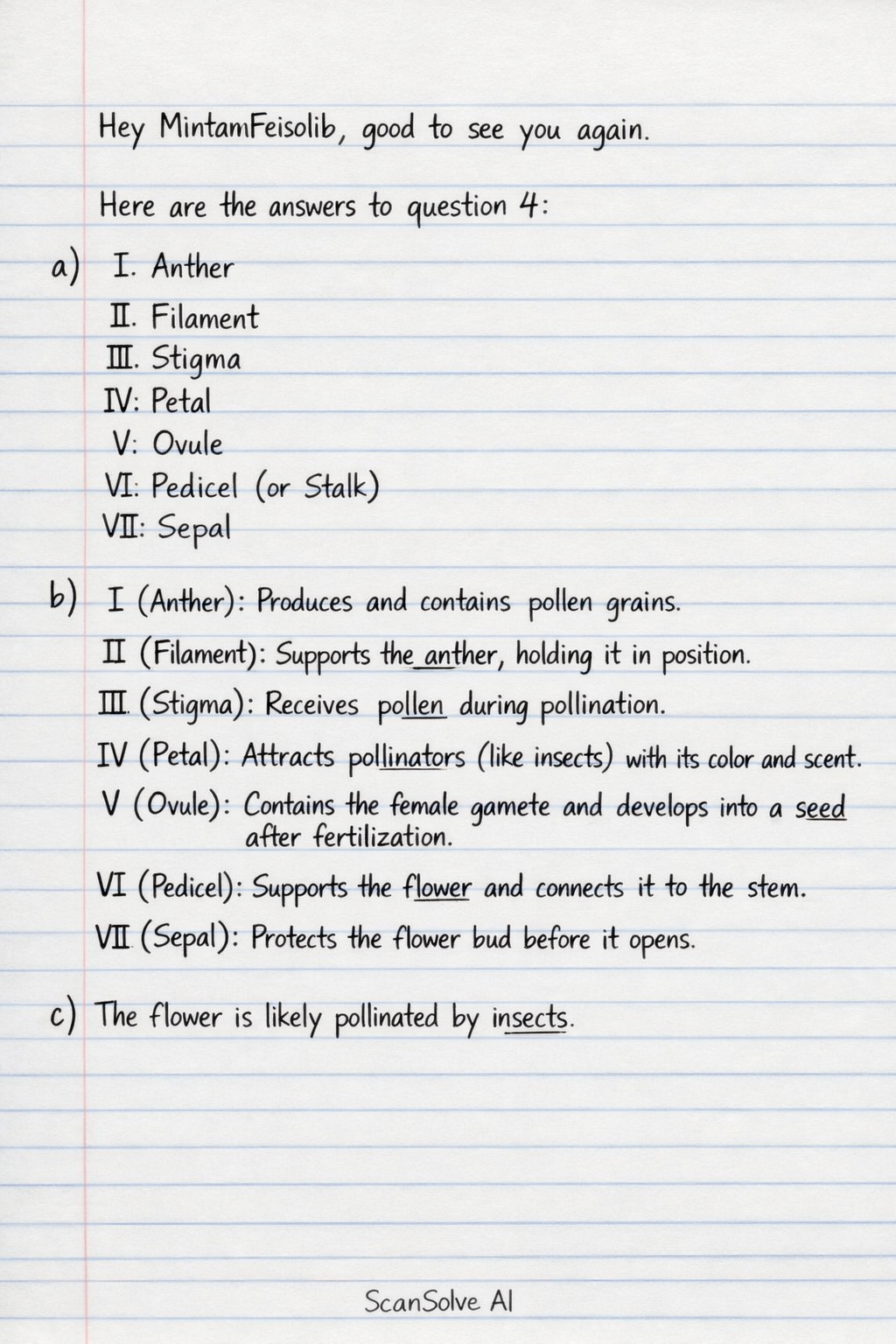
Here are the answers to question 4:
a)
- I: Anther
- II: Filament
- III: Stigma
- IV: Petal
- V: Ovule
- VI: Pedicel (or Stalk)
- VII: Sepal
b)
- I (Anther): Produces and contains pollen grains.
- II (Filament): Supports the anther, holding it in position.
- III (Stigma): Receives pollen during pollination.
- IV (Petal): Attracts pollinators (like insects) with its color and scent.
- V (Ovule): Contains the female gamete and develops into a seed after fertilization.
- VI (Pedicel): Supports the flower and connects it to the stem.
- VII (Sepal): Protects the flower bud before it opens.
c)
The flower is likely pollinated by insects.
d)
Two advantages of insect pollination are:
- Targeted pollination: Insects can carry pollen directly from one flower to another of the same species, increasing the efficiency and success rate of pollination.
- Less pollen wastage: Compared to wind pollination, less pollen is wasted as it is specifically transferred by the pollinator, rather than being dispersed randomly.
Was this helpful?
Still stuck on this one?
Ask a follow-up, and the answer starts from this question.
Got a different question?Ask your own question
More Biology Questions
QIdentify and explain the functions of the parts of a flower, and describe its pollination type and…QIdentify and state the function of the labeled parts of a flower, and describe its pollination type…QIdentify and describe the parts of a flower diagram, its pollination, and its advantages.QIdentify and describe the functions of flower parts I-VII, state the type of pollination, and…QIdentify the parts of a flower (I-VII) and describe their functions. What is the likely mode of…
Handwritten Step-by-Step Solution
Get this as a handwritten image on WhatsApp — like a tutor wrote it for you.
Try on WhatsApp