
We read your photo as:
Describe the landmarks of the sternum, the significance of the sternal angle, the boundaries of the thoracic inlet and outlet, and classify the ribs.
ScanSolve AI Answer
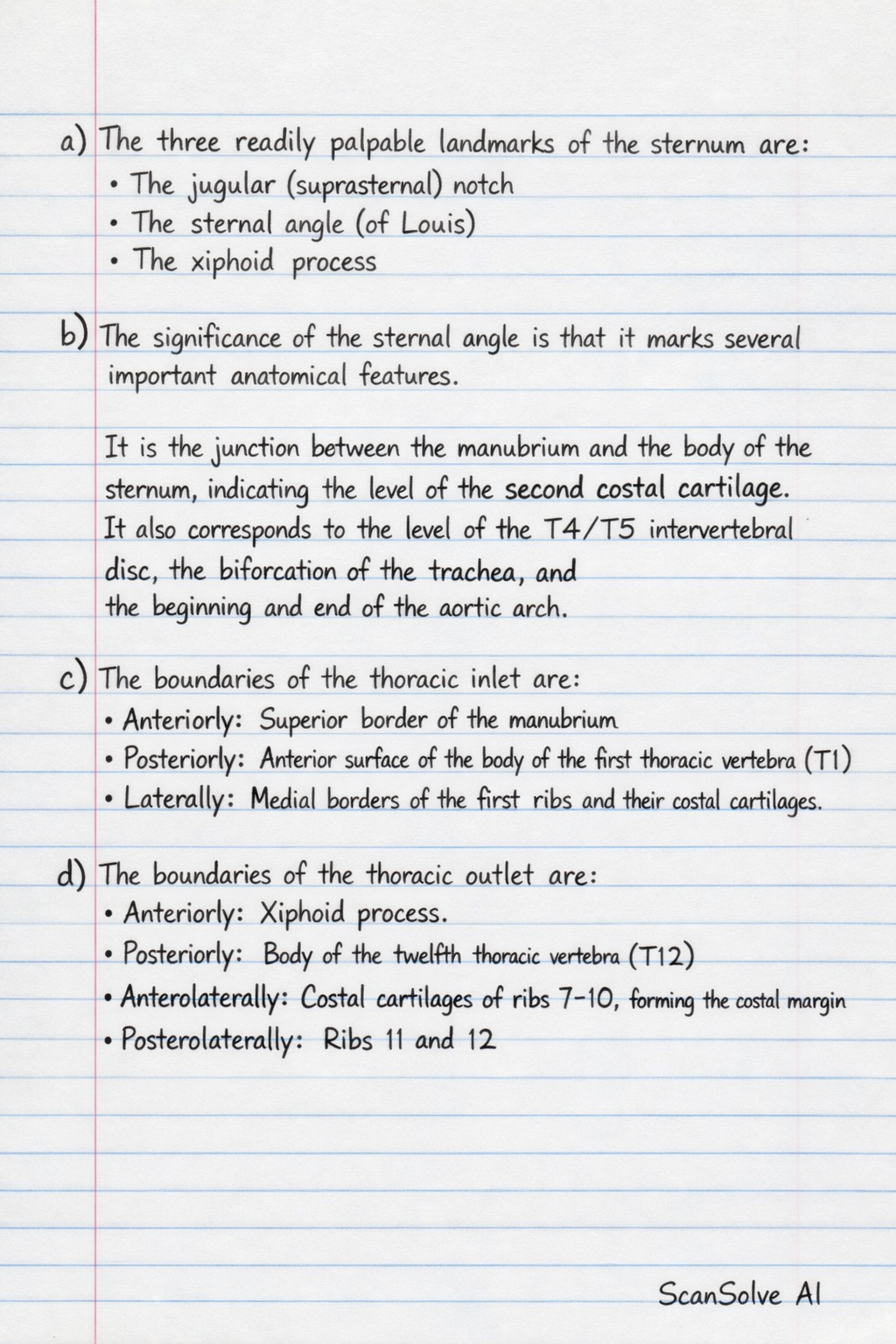
a)
The three readily palpable landmarks of the sternum are:
- The jugular (suprasternal) notch
- The sternal angle (of Louis)
- The xiphoid process
b)
The significance of the sternal angle is that it marks several important anatomical features. It is the junction between the manubrium and the body of the sternum, indicating the level of the second costal cartilage. It also corresponds to the level of the T4/T5 intervertebral disc, the bifurcation of the trachea, and the beginning and end of the aortic arch.
c)
The boundaries of the thoracic inlet are:
- Anteriorly: Superior border of the manubrium
- Posteriorly: Anterior surface of the body of the first thoracic vertebra (T1)
- Laterally: Medial borders of the first ribs and their costal cartilages
d)
The boundaries of the thoracic outlet are:
- Anteriorly: Xiphoid process
- Posteriorly: Body of the twelfth thoracic vertebra (T12)
- Anterolaterally: Costal cartilages of ribs 7-10, forming the costal margin
- Posterolaterally: Ribs 11 and 12
e)
A true rib is a rib that attaches directly to the sternum via its own costal cartilage. There are seven pairs of true ribs (ribs 1-7).
f)
In the human body, there are:
- True ribs: 7 pairs (ribs 1-7), totaling 14 ribs.
- False ribs: 5 pairs (ribs 8-12), totaling 10 ribs. These include vertebrochondral ribs (8-10) and floating ribs (11-12).
- Floating ribs: 2 pairs (ribs 11-12), totaling 4 ribs. These are a subset of false ribs that do not attach to the sternum or to the costal cartilage of another rib anteriorly.
Still stuck on this one?
Ask a follow-up, and the answer starts from this question.
More Biology Questions
Handwritten Step-by-Step Solution
Get this as a handwritten image on WhatsApp — like a tutor wrote it for you.
Try on WhatsApp