
We read your photo as:
Linda, a 17-year-old female, presents with vaginal bleeding and lower abdominal pain for 2 days. Incomplete abortion is diagnosed. a) Define Adolescent. b) Draw a well-labeled diagram of the uterus.
ScanSolve AI Answer
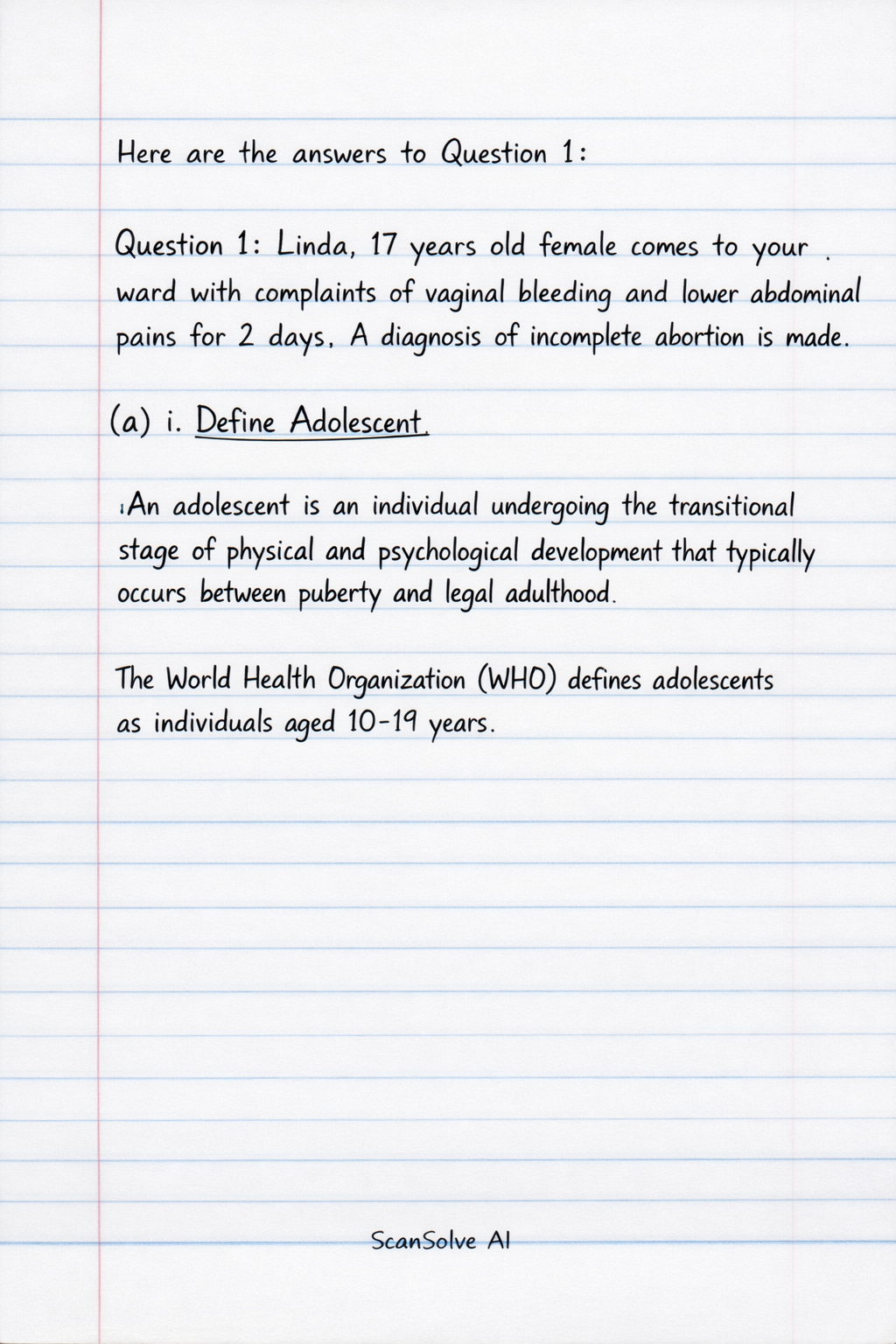
Here are the answers to Question 1:
Question 1: Linda 17 years old female comes to your ward with complaints of vaginal bleeding and lower abdominal pains for 2 days. A diagnosis of incomplete abortion is made.
a) i. Define Adolescent
An adolescent is an individual undergoing the transitional stage of physical and psychological development that typically occurs between puberty and legal adulthood. The World Health Organization (WHO) defines adolescents as individuals aged 10-19 years.
a) ii. Draw a well-labeled diagram of the uterus
I am unable to draw diagrams. However, a well-labeled diagram of the uterus would typically include:
- Fundus: The dome-shaped top portion.
- Body (Corpus): The main part of the uterus.
- Isthmus: The narrow lower segment connecting the body to the cervix.
- Cervix: The lower, narrow part that opens into the vagina.
- Internal os: The opening from the uterus into the cervical canal.
- External os: The opening from the cervical canal into the vagina.
- Endometrium: The inner lining of the uterus.
- Myometrium: The muscular middle layer.
- Perimetrium: The outer serous layer.
- Fallopian tubes (Uterine tubes): Extending from the fundus laterally.
- Ovaries: Located near the fimbriae of the fallopian tubes.
- Round ligaments: Extending from the uterine cornua to the labia majora.
- Broad ligaments: Folds of peritoneum supporting the uterus.
b) Explain any three (3) types of abortion other than the ones mentioned in the stem
Here are three types of abortion other than incomplete abortion:
- Threatened Abortion: This is characterized by vaginal bleeding, usually slight, with or without mild lower abdominal pain, but the cervix remains closed, and there is no expulsion of fetal tissue. The pregnancy may continue to term.
- Inevitable Abortion: This occurs when vaginal bleeding is heavier, and lower abdominal pain is more severe, accompanied by cervical dilation. The products of conception have not yet been expelled, but the abortion is considered unavoidable.
- Missed Abortion: In this type, the fetus has died in utero, but the products of conception are retained within the uterus for an extended period (often weeks). There may be no symptoms of expulsion, and the woman might only notice a cessation of pregnancy symptoms.
c) Describe the management you will give to Linda from admission until discharge
The management for Linda, a 17-year-old with an incomplete abortion, would involve the following steps:
-
Admission and Initial Assessment:
- History Taking: Obtain a detailed history including her last menstrual period (LMP), duration and amount of bleeding, severity of pain, previous pregnancies, and any relevant medical history.
- Physical Examination: Perform a general physical examination, including vital signs (blood pressure, pulse, temperature, respiratory rate) to assess for signs of shock. Conduct an abdominal examination for tenderness and a speculum and bimanual vaginal examination to assess the amount of bleeding, cervical dilation, and presence of retained products of conception.
- Investigations: Order a complete blood count (CBC) to check hemoglobin levels, blood group and Rh factor, urine human chorionic gonadotropin (hCG) to confirm pregnancy, and an ultrasound scan to confirm incomplete abortion and assess the amount of retained tissue.
-
Stabilization:
- Intravenous Access and Fluids: If Linda shows signs of hypovolemia or shock (e.g., low blood pressure, rapid pulse), establish intravenous access and administer crystalloid fluids rapidly.
- Pain Management: Administer appropriate analgesics to manage her lower abdominal pain.
- Antibiotics: Administer prophylactic broad-spectrum antibiotics to prevent infection, especially before any invasive procedure.
- Anti-D Immunoglobulin: If Linda is Rh-negative, administer anti-D immunoglobulin to prevent Rh sensitization.
-
Evacuation of Retained Products of Conception (ERPC):
- This is the definitive treatment for incomplete abortion. The method depends on the gestational age and amount of retained tissue.
- Manual Vacuum Aspiration (MVA): This is often preferred for early gestations and is a safe and effective method to remove retained tissue.
- Dilatation and Curettage (D&C): This surgical procedure involves dilating the cervix and using a curette to gently scrape the uterine lining to remove retained tissue.
- Medical Management: In some cases, misoprostol can be used to induce uterine contractions and expel retained tissue, particularly for early gestations.
-
Post-Procedure Care:
- Monitoring: Continuously monitor vital signs, vaginal bleeding, and pain levels.
- Uterine Contraction: Administer oxytocic agents (e.g., oxytocin) if necessary to ensure adequate uterine contraction and minimize blood loss.
- Antibiotics: Continue antibiotics as prescribed, especially if there were signs of infection or if the procedure was complicated.
- Pain Relief: Ensure adequate pain relief is maintained.
-
Discharge Planning and Follow-up:
- Contraception Counseling: Provide comprehensive counseling on various contraceptive methods and help Linda choose a suitable option to prevent future unintended pregnancies.
- Warning Signs: Educate Linda on warning signs of complications such as heavy bleeding, fever, severe abdominal pain, or foul-smelling vaginal discharge, and advise her to seek immediate medical attention if any occur.
- Follow-up Appointment: Schedule a follow-up appointment to ensure complete recovery and address any concerns.
- Emotional Support: Offer emotional support and counseling, acknowledging the potential psychological impact of the abortion.
d) Explain five (5) points you will consider when counseling Linda
When counseling Linda, a 17-year-old who has experienced an incomplete abortion, five key points to consider are:
- Emotional Support and Validation: Acknowledge that experiencing an abortion can be emotionally distressing. Provide a safe and non-judgmental space for her to express her feelings (grief, guilt, fear, sadness). Reassure her that her feelings are normal and that support is available.
- Clear Explanation of the Condition and Procedure: Explain in simple, age-appropriate language what an incomplete abortion means, why the procedure (e.g., MVA/D&C) is necessary, and what she can expect during and after the procedure. This helps reduce anxiety and empowers her to make informed decisions.
- Contraception and Future Planning: Discuss the importance of preventing future unintended pregnancies. Present various contraceptive options suitable for her age and lifestyle, explaining their effectiveness, side effects, and proper use. Emphasize that she can still have children in the future.
- Sexual Health Education: Provide comprehensive information on safe sexual practices, including the consistent and correct use of condoms to prevent sexually transmitted infections (STIs). Discuss the importance of regular sexual health check-ups.
- Warning Signs and Follow-up Care: Educate Linda about potential complications post-abortion, such as heavy bleeding, fever, severe abdominal pain, or foul-smelling discharge, and instruct her on when and where to seek immediate medical attention. Stress the importance of attending all scheduled follow-up appointments.
Still stuck on this one?
Ask a follow-up, and the answer starts from this question.
More Biology Questions
Handwritten Step-by-Step Solution
Get this as a handwritten image on WhatsApp — like a tutor wrote it for you.
Try on WhatsApp