

This biology question covers important biological concepts and processes. The step-by-step explanation below helps you understand the underlying mechanisms and reasoning.
ScanSolve AI Answer
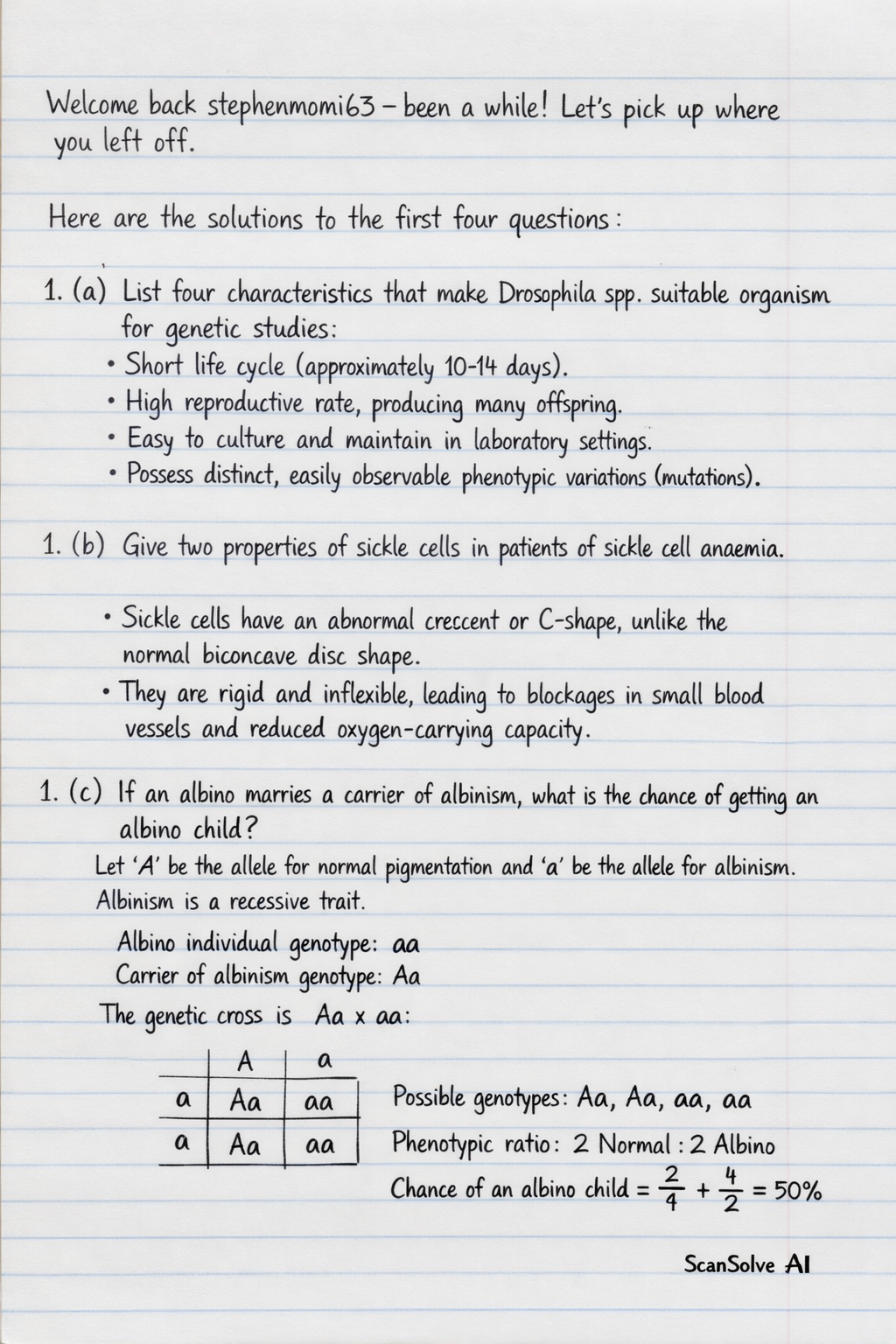
Here are the solutions to the first four questions: 1. (a) List four characteristics that make Drosophila spp. suitable organism for genetic studies. Short life cycle (approximately 10-14 days). High reproductive rate, producing many offspring. Easy to culture and maintain in laboratory settings. Possess distinct, easily observable phenotypic variations (mutations). 1. (b) Give two properties of sickle cells in patients of sickle cell anaemia. Sickle cells have an abnormal crescent or C-shape, unlike the normal biconcave disc shape. They are rigid and inflexible, leading to blockages in small blood vessels and reduced oxygen-carrying capacity. 1. (c) If an albino marries a carrier of albinism, what is the chance of getting an albino child? Let 'A' be the allele for normal pigmentation and 'a' be the allele for albinism. Albinism is a recessive trait. Albino individual genotype: aa Carrier of albinism genotype: Aa The genetic cross is Aa × aa. Step 1: Determine the gametes produced by each parent. Parent 1 (Aa): Gametes are A and a. Parent 2 (aa): Gametes are a and a. Step 2: Construct a Punnett square to show the possible offspring genotypes. c — c — c & A & a \\ a & Aa & aa \\ a & Aa & aa \\ Step 3: Determine the genotypes and phenotypes of the offspring. Aa: Carrier (normal pigmentation) aa: Albino Step 4: Calculate the chance of getting an albino child. From the Punnett square, 2 out of 4 offspring are aa. The chance of getting an albino child is (2)/(4) = (1)/(2). The chance of getting an albino child is 50\%. 2. (a) A case of inheritance involving three children with blood group O, A (genotype AO) and AB is in court. Their mother is of blood group A (genotype AA) while their late millionaire father is of blood group O. Resolve the above case genetically showing the real inheritor. Let the alleles for blood groups be I^A, I^B, and i. Mother's genotype: I^A I^A (Blood group A) Father's genotype: ii (Blood group O) Step 1: Determine the possible offspring from the biological parents. Cross: I^A I^A × ii Mother's gametes: I^A Father's gametes: i All biological children would have the genotype I^A i, which corresponds to blood group A. Step 2: Compare the children's blood groups with the expected biological offspring. Child 1: Blood group O (genotype ii). This child cannot be biological offspring of the mother (I^A I^A) as the mother cannot contribute an i allele. Child 2: Blood group A (genotype I^A i). This child matches the expected genotype from the biological parents (I^A from mother, i from father). Child 3: Blood group AB (genotype I^A I^B). This child cannot be biological offspring of either parent, as neither parent possesses the I^B allele. Step 3: Conclude the real inheritor. Only the child with blood group A (genotype I^A i) is genetically consistent with being the biological offspring of the stated mother and the late millionaire father. The real inheritor is the child with blood group A (genotype AO). 2. (b) Use genetic crosses to explain the yellow lethal gene in mice. In mice, the yellow coat color allele (A^Y) is dominant to the agouti allele (A). However, the A^Y allele is lethal in homozygous condition (A^Y A^Y), meaning individuals with this genotype die, usually during embryonic development. A^Y A^Y: Lethal (dies) A^Y A: Yellow coat color AA: Agouti (wild type) coat color Step 1: Consider a cross between two yellow mice, which must be heterozygous (A^Y A). Cross: A^Y A × A^Y A Step 2: Determine the gametes produced by each parent. Parent 1 (A^Y A): Gametes are A^Y and A. Parent 2 (A^Y A): Gametes are A^Y and A. Step 3: Construct a Punnett square. c — c — c & A^Y & A \\ A^Y & A^Y A^Y & A^Y A \\ A & A^Y A & AA \\ Step 4: Determine the genotypes and phenotypes of the offspring. A^Y A^Y: Lethal (dies before birth) A^Y A: Yellow AA: Agouti Step 5: State the observed phenotypic ratio among surviving offspring. Since A^Y A^Y individuals do not survive, the observed phenotypic ratio among the living offspring is 2 Yellow : 1 Agouti. This demonstrates that the yellow allele is dominant for coat color but recessive for lethality. 3. (a) List five characteristics of Pisum sativum that makes it suitable for genetic experiments. Easy to cultivate and grow. Short generation time, allowing for rapid study of multiple generations. Produces a large number of offspring. Possesses several distinct, easily observable traits (e.g., seed shape, seed color, flower color, plant height). Can be easily self-pollinated or cross-pollinated. 3. (b) (i) State Mendel's law of segregation of genes and independent assortment. Law of Segregation: During the formation of gametes, the two alleles for a heritable character separate (segregate) from each other, so that each gamete carries only one allele for that character. Law of Independent Assortment: Alleles for different genes assort independently of one another during gamete formation, provided they are located on different chromosomes or are far apart on the same chromosome. 3. (b) (ii) Using T for tallness and t for dwarfism and R for red flower, r for white flower in Pisum sativum, show the application of Mendel's Independent Assortment Law in Meiosis. Consider a dihybrid parent with genotype TtRr. During meiosis, the alleles for plant height (T/t) and flower color (R/r) are located on different homologous chromosomes. Step 1: During Metaphase I of meiosis, homologous chromosomes align independently at the metaphase plate. The chromosome carrying the T/t alleles can orient independently of the chromosome carrying the R/r alleles. Step 2: This independent orientation leads to different combinations of alleles in the gametes. For example, the chromosome with T can go to the same pole as the chromosome with R, or it can go with the chromosome with r. Step 3: As a result, a TtRr individual produces four types of gametes in approximately equal proportions: TR, Tr, tR, and tr. This demonstrates that the alleles for height and flower color assort independently into gametes. 3. (b) (iii) What type of cross is involved in Independent Assortment of genes. The type of cross involved in demonstrating independent assortment of genes is a dihybrid cross. 4. (a) Defined sex linked characteristics. Sex-linked characteristics are traits determined by genes located on the sex chromosomes (X or Y). These traits often exhibit different inheritance patterns in males and females due to the differing number of X and Y chromosomes. 4. (b) A carrier of haemophilia marries a haemophiliac male, state the chance of them having (i) a haemophiliac (ii) a carrier (iii) a normal child. Haemophilia is an X-linked recessive disorder. Let X^H be the normal allele and X^h be the haemophilia allele. Carrier female genotype: X^H X^h Haemophiliac male genotype: X^h Y The genetic cross is X^H X^h × X^h Y. Step 1: Determine the gametes produced by each parent. Female (X^H X^h): Gametes are X^H and X^h. Male (X^h Y): Gametes are X^h and Y. Step 2: Construct a Punnett square. c — c — c & X^h & Y \\ X^H & X^H X^h & X^H Y \\ X^h & X^h X^h & X^h Y \\ Step 3: Determine the genotypes and phenotypes of the offspring. X^H X^h: Carrier female X^H Y: Normal male X^h X^h: Haemophiliac female X^h Y: Haemophiliac male Step 4: Calculate the chance for each type of child. (i) Chance of a haemophiliac child: X^h X^h (haemophiliac female) = 1/4 X^h Y (haemophiliac male) = 1/4 Total haemophiliac children = (1)/(4) + (1)/(4) = (2)/(4) = (1)/(2) The chance of a haemophiliac child is 50\%. (ii) Chance of a carrier child: X^H X^h (carrier female) = 1/4 The chance of a carrier child is 25\%. (iii) Chance of a normal child: X^H Y (normal male) = 1/4 The chance of a normal child is 25\%. 4. (c) Which chromosome is normally involved in sex-linked characteristics? The chromosome normally involved in sex-linked characteristics is the X chromosome.