
We read your photo as:
List four factors contributing to weed competitive ability and four ways pesticides can be classified.
Biology
ScanSolve AI Answer
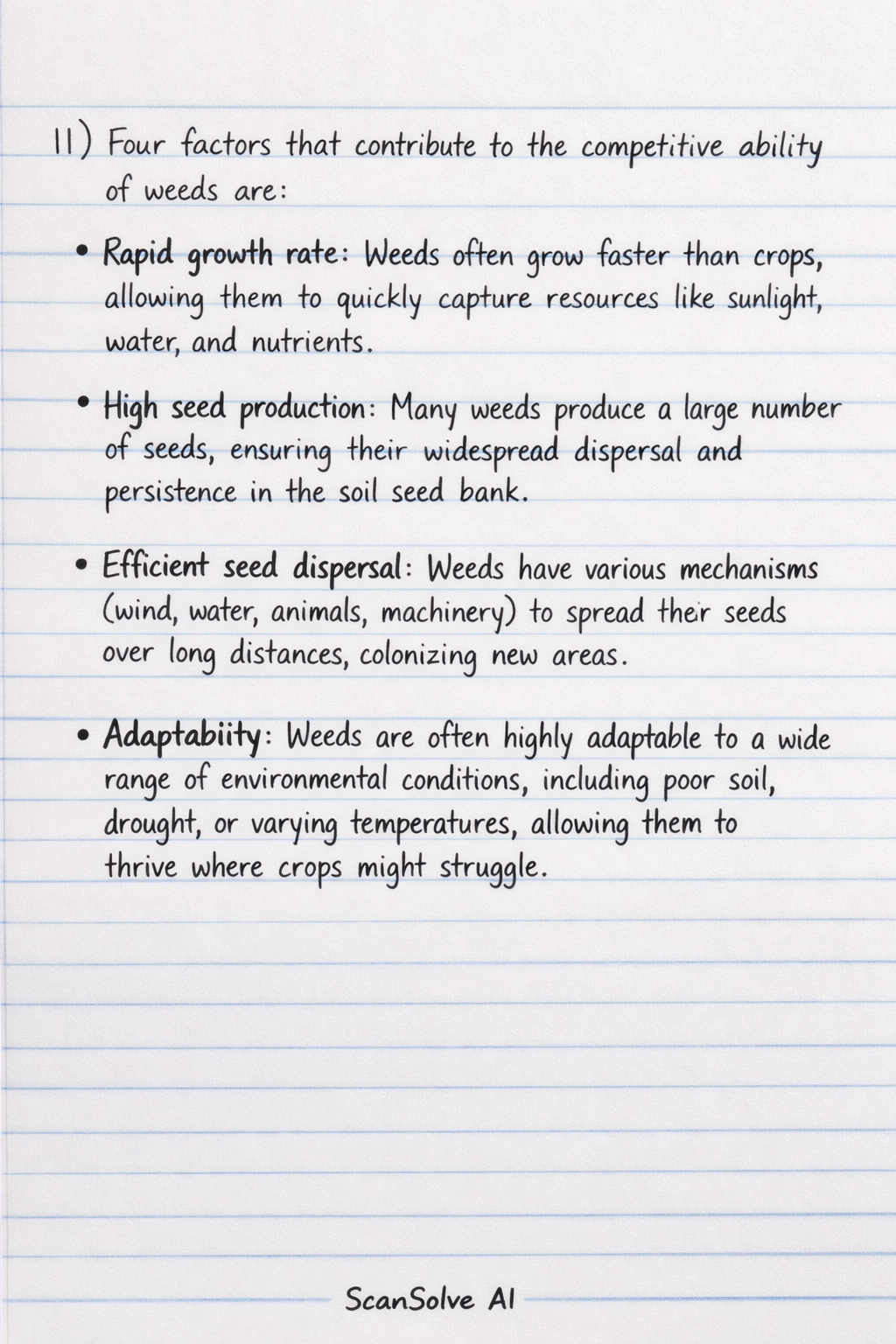
- Four factors that contribute to the competitive ability of weeds are:
- Rapid growth rate: Weeds often grow faster than crops, allowing them to quickly capture resources like sunlight, water, and nutrients.
- High seed production: Many weeds produce a large number of seeds, ensuring their widespread dispersal and persistence in the soil seed bank.
- Efficient seed dispersal: Weeds have various mechanisms (wind, water, animals, machinery) to spread their seeds over long distances, colonizing new areas.
- Adaptability: Weeds are often highly adaptable to a wide range of environmental conditions, including poor soil, drought, or varying temperatures, allowing them to thrive where crops might struggle.
- Four ways of classifying pesticides are:
- By target pest: This classifies pesticides based on the type of pest they control (e.g., insecticides for insects, herbicides for weeds, fungicides for fungi, rodenticides for rodents).
- By chemical composition: This groups pesticides based on their chemical structure (e.g., organophosphates, carbamates, pyrethroids, neonicotinoids).
- By mode of action: This categorizes pesticides by how they affect the pest (e.g., contact poisons, stomach poisons, systemic poisons, respiratory poisons).
- By formulation: This classifies pesticides based on how they are prepared for application (e.g., wettable powders, emulsifiable concentrates, granules, dusts).
- Four cultural methods of controlling crop diseases are:
- Crop rotation: Alternating different crops in a sequence to break the life cycles of disease-causing pathogens that are specific to certain crops.
- Use of resistant varieties: Planting crop varieties that have been bred or selected for their natural resistance to common diseases.
- Field sanitation: Removing and destroying infected plant debris, weeds, and volunteer plants that can harbor pathogens and serve as sources of infection.
- Proper spacing and planting density: Ensuring adequate space between plants to improve air circulation, reduce humidity, and minimize the spread of fungal and bacterial diseases.
Was this helpful?
Still stuck on this one?
Ask a follow-up, and the answer starts from this question.
Got a different question?Ask your own question
More Biology Questions
QList four ways to classify pesticides and four factors that affect their efficiency.QQ4 State three structural features that adapt cockroach to it habitat. Q5 State four factors that…QDefine pest, give five reasons why pesticides are necessary, and explain phytotoxicity.QControl of crops Weeds pest and diseaseQState two ways in which weeds are economically important and describe eight methods used in water…
Handwritten Step-by-Step Solution
Get this as a handwritten image on WhatsApp — like a tutor wrote it for you.
Try on WhatsApp