
We read your photo as:
List four ways to classify pesticides and four factors that affect their efficiency.
Biology
ScanSolve AI Answer
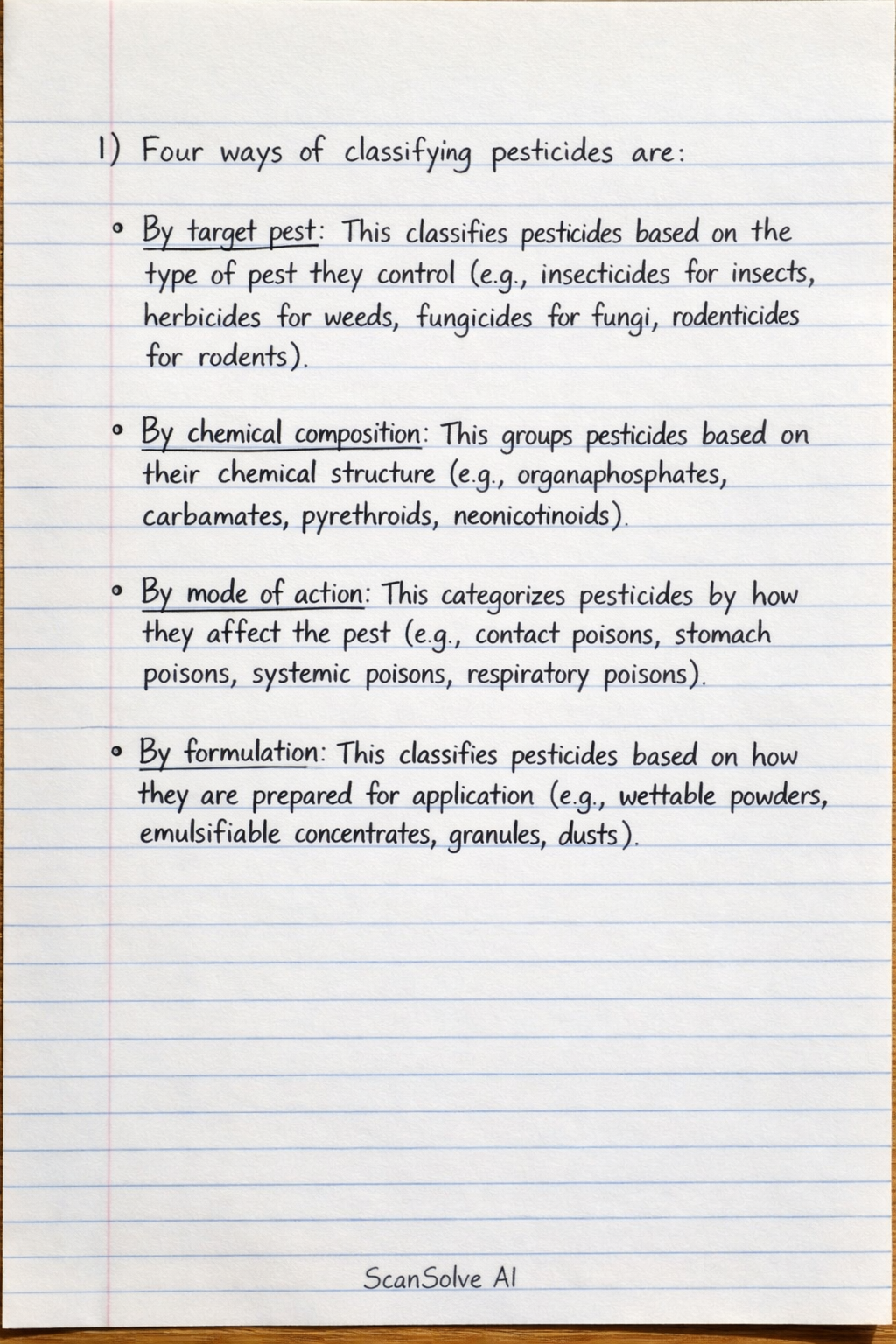
- Four ways of classifying pesticides are:
- By target pest: This classifies pesticides based on the type of pest they control (e.g., insecticides for insects, herbicides for weeds, fungicides for fungi, rodenticides for rodents).
- By chemical composition: This groups pesticides based on their chemical structure (e.g., organophosphates, carbamates, pyrethroids, neonicotinoids).
- By mode of action: This categorizes pesticides by how they affect the pest (e.g., contact poisons, stomach poisons, systemic poisons, respiratory poisons).
- By formulation: This classifies pesticides based on how they are prepared for application (e.g., wettable powders, emulsifiable concentrates, granules, dusts).
- Four factors that affect the efficiency of pesticides are:
- Environmental conditions: Factors like temperature, humidity, rainfall, and wind can affect pesticide degradation, drift, and uptake by pests or plants.
- Pest characteristics: The life stage, mobility, population density, and resistance level of the target pest influence how effective a pesticide will be.
- Application method: The technique used to apply the pesticide (e.g., spraying, dusting, soil incorporation) and the coverage achieved can significantly impact its efficiency.
- Pesticide properties: The inherent toxicity, persistence, solubility, and formulation of the pesticide itself determine its effectiveness.
Was this helpful?
Still stuck on this one?
Ask a follow-up, and the answer starts from this question.
Got a different question?Ask your own question
More Biology Questions
QList four factors contributing to weed competitive ability and four ways pesticides can be…QFarmers have been adopting the use of chemicals in their farms for the production of crops and…QDefine pest, give five reasons why pesticides are necessary, and explain phytotoxicity.QExplain FOUR ways through which a group can legally access land for agricultural use and identify…QClassify the given items and list four factors that determine business location.
Handwritten Step-by-Step Solution
Get this as a handwritten image on WhatsApp — like a tutor wrote it for you.
Try on WhatsApp