
We read your photo as:
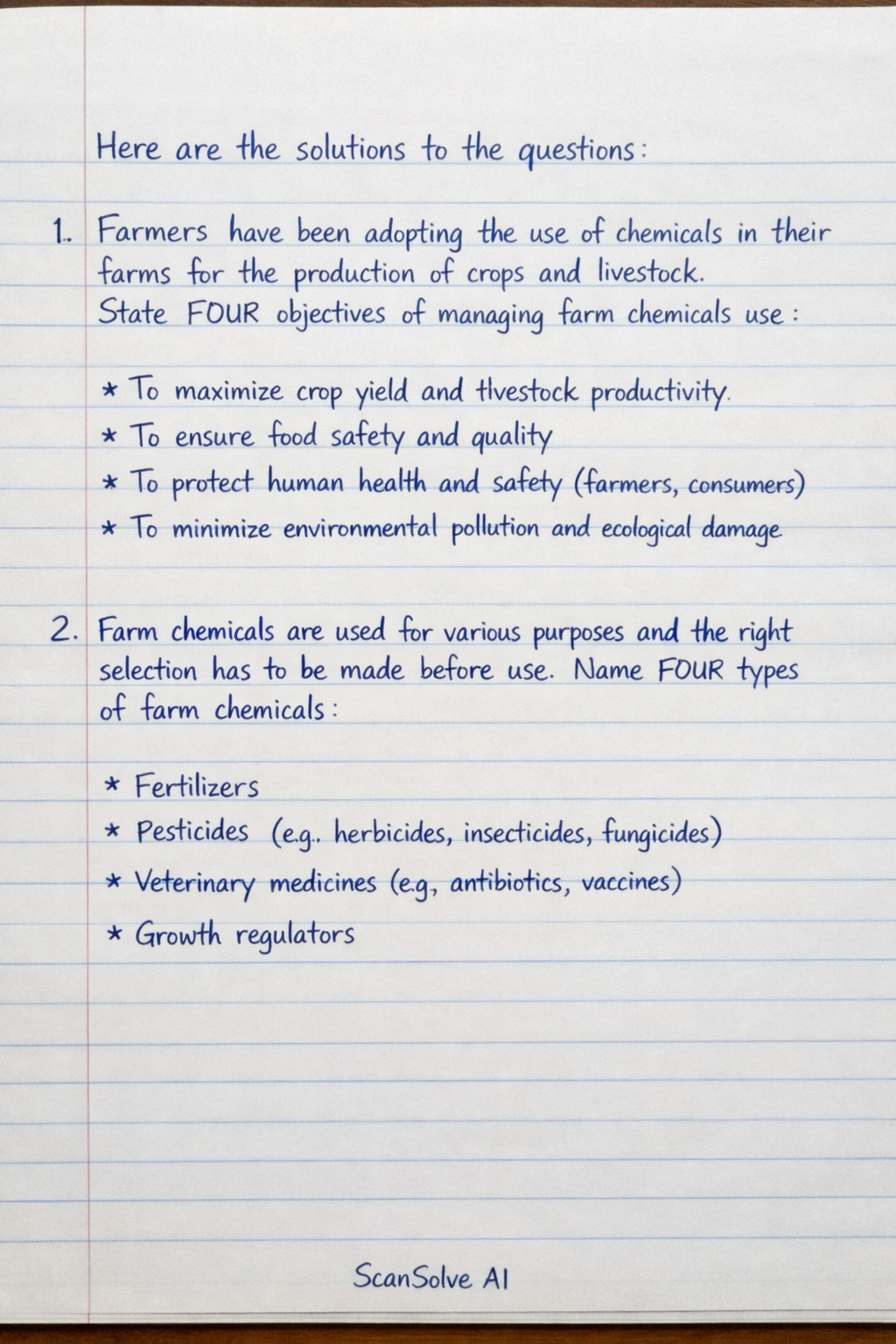
Farmers have been adopting the use of chemicals in their farms for the production of crops and livestock. State FOUR objectives of managing farm chemicals use.
ScanSolve AI Answer
Here are the solutions to the questions:
-
Farmers have been adopting the use of chemicals in their farms for the production of crops and livestock. State FOUR objectives of managing farm chemicals use.
- To maximize crop yield and livestock productivity
- To ensure food safety and quality
- To protect human health and safety (farmers, consumers)
- To minimize environmental pollution and ecological damage
-
Farm chemicals are used for various purposes and the right selection has to be made before use. Name FOUR types of farm chemicals.
- Fertilizers
- Pesticides (e.g., herbicides, insecticides, fungicides)
- Veterinary medicines (e.g., antibiotics, vaccines)
- Growth regulators
-
Farm chemical handlers, consumers and even the environment are exposed to risks. List FOUR risk factors associated with the use of farm chemicals.
- Direct exposure to chemicals (e.g., during mixing, application) leading to poisoning or skin irritation.
- Contamination of food and water sources affecting consumers and wildlife.
- Improper storage and disposal leading to environmental pollution.
- Development of pest resistance requiring higher doses or stronger chemicals.
-
When handling farm chemicals precautions must be taken and management strategies must be instituted to reduce risks levels. Identify FOUR risk management strategies that can be used when handling farm chemicals.
- Using appropriate Personal Protective Equipment (PPE).
- Providing comprehensive training on safe handling, storage, and application.
- Implementing Integrated Pest Management (IPM) to reduce chemical reliance.
- Ensuring proper ventilation in storage areas and during application.
-
Farm chemical application is an activity carried out regularly in... (The question is incomplete, but based on common farming practices, here are contexts where farm chemical application is carried out regularly):
- Crop fields for pest, disease, and weed control.
- Orchards and vineyards for fruit protection and nutrient management.
- Greenhouses for controlled environment pest and disease management.
- Livestock facilities for parasite control and sanitation.
Still stuck on this one?
Ask a follow-up, and the answer starts from this question.
More Economics Questions
Handwritten Step-by-Step Solution
Get this as a handwritten image on WhatsApp — like a tutor wrote it for you.
Try on WhatsApp