
We read your photo as:
Answer any 3 of the following 5 questions. Each question is rated 20 marks.
ScanSolve AI Answer
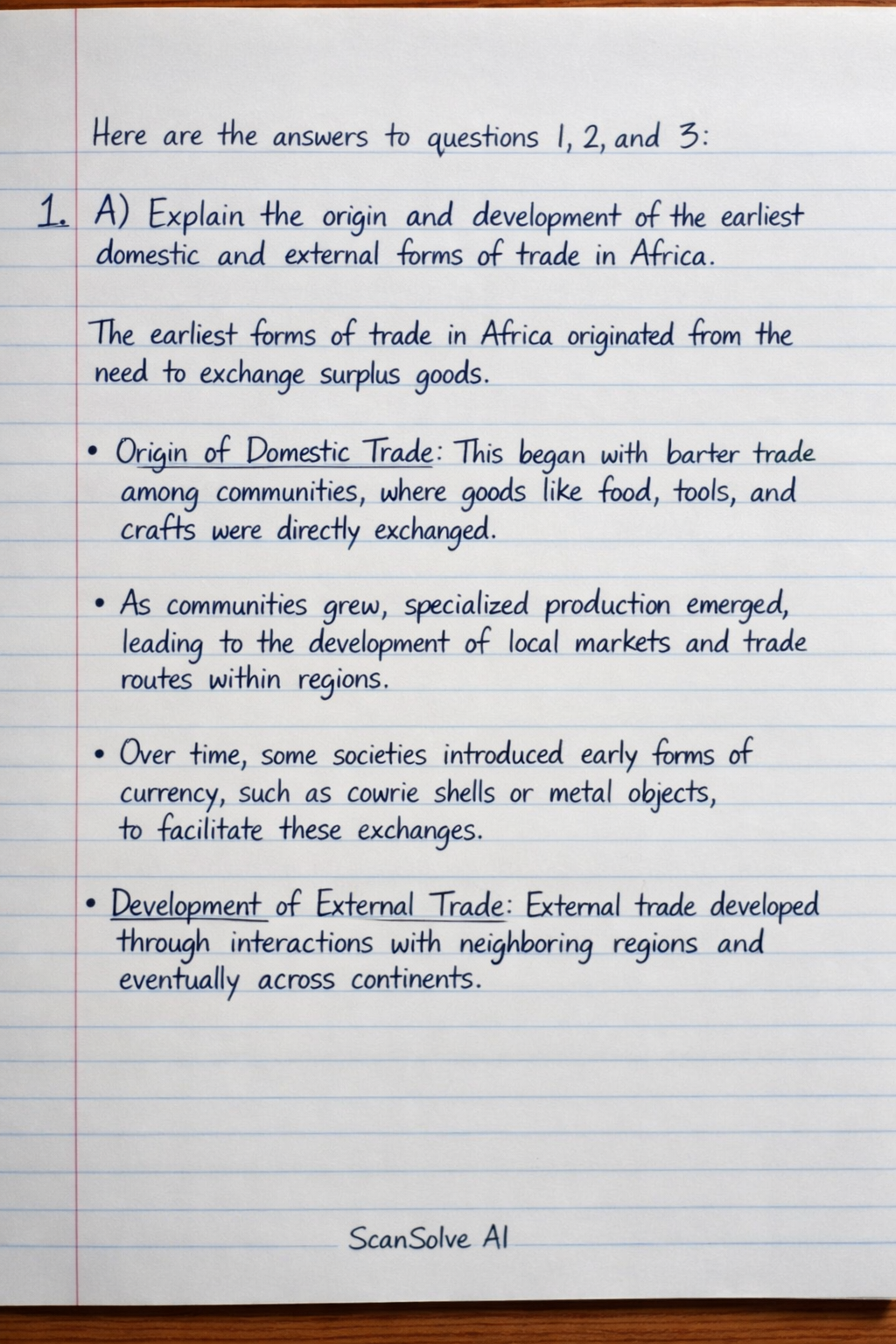
Here are the answers to questions 1, 2, and 3:
1. A) Explain the origin and development of the earliest domestic and external forms of trade in Africa.
The earliest forms of trade in Africa originated from the need to exchange surplus goods.
- Origin of Domestic Trade: This began with barter trade among communities, where goods like food, tools, and crafts were directly exchanged. As communities grew, specialized production emerged, leading to the development of local markets and trade routes within regions. Over time, some societies introduced early forms of currency, such as cowrie shells or metal objects, to facilitate these exchanges.
- Development of External Trade: External trade developed through interactions with neighboring regions and eventually across continents.
- The Trans-Saharan Trade was one of the earliest major external trade networks, connecting West Africa with North Africa and the Mediterranean. It involved the exchange of gold, salt, kola nuts, and slaves from West Africa for goods like textiles, beads, and manufactured items from North Africa and beyond.
- The Indian Ocean Trade connected East African coastal cities with Arabia, Persia, India, and Southeast Asia. This trade involved goods such as gold, ivory, timber, and slaves from Africa, exchanged for spices, textiles, and pottery.
- Later, European coastal trade emerged, initially focused on gold and other resources, but tragically evolving into the transatlantic slave trade.
B) Discuss three ways these trade systems shaped the development of African kingdoms.
These trade systems profoundly shaped African kingdoms in several ways:
- Wealth Accumulation and Economic Power: Kingdoms that controlled key trade routes or valuable resources (like gold or salt mines) accumulated immense wealth through taxes, tolls, and direct trade. This wealth allowed them to build powerful armies, construct impressive cities, and support a ruling elite, leading to the rise of empires such as Ghana, Mali, and Songhai in West Africa, and city-states like Kilwa and Great Zimbabwe in East and Southern Africa.
- Political Centralization and Expansion: The control over trade often led to political centralization. Rulers consolidated power to protect trade routes, enforce laws, and manage resources. This often resulted in the expansion of territories as kingdoms sought to control more trade networks and resource-rich areas, leading to the formation of larger, more complex political structures.
- Cultural Exchange and Urbanization: Trade facilitated significant cultural exchange. The Trans-Saharan trade, for instance, led to the widespread adoption of Islam in West Africa, influencing law, education, architecture, and governance. Similarly, the Indian Ocean trade brought Islamic and Asian cultural influences to East Africa. Trade centers grew into vibrant urban hubs, attracting diverse populations and fostering the exchange of ideas, technologies, and languages.
2. A) Explain three importance of entrepreneurship to personal development.
Entrepreneurship offers significant benefits for personal development:
- Development of Problem-Solving and Decision-Making Skills: Entrepreneurs constantly face challenges, from market fluctuations to operational hurdles. Navigating these requires critical thinking, creativity, and the ability to make timely and effective decisions, which sharpens their problem-solving and decision-making capabilities.
- Enhanced Self-Reliance and Resilience: Starting and running a business demands a high degree of self-reliance, as entrepreneurs are often solely responsible for their venture's success or failure. This process builds resilience, teaching individuals to learn from setbacks, adapt to change, and persevere through difficulties, fostering a strong sense of personal agency.
- Cultivation of Leadership and Communication Skills: As businesses grow, entrepreneurs often need to lead teams, motivate employees, and communicate their vision to stakeholders, investors, and customers. This experience hones their leadership qualities, public speaking abilities, and interpersonal communication skills, which are valuable in all aspects of life.
B) Compare three similarities and differences between self-employment and entrepreneurship in the context of Ghana's economic development.
Similarities:
- Independence and Autonomy: Both self-employed individuals and entrepreneurs operate independently, making their own decisions regarding their work, hours, and business direction, rather than working for an employer.
- Risk-Taking: Both assume financial and operational risks. They invest their own time and resources, and their income is directly tied to the success of their ventures, bearing the full responsibility for profits and losses.
- Income Generation: Both aim to generate income and create a livelihood for themselves. In Ghana, both contribute to reducing unemployment by creating their own jobs.
Differences:
- Growth and Innovation Focus: Entrepreneurs typically focus on innovation, growth, and scaling their ventures, often seeking to disrupt markets or create new ones. They aim to build large, sustainable businesses that can expand nationally or internationally. Self-employed individuals, in contrast, often focus on maintaining their current operation to provide a steady income, with less emphasis on significant growth or groundbreaking innovation.
- Job Creation Potential: Entrepreneurs are often job creators, building teams and employing others as their businesses expand. Their ventures contribute significantly to formal employment and economic diversification. Self-employed individuals primarily create a job for themselves, though they might occasionally hire a few assistants, their primary goal is not large-scale job creation.
- Impact on Economic Development (Ghana Context): Entrepreneurship, with its focus on innovation and growth, drives structural transformation, industrialization, and significant economic diversification in Ghana, leading to new industries and large-scale employment. Self-employment, while crucial for livelihoods and poverty reduction, primarily supports the informal sector and provides basic services, contributing to economic stability at a more localized and smaller scale.
3. A) Examine five types of consumer rights and explain the importance of consumer protection in Ghana.
Here are five types of consumer rights:
- Right to Safety: Consumers have the right to be protected against products, production processes, and services that are hazardous to health or life.
- Right to Information: Consumers have the right to be given accurate, adequate, and clear information about products and services to make informed choices. This includes details on price, quality, ingredients, and potential risks.
- Right to Choose: Consumers have the right to access a variety of products and services at competitive prices, ensuring they are not forced into monopolies or limited options.
- Right to be Heard: Consumers have the right to express their interests and concerns, and to have these considered in the formulation and execution of government policy and in the development of products and services.
- Right to Redress: Consumers have the right to receive fair settlement of just claims, including compensation for misrepresentation, shoddy goods, or unsatisfactory services.
Importance of Consumer Protection in Ghana:
Consumer protection is crucial in Ghana for several reasons:
- Prevents Exploitation: It safeguards consumers from unfair trade practices, misleading advertising, price gouging, and fraudulent activities by businesses, ensuring they get fair value for their money.
- Ensures Health and Safety: By setting standards for product quality and safety, consumer protection laws prevent the sale of hazardous or substandard goods, thereby protecting public health and well-being.
- Promotes Fair Competition: It creates a level playing field for businesses by preventing anti-competitive practices, which ultimately benefits consumers through better quality products and services at competitive prices.
- Builds Consumer Confidence: When consumers know their rights are protected and there are avenues for redress, they are more confident in participating in the market, which stimulates economic activity and growth.
- Supports Economic Development: A robust consumer protection framework fosters a trustworthy market environment, attracting both local and foreign investment, and contributing to sustainable economic development.
B) Discuss four ways consumers can be protected through existing laws and institutions.
Consumers in Ghana are protected through various existing laws and institutions:
- Consumer Protection Act (e.g., Act 995 of 2019): This overarching law provides a legal framework that defines consumer rights, prohibits unfair trade practices, and outlines mechanisms for redress. It empowers consumers to seek compensation for damages caused by defective products or misleading information, and imposes penalties on businesses that violate consumer rights.
- Regulatory Bodies and Agencies: Institutions like the Ghana Standards Authority (GSA) ensure that products meet specified quality and safety standards before they are sold to consumers. The Food and Drugs Authority (FDA) regulates food, drugs, cosmetics, and medical devices, ensuring their safety and efficacy. These bodies conduct inspections, issue certifications, and can recall unsafe products from the market.
- Judicial System and Alternative Dispute Resolution (ADR): Consumers can seek legal redress through the courts for breaches of contract, product liability, or other consumer-related disputes. Additionally, ADR mechanisms, such as mediation and arbitration, offer less formal and often quicker ways to resolve disputes between consumers and businesses without resorting to lengthy court processes.
- Consumer Advocacy Groups and NGOs: Various non-governmental organizations and consumer associations actively advocate for consumer rights. They educate consumers about their rights, provide advice, mediate disputes, and lobby the government for stronger consumer protection policies. These groups play a vital role in empowering consumers and holding businesses accountable.
Still stuck on this one?
Ask a follow-up, and the answer starts from this question.
More Economics Questions
Handwritten Step-by-Step Solution
Get this as a handwritten image on WhatsApp — like a tutor wrote it for you.
Try on WhatsApp