
We read your photo as:
Answer three questions from this part. All questions carry equal marks.
ScanSolve AI Answer
Step-by-step solution
4 steps8. (a) (i) The law of conservation of linear momentum states that for an isolated system, the total linear momentum remains constant in the absence of external forces.
8. (a) (ii)
Given:
Mass of ball 1,
Initial velocity of ball 1,
Mass of ball 2,
Initial velocity of ball 2, (stationary)
The collision is perfectly elastic.
Apply the principle of conservation of linear momentum.
The total momentum before collision equals the total momentum after collision.
Substitute the given values:
Apply the principle for a perfectly elastic collision using relative velocities.
For a perfectly elastic collision, the relative speed of approach equals the relative speed of separation:
Substitute the given values:
Solve the system of equations.
From equation , express in terms of :
Substitute this expression for into equation :
Calculate using the value of .
The velocities of the balls after collision are:
Velocity of the first ball:
Velocity of the second ball:
Still stuck on this one?
Ask a follow-up, and the answer starts from this question.
More Physics Questions
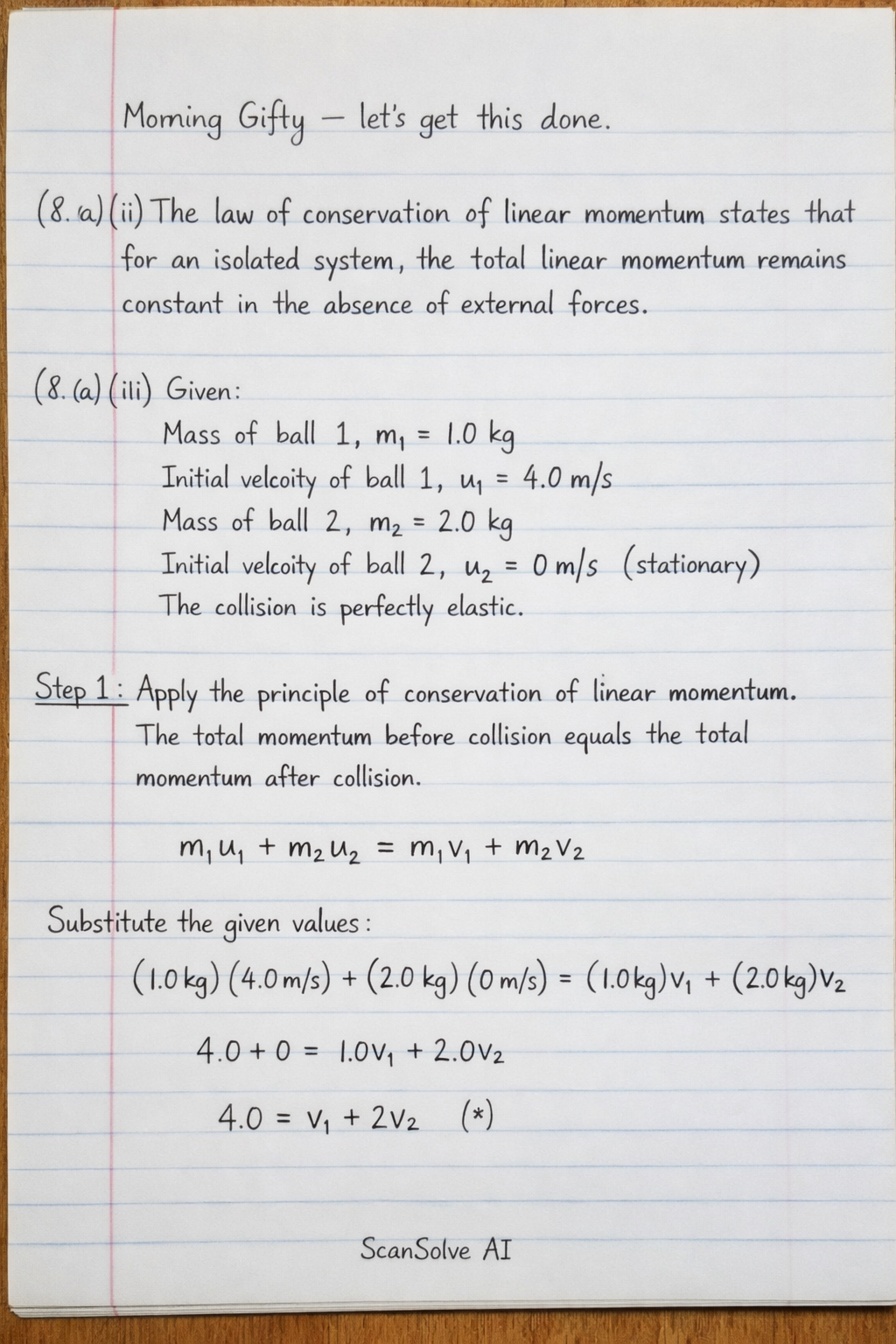
Handwritten Step-by-Step Solution
Get this as a handwritten image on WhatsApp — like a tutor wrote it for you.
Try on WhatsApp