
We read your photo as:
Answer eight questions in all; five questions from Part I and three questions from Part II. PART 1 [15 marks] Answer any five questions from this part. All questions carry equal marks.
Physics
ScanSolve AI Answer
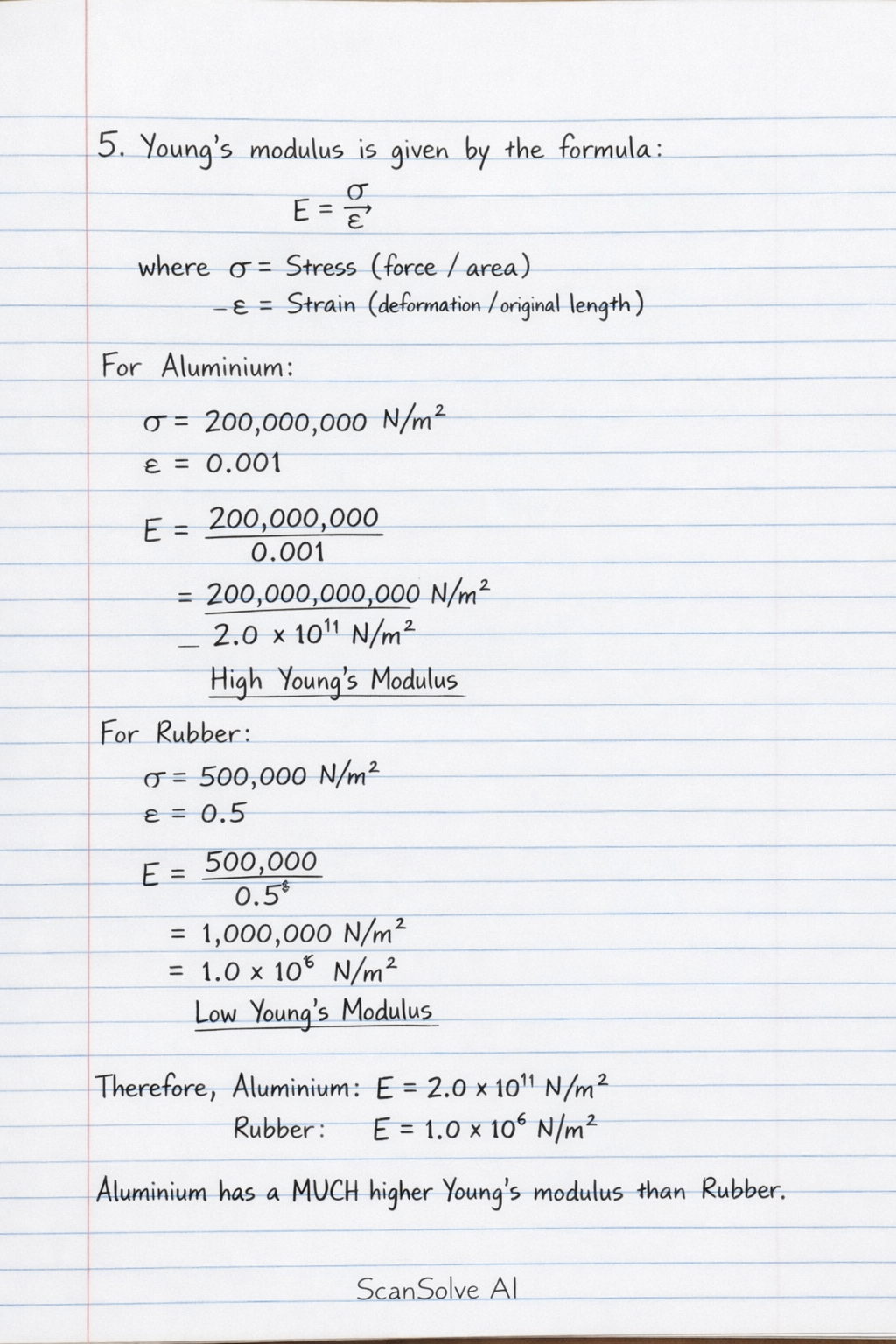
5. Young's modulus is a measure of a material's stiffness or resistance to elastic deformation. A higher Young's modulus indicates a stiffer material.
- Aluminium is a metal with a crystalline structure and strong metallic bonds between its atoms. These bonds require a large amount of force (stress) to stretch or deform them, resulting in very little strain. This makes aluminium very stiff and gives it a high Young's modulus.
- Rubber, on the other hand, is an elastomer composed of long, coiled polymer chains held together by relatively weak intermolecular forces. These chains can easily uncoil and stretch under stress, leading to a large amount of strain for a given stress. This makes rubber highly elastic and gives it a much lower Young's modulus compared to aluminium.
Was this helpful?
Still stuck on this one?
Ask a follow-up, and the answer starts from this question.
Got a different question?Ask your own question
More Physics Questions
QAnswer six questions from this part: Question 1 and any other five. Question 1 carries 5 marks while…QAnswer three questions from this part. All questions carry equal marks.QAnswer any FOUR questions in all. All questions carry 25 marks each.QANSWER ALL QUESTIONS IN SECTION ONE AND TWO Section one-short answer questions- 40 marks Section…QAnswer any SIX questions from this paper. Each question carries 20 marks.
Handwritten Step-by-Step Solution
Get this as a handwritten image on WhatsApp — like a tutor wrote it for you.
Try on WhatsApp