
We read your photo as:
Answer any FOUR questions in all. All questions carry 25 marks each.
ScanSolve AI Answer
Step-by-step solution
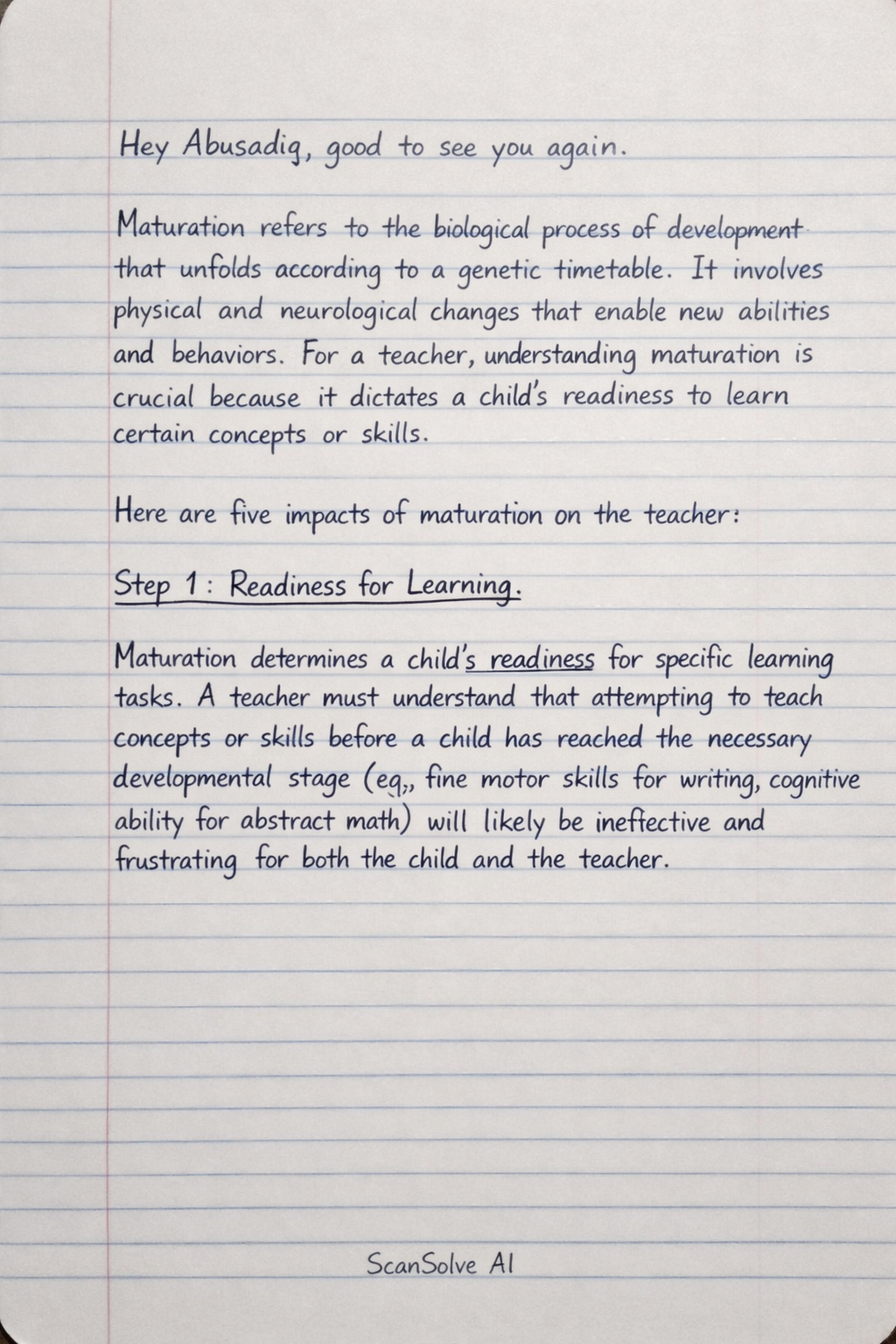
5 stepsMaturation refers to the biological process of development that unfolds according to a genetic timetable. It involves physical and neurological changes that enable new abilities and behaviors. For a teacher, understanding maturation is crucial because it dictates a child's readiness to learn certain concepts or skills.
Here are five impacts of maturation on the teacher:
Readiness for Learning
Maturation determines a child's readiness for specific learning tasks. A teacher must understand that attempting to teach concepts or skills before a child has reached the necessary developmental stage (e.g., fine motor skills for writing, cognitive ability for abstract math) will likely be ineffective and frustrating for both the child and the teacher.
Curriculum Design and Pacing
Teachers need to design and pace their curriculum in alignment with the typical maturational stages of their students. For example, teaching complex problem-solving to preschoolers who are still in the preoperational stage of cognitive development would be inappropriate. Maturation guides the sequencing of learning experiences from simple to complex.
Individual Differences
While there are general maturational timelines, individual children mature at different rates. A teacher must be aware of these individual differences and avoid a one-size-fits-all approach. Some students may be ready for advanced tasks earlier, while others may need more time and support, requiring differentiated instruction.
Behavior Management and Expectations
Understanding maturation helps teachers set realistic behavioral and academic expectations. For instance, expecting a toddler to sit still for long periods or a young child to have fully developed impulse control is unrealistic given their neurological maturation. Teachers can use this knowledge to implement age-appropriate classroom management techniques.
Assessment and Evaluation
Maturation impacts how teachers assess and evaluate student progress. Assessments should be developmentally appropriate, measuring what a child is capable of demonstrating at their current maturational stage. For example, evaluating a young child's understanding through hands-on activities rather than solely written tests acknowledges their developing cognitive and motor skills.
Still stuck on this one?
Ask a follow-up, and the answer starts from this question.
More Psychology Questions
Handwritten Step-by-Step Solution
Get this as a handwritten image on WhatsApp — like a tutor wrote it for you.
Try on WhatsApp