
We read your photo as:
Answer four questions only. All questions carry equal marks. Credit will be given for clarity of expression and orderly presentation.
ScanSolve AI Answer
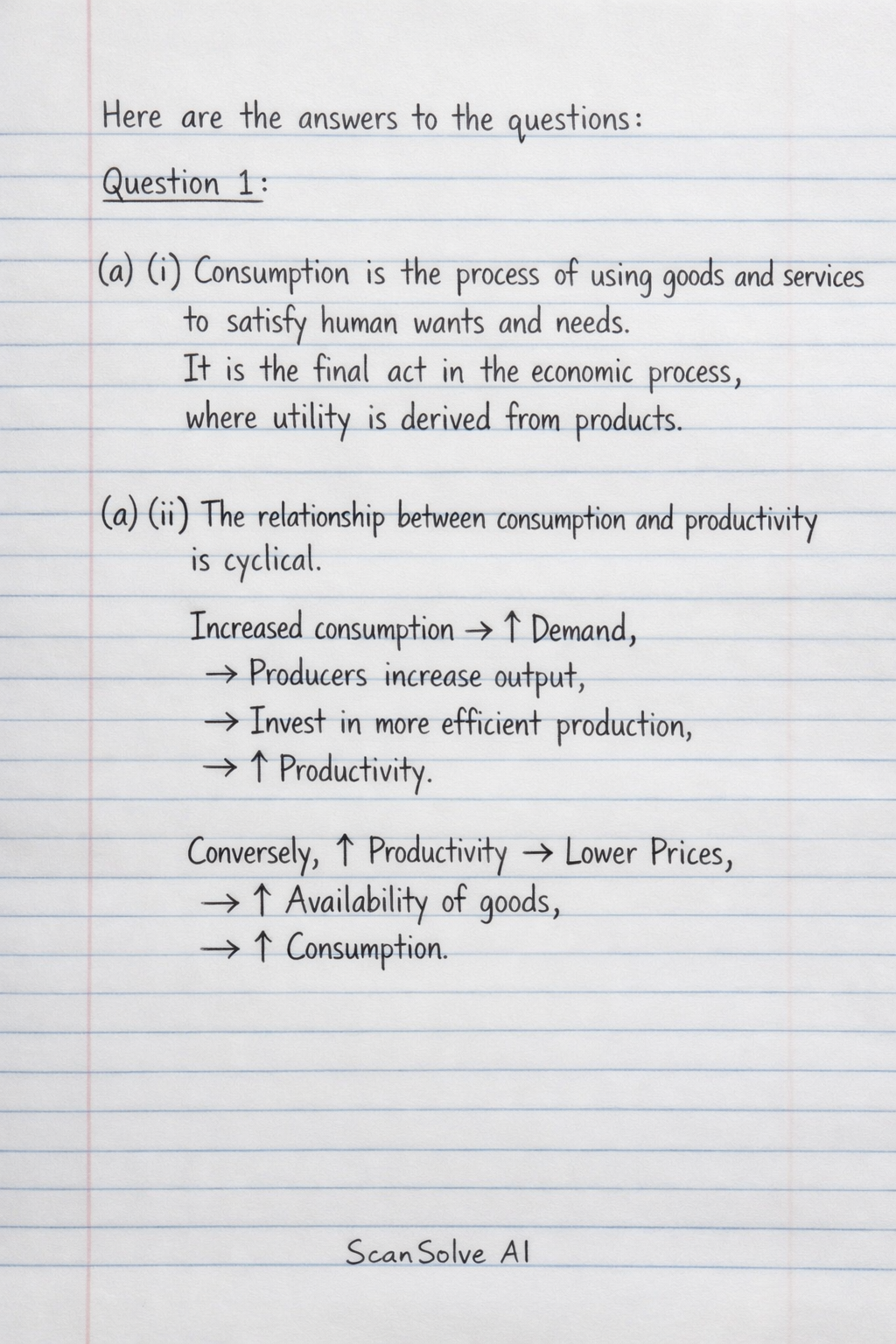
Here are the answers to the questions:
Question 1:
a) (i) Consumption is the process of using goods and services to satisfy human wants and needs. It is the final act in the economic process, where utility is derived from products.
a) (ii) The relationship between consumption and productivity is cyclical. Increased consumption often stimulates demand, which in turn encourages producers to increase output and invest in more efficient production methods, leading to higher productivity. Conversely, higher productivity can lead to lower prices and increased availability of goods, potentially boosting consumption.
b) Three rights of a consumer are:
- The right to safety: Consumers have the right to be protected against products, production processes, and services that are hazardous to health or life.
- The right to be informed: Consumers have the right to be given facts needed to make an informed choice and to be protected against dishonest or misleading advertising and labeling.
- The right to choose: Consumers have the right to choose from a range of products and services offered at competitive prices with an assurance of satisfactory quality.
c) Three sources of consumer information are:
- Advertising and product labels: These provide details about product features, ingredients, and usage instructions.
- Consumer organizations and reviews: Independent bodies or online platforms offer unbiased product testing, comparisons, and user feedback.
- Sales personnel and experts: Store employees or specialists can provide direct information, demonstrations, and advice on products and services.
d) Five complaints usually made by consumers are:
- Defective or faulty products: Goods that do not work as intended or break down prematurely.
- Misleading advertising: Claims about products or services that are untrue or exaggerated.
- Poor customer service: Unhelpful, rude, or unresponsive staff when seeking assistance or making complaints.
- Overcharging or hidden fees: Being charged more than expected or encountering undisclosed costs.
- Unsatisfactory repairs or services: Services that are not performed correctly or do not resolve the original issue.
Question 2:
a) Three aims of Home Improvement are:
- To enhance comfort and convenience: Making the living space more pleasant and easier to use for residents.
- To increase property value: Upgrading features and aesthetics can boost the market worth of a home.
- To improve safety and functionality: Addressing structural issues, updating systems, and ensuring the home meets modern safety standards.
b) (i) Four practices traditional homemakers do that improve their quality of life:
- Meal preparation: Cooking nutritious meals from scratch ensures healthy eating and saves money.
- Home organization: Maintaining a tidy and organized living space reduces stress and improves efficiency.
- Budget management: Carefully planning household expenses and savings ensures financial stability.
- Childcare and education: Nurturing children's development and assisting with their learning fosters a positive family environment.
b) (ii) A home improvement principle that can be applied to the practice of home organization (from b(i)) is maximising space utilization. This involves using storage solutions like shelves, cabinets, and multi-functional furniture to keep the home clutter-free and efficient.
c) One way by which the aim of home improvement can be achieved for each aspect:
- (i) decoration: Repainting walls with fresh colors can instantly brighten a room and change its ambiance.
- (ii) storage: Installing built-in shelves or custom cabinetry can create dedicated spaces for items, reducing clutter and improving organization.
Question 3:
a) (i) Savings refers to the portion of income not spent on current consumption. It is money set aside for future use, often deposited in a bank or invested.
a) (ii) Dividends are a distribution of a portion of a company's earnings, decided by the board of directors, to its shareholders. They can be issued as cash payments, shares of stock, or other property.
b) Four reasons for saving money are:
- Emergency fund: To cover unexpected expenses like medical emergencies or job loss.
- Future goals: To finance significant purchases such as a house, car, or education.
- Retirement: To ensure financial security and maintain a desired lifestyle after leaving the workforce.
- Investment opportunities: To accumulate capital that can be invested to generate further income or wealth.
c) (i) Four advantages of using cheques as a method of payment:
- Security: Cheques reduce the risk of carrying large amounts of cash.
- Record-keeping: Cheque stubs and bank statements provide a clear record of transactions.
- Convenience: They allow for payments to be made without needing exact change or physical presence.
- Proof of payment: A cancelled cheque serves as legal proof that a payment was made.
c) (ii) Three disadvantages of using cheques as a method of payment:
- Processing time: Cheques can take several days to clear, delaying access to funds.
- Risk of fraud: Cheques can be forged or altered, leading to financial losses.
- Bounced cheques: Insufficient funds can lead to fees for both the issuer and the recipient.
d) Two precautions to be taken against forgery in cheque writing:
- Fill in all spaces: Ensure there are no blank spaces where additional figures or words could be added, especially for the amount and payee name.
- Use indelible ink: Write cheques using a pen with ink that cannot be easily erased or altered.
Still stuck on this one?
Ask a follow-up, and the answer starts from this question.
More Economics Questions
Handwritten Step-by-Step Solution
Get this as a handwritten image on WhatsApp — like a tutor wrote it for you.
Try on WhatsApp