
We read your photo as:
A) Analyse four ways of ensuring sustainable use of public finance in Ghana, at the national level, B) Compare or Evaluate three implications of bad and prudent financial decisions on public financial security.
ScanSolve AI Answer
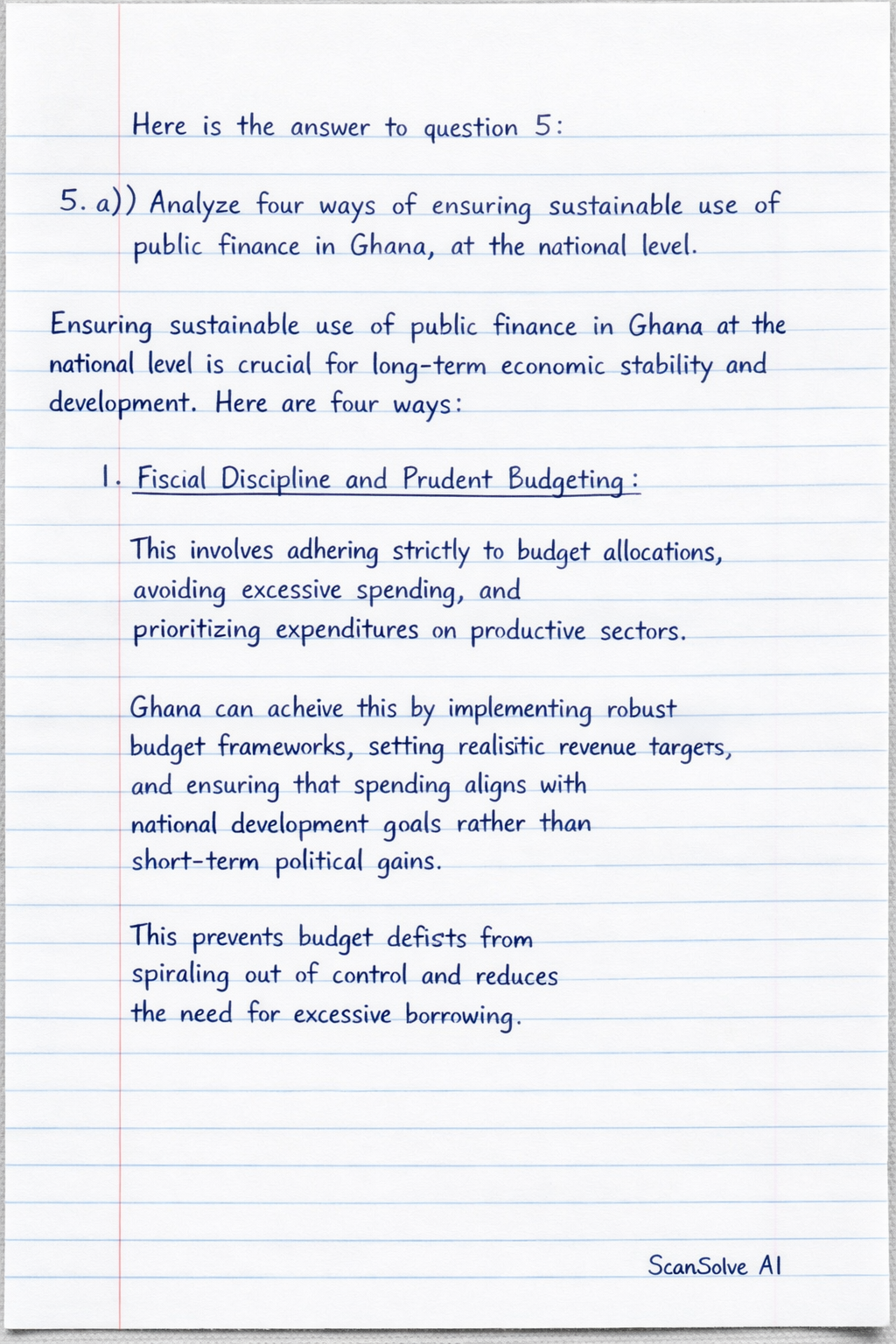
Here is the answer to question 5:
5. A) Analyze four ways of ensuring sustainable use of public finance in Ghana, at the national level.
Ensuring sustainable use of public finance in Ghana at the national level is crucial for long-term economic stability and development. Here are four ways:
- Fiscal Discipline and Prudent Budgeting: This involves adhering strictly to budget allocations, avoiding excessive spending, and prioritizing expenditures on productive sectors. Ghana can achieve this by implementing robust budget frameworks, setting realistic revenue targets, and ensuring that spending aligns with national development goals rather than short-term political gains. This prevents budget deficits from spiraling out of control and reduces the need for excessive borrowing.
- Effective Revenue Mobilization and Diversification: Sustainable public finance requires a strong and diversified revenue base. Ghana needs to enhance its tax collection efficiency, broaden the tax net to include more informal sector activities, and reduce tax exemptions. Diversifying revenue sources beyond traditional commodities (like oil and gold) through promoting other sectors and improving non-tax revenue collection can also provide more stable and predictable income for the government.
- Prudent Debt Management and Sustainability: Managing public debt effectively is paramount. This involves borrowing only for productive investments that generate returns, negotiating favorable loan terms, and ensuring that debt servicing costs do not consume an unsustainable portion of national revenue. Ghana must develop a clear debt strategy, monitor debt levels closely, and prioritize domestic resource mobilization over external borrowing to reduce vulnerability to exchange rate fluctuations and external shocks.
- Transparency, Accountability, and Anti-Corruption Measures: Good governance is fundamental to sustainable public finance. Implementing strong anti-corruption laws, ensuring transparency in public procurement and financial reporting, and holding public officials accountable for the use of public funds can significantly reduce waste and leakage. When public funds are managed transparently and accountably, it builds public trust, encourages compliance, and ensures that resources are directed towards their intended purposes, maximizing their impact.
B) Compare or Evaluate three implications of bad and prudent financial decisions on public financial security.
Public financial security refers to the government's ability to meet its financial obligations, maintain economic stability, and fund essential public services both now and in the future. Bad and prudent financial decisions have contrasting implications for this security.
-
Implication 1: Public Debt and Fiscal Burden
- Bad Financial Decisions: Lead to increased public debt through excessive borrowing, often for non-productive expenditures or to cover recurrent budget deficits. This results in a heavy debt servicing burden, where a significant portion of national revenue is used to pay interest and principal, leaving fewer resources for essential public services like healthcare, education, and infrastructure. This erodes public financial security by making the nation vulnerable to financial crises and limiting future fiscal space.
- Prudent Financial Decisions: Involve borrowing responsibly for productive investments and maintaining fiscal discipline. This leads to reduced public debt or a manageable debt-to-GDP ratio, freeing up national revenue for development. A lower debt burden enhances public financial security by ensuring the government can meet its obligations without compromising future generations' economic well-being.
-
Implication 2: Provision of Public Services and Infrastructure
- Bad Financial Decisions: Often result in underfunding of critical public services and a lack of investment in essential infrastructure. When funds are mismanaged, diverted, or consumed by debt servicing, the quality of education, healthcare, and public utilities deteriorates. This directly impacts citizens' quality of life and hinders long-term economic growth, thereby undermining public financial security.
- Prudent Financial Decisions: Prioritize strategic investments in public services and infrastructure. By allocating resources efficiently and effectively, the government can improve healthcare systems, enhance educational outcomes, and develop robust infrastructure (roads, energy, water). These investments boost productivity, attract private investment, and improve human capital, strengthening the nation's economic foundation and public financial security.
-
Implication 3: Investor Confidence and Economic Stability
- Bad Financial Decisions: Can lead to a loss of investor confidence, both domestic and international. When a government is perceived as fiscally irresponsible, investors become hesitant to invest, leading to capital flight, currency depreciation, and increased borrowing costs. This creates economic instability, making it difficult for businesses to plan and grow, and ultimately jeopardizing public financial security.
- Prudent Financial Decisions: Foster strong investor confidence and promote economic stability. A government that demonstrates fiscal responsibility, transparency, and sound economic policies attracts investment, leading to job creation, economic growth, and a stable currency. This positive environment enhances the nation's creditworthiness, reduces borrowing costs, and strengthens public financial security by creating a resilient and growing economy.
Still stuck on this one?
Ask a follow-up, and the answer starts from this question.
More Economics Questions
Handwritten Step-by-Step Solution
Get this as a handwritten image on WhatsApp — like a tutor wrote it for you.
Try on WhatsApp