
We read your photo as:
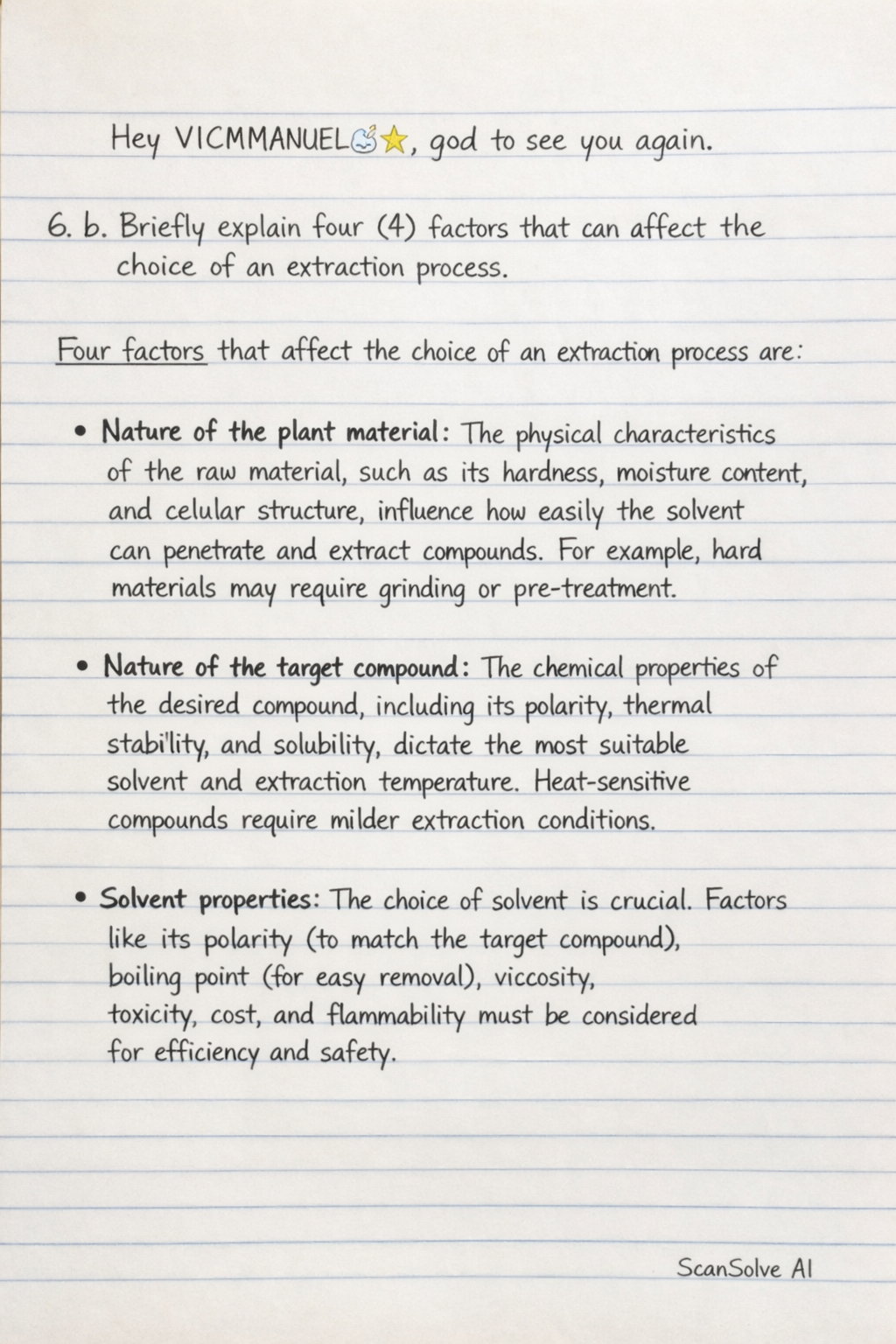
Briefly explain four (4) factors that can affect the choice of an extraction process.
ScanSolve AI Answer
Step-by-step solution
4 steps6. b. Briefly explain four (4) factors that can affect the choice of an extraction process.
Four factors that affect the choice of an extraction process are:
- Nature of the plant material: The physical characteristics of the raw material, such as its hardness, moisture content, and cellular structure, influence how easily the solvent can penetrate and extract compounds. For example, hard materials may require grinding or pre-treatment.
- Nature of the target compound: The chemical properties of the desired compound, including its polarity, thermal stability, and solubility, dictate the most suitable solvent and extraction temperature. Heat-sensitive compounds require milder extraction conditions.
- Solvent properties: The choice of solvent is crucial. Factors like its polarity (to match the target compound), boiling point (for easy removal), viscosity, toxicity, cost, and flammability must be considered for efficiency and safety.
- Scale of operation: The volume of material to be processed (laboratory vs. industrial scale) influences equipment choice and method. Large-scale operations often require continuous or semi-continuous processes like percolation, while small-scale might use Soxhlet extraction.
7. a. Mention five (5) Pharmaceutical applications of centrifugation.
Five pharmaceutical applications of centrifugation are:
- Separation of blood components (e.g., plasma from red blood cells).
- Harvesting microbial cells (bacteria, yeast) from fermentation broths.
- Clarification of liquids by removing suspended particles (e.g., in vaccine production).
- Separation of immiscible liquids, such as in the preparation of emulsions.
- Particle size analysis, where sedimentation rates are used to determine particle size distribution.
7. b. What is the maximum relative centrifugal force applied when starch suspension is sedimented at 2500 rpm in a rotor of maximum sample radius equal to 10 cm?
Identify the given values.
Rotational speed () =
Radius () =Use the formula for Relative Centrifugal Force (RCF).
Where is in cm and is in rpm.
Substitute the values into the formula.
The maximum relative centrifugal force is .
7. c. Determine the centrifugal effect if the rotor is operated at a rotational speed of 650 s⁻¹
Interpret the rotational speed and assume the radius.
"Rotational speed of " is interpreted as 650 revolutions per second (rps).
Convert rps to rpm: $N = 6
Still stuck on this one?
Ask a follow-up, and the answer starts from this question.
More Chemistry Questions
Handwritten Step-by-Step Solution
Get this as a handwritten image on WhatsApp — like a tutor wrote it for you.
Try on WhatsApp