
We read your photo as:
Explain the principle of extraction and list the ideal properties of solvents used in this process.
ScanSolve AI Answer
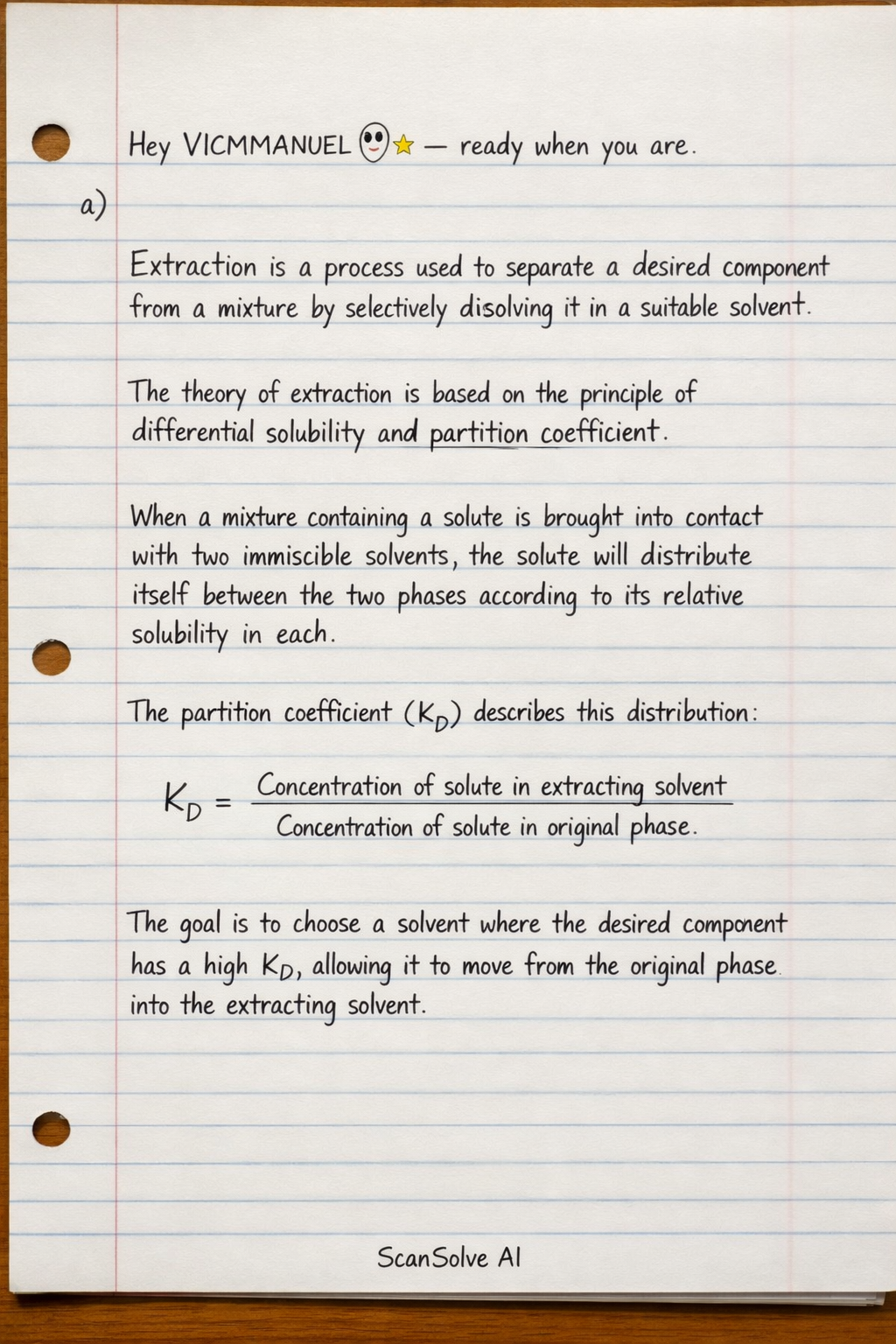
a) Extraction is a process used to separate a desired component from a mixture by selectively dissolving it in a suitable solvent.
The theory of extraction is based on the principle of differential solubility and partition coefficient. When a mixture containing a solute is brought into contact with two immiscible solvents, the solute will distribute itself between the two phases according to its relative solubility in each. The partition coefficient () describes this distribution:
The goal is to choose a solvent where the desired component has a high , allowing it to move from the original phase into the extracting solvent.
b) Ideal properties of solvents used for extraction include:
- High selectivity: The solvent should dissolve only the desired component and not impurities.
- High solvent power: It should dissolve a large quantity of the desired component.
- Low solubility in the original phase: This minimizes solvent loss and contamination of the original mixture.
- Easily separable from the solute: The solvent should be easily removed from the extracted component, often by distillation or evaporation.
- Non-reactive: It should not react chemically with the solute or other components in the mixture.
- Non-toxic and non-flammable: For safety during handling and processing.
- Low cost and readily available: To ensure economic viability of the process.
- Low viscosity and low surface tension: To facilitate good mass transfer and easy separation of phases.
a) Pharmaceutical applications of Filtration as a unit operation include:
- Clarification of liquids: Removing suspended particles from solutions like syrups, elixirs, and parenteral preparations to improve clarity and stability.
- Sterilization of heat-sensitive solutions: Using membrane filters with very small pore sizes (e.g., ) to remove microorganisms from solutions that cannot be heat-sterilized.
- Separation of crystalline products: Isolating solid drug crystals from the mother liquor after crystallization.
- Removal of particulate matter: Ensuring air and gases in cleanrooms are free of particles.
- Recovery of active pharmaceutical ingredients (APIs): Separating APIs from fermentation broths or reaction mixtures.
b) The mechanisms of Filtration include:
- Surface filtration (Screening/Straining): Particles larger than the filter medium's pores are retained on the surface.
- Depth filtration: Particles are trapped within the tortuous channels and pores of a thick filter medium, often through adsorption or impaction.
- Cake filtration: A layer of accumulated solids (filter cake) forms on the filter medium, which then acts as the primary filtering medium, retaining further particles.
- Membrane filtration: Utilizes very fine pores to separate particles based on size exclusion, commonly used for sterile filtration.
a) The principle of Centrifugation is the use of centrifugal force to separate components of a mixture based on differences in their density, size, and shape. When a mixture is spun at high speed, denser or larger particles experience a greater centrifugal force, causing them to move outwards from the axis of rotation and settle at the bottom of the centrifuge tube, while lighter or smaller particles remain closer to the center.
b) Four (4) Pharmaceutical applications of centrifugation are:
- Separation of blood components: For example, separating plasma from red blood cells for diagnostic or therapeutic purposes.
- Harvesting of cells or microorganisms: Isolating bacterial or yeast cells from fermentation broths in biotechnology.
- Clarification of vaccines and serums: Removing particulate matter or cellular debris from biological products.
- Separation of emulsions: Breaking down stable emulsions (e.g., oil-in-water or water-in-oil) into their constituent phases.
Still stuck on this one?
Ask a follow-up, and the answer starts from this question.
More Chemistry Questions
Handwritten Step-by-Step Solution
Get this as a handwritten image on WhatsApp — like a tutor wrote it for you.
Try on WhatsApp