
We read your photo as:
Explain filtration, solvent extraction, and distillation as separation techniques, including their definitions, apparatus, examples, and working principles.
Chemistry
ScanSolve AI Answer
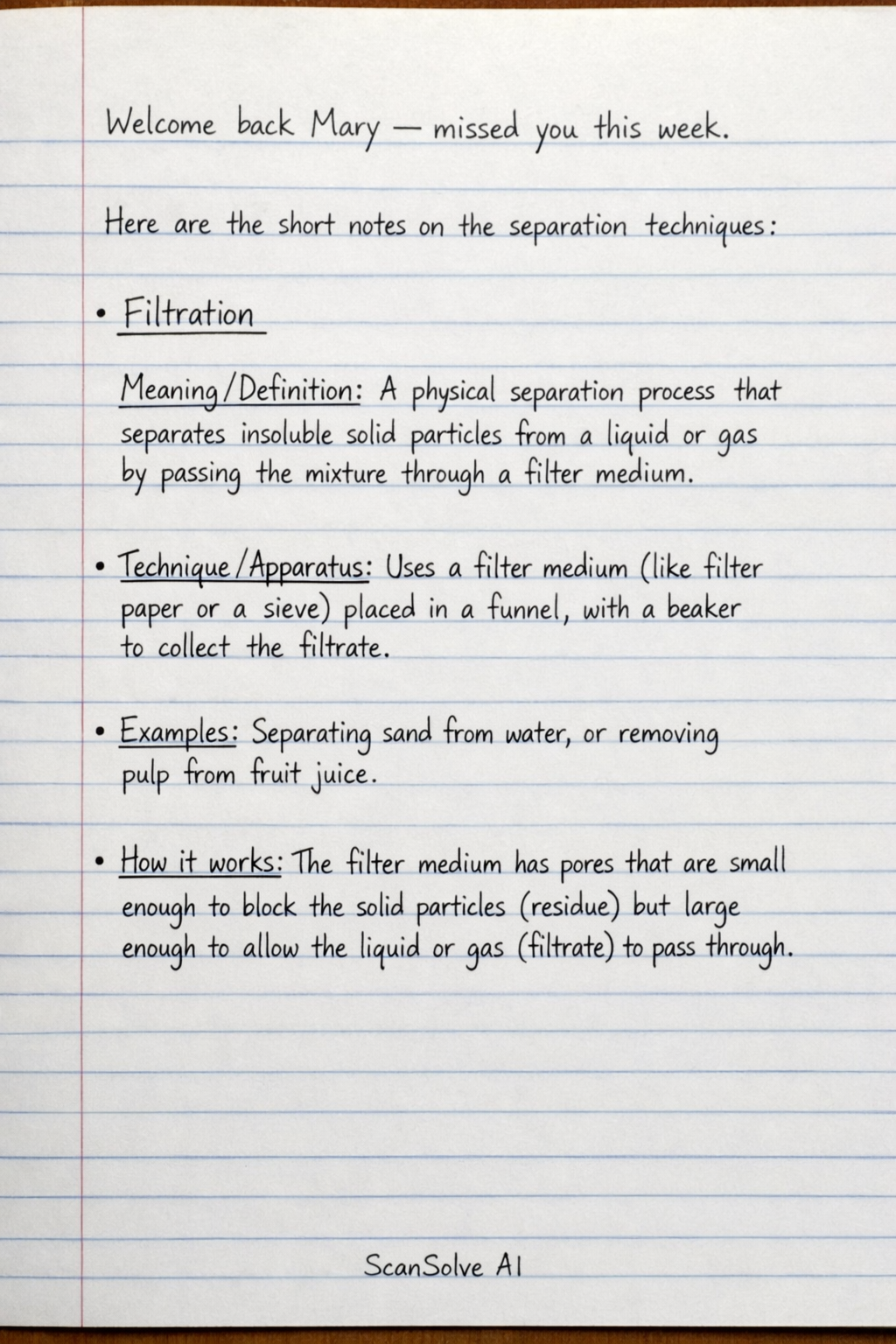
Here are the short notes on the separation techniques:
-
Filtration
- Meaning/Definition: A physical separation process that separates insoluble solid particles from a liquid or gas by passing the mixture through a filter medium.
- Technique/Apparatus: Uses a filter medium (like filter paper or a sieve) placed in a funnel, with a beaker to collect the filtrate.
- Examples: Separating sand from water, or removing pulp from fruit juice.
- How it works: The filter medium has pores that are small enough to block the solid particles (residue) but large enough to allow the liquid or gas (filtrate) to pass through.
-
Solvent Extraction
- Meaning/Definition: A method to separate a component from a mixture by selectively dissolving it in a suitable solvent that is immiscible with the original mixture.
- Technique/Apparatus: Typically performed using a separating funnel, where two immiscible liquid layers are formed and then drained separately.
- Examples: Extracting caffeine from coffee beans, or separating organic compounds from aqueous solutions.
- How it works: The desired substance moves from one solvent phase to another based on its solubility and distribution coefficient between the two immiscible solvents.
-
Distillation
- Meaning/Definition: A process used to separate components of a liquid mixture based on differences in their boiling points, typically to separate a volatile liquid from a non-volatile solid or two liquids with significantly different boiling points.
- Technique/Apparatus: Involves heating the mixture in a distillation flask, vaporizing the more volatile component, condensing the vapor in a condenser, and collecting the purified liquid (distillate) in a receiver.
- Examples: Separating pure water from salt solution, or purifying alcohol.
- How it works: The liquid with the lower boiling point vaporizes first, leaving the less volatile components behind. The vapor is then cooled and condensed back into a liquid, effectively separating it from the original mixture.
-
Fractional Distillation
- Meaning/Definition: A specialized distillation technique used to separate two or more miscible liquids with close but different boiling points.
- Technique/Apparatus: Uses a fractionating column (often packed with glass beads or rings) placed between the distillation flask and the condenser to provide a large surface area for repeated vaporization and condensation cycles.
- Examples: Separating ethanol from water, or refining crude oil into different fractions like gasoline and diesel.
- How it works: As the mixture is heated, vapors rise through the fractionating column. Repeated vaporization and condensation occur at different levels, enriching the vapor with the more volatile component as it moves up the column, leading to better separation.
-
Chromatography
- Meaning/Definition: A laboratory technique for separating a mixture into its components by passing it through a stationary phase, with the components separating based on their differential partitioning between the stationary phase and a mobile phase.
- Technique/Apparatus: Varies by type (e.g., paper chromatography uses paper as the stationary phase and a solvent as the mobile phase; column chromatography uses a packed column).
- Examples: Separating pigments in ink, analyzing drug samples, or purifying proteins.
- How it works: Components of the mixture travel at different speeds through the stationary phase because they have varying affinities for the stationary phase and the mobile phase, causing them to separate.
-
Sublimation
- Meaning/Definition: A separation technique used to separate a solid that sublimes (changes directly from solid to gas without passing through a liquid phase) from a non-subliming solid.
- Technique/Apparatus: The mixture is heated, causing the sublimable solid to vaporize. The vapor is then cooled, often by placing a cold surface (like a watch glass with ice) above the mixture, causing the vapor to deposit back into a solid.
- Examples: Separating iodine from sand, purifying benzoic acid, or separating camphor from salt.
- How it works: When heated, the sublimable solid bypasses the liquid state and turns directly into a gas. This gas then comes into contact with a cold surface, where it cools and changes directly back into a solid, leaving the non-subliming impurities behind.
Was this helpful?
Still stuck on this one?
Ask a follow-up, and the answer starts from this question.
Got a different question?Ask your own question
More Chemistry Questions
QExplain the separation technique of filtration and list other common separation techniques.QDescribe the process of separating immiscible liquids, including examples and the underlying…QDescribe the separation of immiscible liquids using a separating funnel, including examples and the…QDescribe the scientific principles, apparatus, and procedures involved in the separation of mixtures…QProvide methods for separating mixtures and explain the principles behind them.
Handwritten Step-by-Step Solution
Get this as a handwritten image on WhatsApp — like a tutor wrote it for you.
Try on WhatsApp