

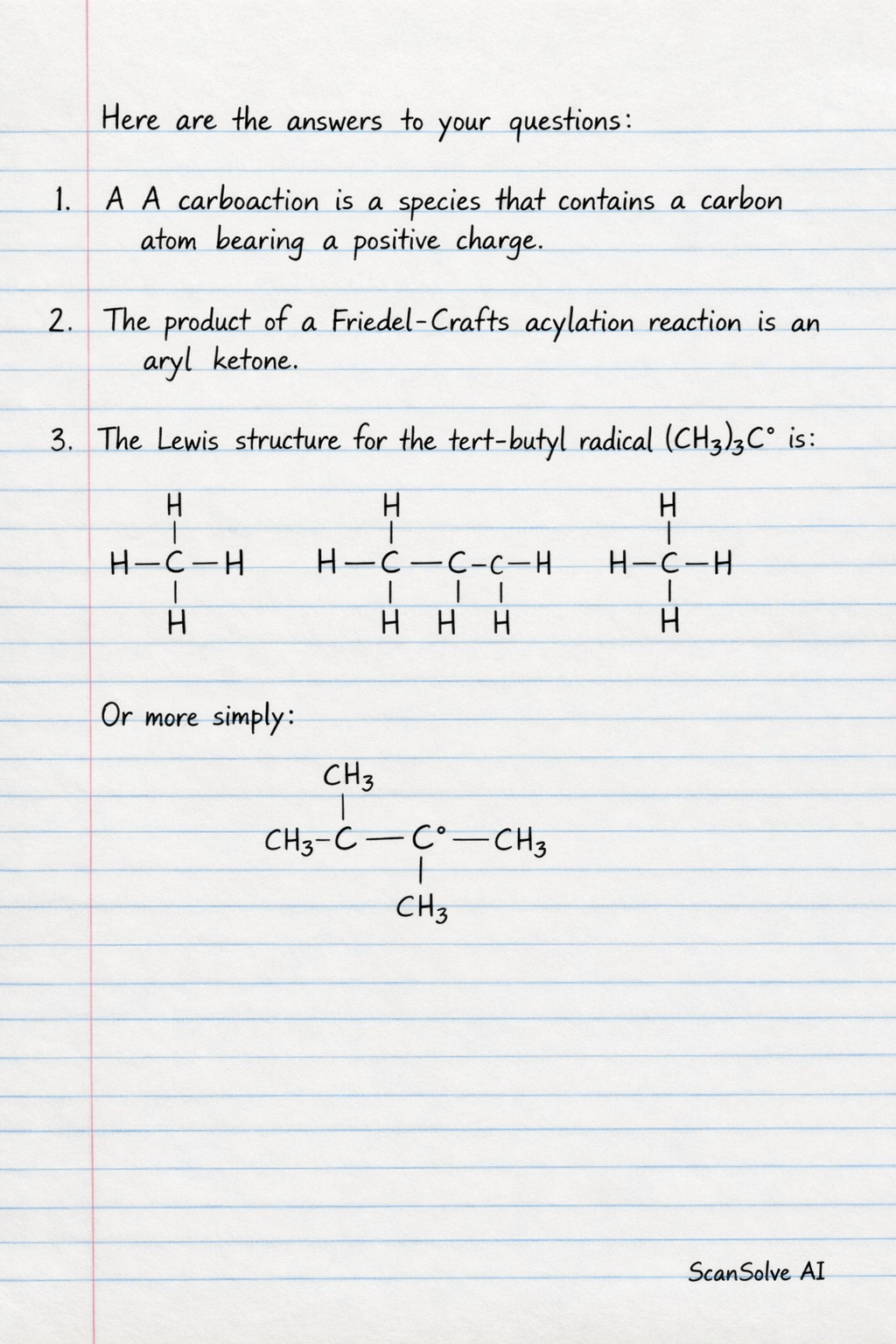
This chemistry question involves key chemical concepts and calculations. The detailed solution below walks through each step, from identifying the reaction type to computing the final answer.
ScanSolve AI Answer
Here are the answers to your questions: 1. A carbocation is a species that contains a carbon atom bearing a positive charge. 2. The product of a Friedel-Crafts acylation reaction is an aryl ketone. 3. The Lewis structure for the tert-butyl radical (CH₃)₃C• is: c H \\ | \\ H-C-H \\ | \\ H \\ c H \\ | \\ H-C-C·-C-H \\ | | | \\ H H H \\ c H \\ | \\ H-C-H \\ | \\ H \\ Or more simply, showing the central carbon with the radical: c CH_3 \\ | \\ CH_3-C· \\ | \\ CH_3 \\ 4. • Heterolysis (or heterolytic cleavage) is the unsymmetrical breaking of a covalent bond, where both bonding electrons remain with one of the fragments, forming a cation and an anion. • Homolysis (or homolytic cleavage) is the symmetrical breaking of a covalent bond, where each fragment retains one of the bonding electrons, forming two radicals. 5. A carbanion has a trivalent carbon atom that bears a negative charge and an unshared pair of electrons. 6. Markovnikov's Rule states that in the electrophilic addition of HX (where X is a halogen) to an unsymmetrical alkene, the hydrogen atom adds to the carbon atom of the double bond that already has the greater number of hydrogen atoms, while the halogen adds to the carbon atom with fewer hydrogen atoms. This results in the formation of the more stable carbocation intermediate. 7. a) (CH₃)₂CHCH₃ (2-methylpropane) The hydrogens on the two terminal CH₃ groups are primary (1°). The hydrogens on the central CH group are tertiary (3°). The hydrogens on the other CH₃ group are primary (1°). b) (CH₃)₃CCH₂CH₃ (2,2-dimethylbutane) The hydrogens on the three CH₃ groups attached to C2 are primary (1°). The hydrogens on the CH₂ group (C3) are secondary (2°). The hydrogens on the terminal CH₃ group (C4) are primary (1°). 8. The reaction of methylcyclopentane with bromine under irradiation with hv (light) is a free radical halogenation. Bromine will substitute a hydrogen on the most stable radical intermediate. The most stable radical is formed at the tertiary carbon (the one bonded to the methyl group). The product is 1-bromo-1-methylcyclopentane. c CH_3 \\ C_5H_9 \\ + Br_2 h c CH_3 \\ | \\ C_5H_8Br \\ Specifically: Methylcyclopentane + Br_2 h 1-bromo-1-methylcyclopentane The structure of 1-bromo-1-methylcyclopentane: c CH_3 \\ | \\ Br-C \\ / \ \\ CH_2-CH_2 \\ | | \\ CH_2-CH_2 \\ (This is a simplified representation of the cyclopentane ring with a methyl and bromine on the same carbon.) 9. To prepare cyclohexene from cyclohexane: Step 1: Free radical halogenation of cyclohexane to form bromocyclohexane. Cyclohexane + Br_2 h Bromocyclohexane + HBr Step 2: Dehydrohalogenation (elimination reaction) of bromocyclohexane using a strong base (e.g., potassium hydroxide in ethanol) to form cyclohexene. Bromocyclohexane + KOH (alc.) Cyclohexene + KBr + H_2O 10. A nucleophile is a chemical species (an ion or molecule) that donates an electron pair to an electrophile to form a chemical bond. Nucleophiles are typically electron-rich and can be negatively charged or neutral with a lone pair of electrons. 11. The relative stabilities of alkyl radicals from least stable to most stable are: Methyl radical < Primary radical < Secondary radical < Tertiary radical 12. The Fischer projection of (S)-1,2-dibromobutane: The chiral center is C2. c CH_2Br \\ | \\ Br--- H \\ | \\ CH_2CH_3 \\ 13. An asymmetric carbon (also called a chiral carbon) is a carbon atom that is bonded to four different atoms or groups of atoms. 14. The compound is CH₃-CH(Cl)-CH=CH-CH₃. • Asymmetric centers: There is one asymmetric (chiral) center, which is the carbon atom bonded to the chlorine atom (C2). • Stereoisomers: The chiral center (C2) can exist in R or S configurations (2 possibilities). The double bond between C3 and C4 can exhibit cis/trans isomerism because both C3 and C4 are bonded to two different groups (H and the rest of the chain/methyl group) (2 possibilities). Therefore, the total number of stereoisomers is 2 × 2 = 4. 15. The systematic name of the compound is 1,3-dimethylcyclohexene. (The double bond is implicitly between C1 and C2). Section B: Answer All Questions 16. Functional groups are specific groups of atoms within molecules that are responsible for the characteristic chemical reactions of those molecules. They determine the chemical properties and reactivity of organic compounds. 17. Using aldehydes or ketones with a Grignard reagent (R-MgX), primary, secondary, and tertiary alcohols can be synthesized as follows: • Primary (1°) alcohol: React a Grignard reagent with formaldehyde (methanal, HCHO). R-MgX + HCHO R-CH_2O-MgX H_3O^+ R-CH_2OH • Secondary (2°) alcohol: React a Grignard reagent with any aldehyde other than formaldehyde (e.g., ethanal, CH₃CHO). R-MgX + R'-CHO RR'CHO-MgX H_3O^+ RR'CHOH • Tertiary (3°) alcohol: React a Grignard reagent with a ketone (e.g., propanone, CH₃COCH₃). R-MgX + R'-CO-R'' RR'R''CO-MgX H_3O^+ RR'R''COH Send me the next one 📸