
We read your photo as:
Propose a mechanism for the following diazotization coupling reaction and reactions below.
ScanSolve AI Answer
Step-by-step solution
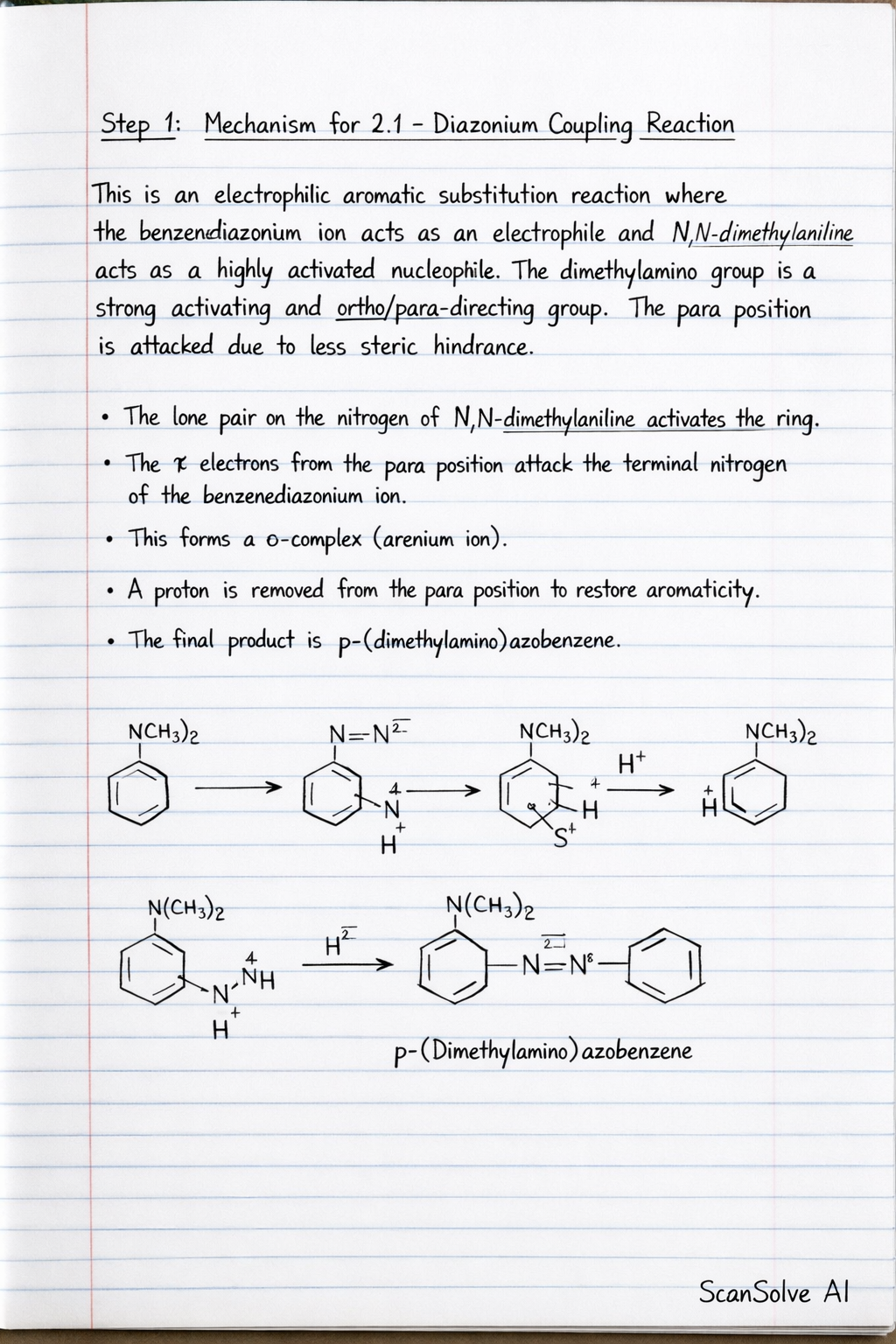
4 stepsMechanism for 2.1 - Diazonium Coupling Reaction
This is an electrophilic aromatic substitution reaction where the benzenediazonium ion acts as an electrophile and -dimethylaniline acts as a highly activated nucleophile. The dimethylamino group is a strong activating and ortho/para-directing group. The para position is attacked due to less steric hindrance.
\begin{center} \includegraphics[width=0.9\textwidth]{2.1_mechanism.png} \end{center}Mechanism for 2.2a - Benzyne Reaction
The reaction conditions ( in ) are characteristic of a benzyne (elimination-addition) mechanism for aryl halides. This mechanism requires an ortho hydrogen atom relative to the leaving group (bromine) for the initial deprotonation step.
Upon examining the given reactant, 2-bromo-1,3-dimethylbenzene, the bromine atom is at position 2. The ortho positions (positions 1 and 3) are both substituted with methyl groups (), meaning there are no hydrogen atoms available at these positions for abstraction by the strong base ().
Therefore, the benzyne mechanism is not possible for the specific reactant shown. The reaction as depicted (direct substitution of bromine by an amino group at the same position) cannot proceed via the expected benzyne pathway under these conditions.
Mechanism for 2.2b - Nucleophilic Aromatic Substitution (SNAr)
This is a nucleophilic aromatic substitution reaction. The chlorine atom is replaced by a methoxy group. The presence of the strong electron-withdrawing nitro () group para to the leaving group (Cl) and the carboxylic acid () group ortho to the leaving group activates the ring towards SNAr.
\begin{center} \includegraphics[width=0.9\textwidth]{2.2b_mechanism.png} \end{center}Mechanism for 2.2c - Diazotization and Hydrolysis
This reaction proceeds in two main parts:
Part 1: Diazotization (formation of the arenediazonium salt)
Nitrous acid () is generated in situ from and . is then protonated and loses water to form the electrophilic nitrosonium ion (). The nitrogen of 3-methylaniline attacks the nitrosonium ion, followed by a series of proton transfers and tautomerization, leading to the formation of the 3-methylbenzenediazonium ion.Part 2: Hydrolysis (replacement of the diazonium group with a hydroxyl group)
When the arenediazonium ion is warmed in the presence of water, the diazonium group () departs as stable nitrogen gas (), forming an aryl cation. Water then acts as a nucleophile, attacking the aryl cation. Subsequent deprotonation yields the 3-methylphenol product.\begin{center} \includegraphics[width=0.9\textwidth]{2.2c_diazotization_part1.png} \end{center}\begin{center} \includegraphics[width=0.9\textwidth]{2.2c_diazotization_part2.png} \end{center}\begin{center} \includegraphics[width=0.9\textwidth]{2.2c_hydrolysis_part1.png} \end{center}\begin{center} \includegraphics[width=0.9\textwidth]{2.2c_hydrolysis_part2.png} \end{center}
Still stuck on this one?
Ask a follow-up, and the answer starts from this question.
More Chemistry Questions
Handwritten Step-by-Step Solution
Get this as a handwritten image on WhatsApp — like a tutor wrote it for you.
Try on WhatsApp