
We read your photo as:
Briefly explain four factors affecting extraction process choice and mention five pharmaceutical applications of centrifugation.
ScanSolve AI Answer
Step-by-step solution
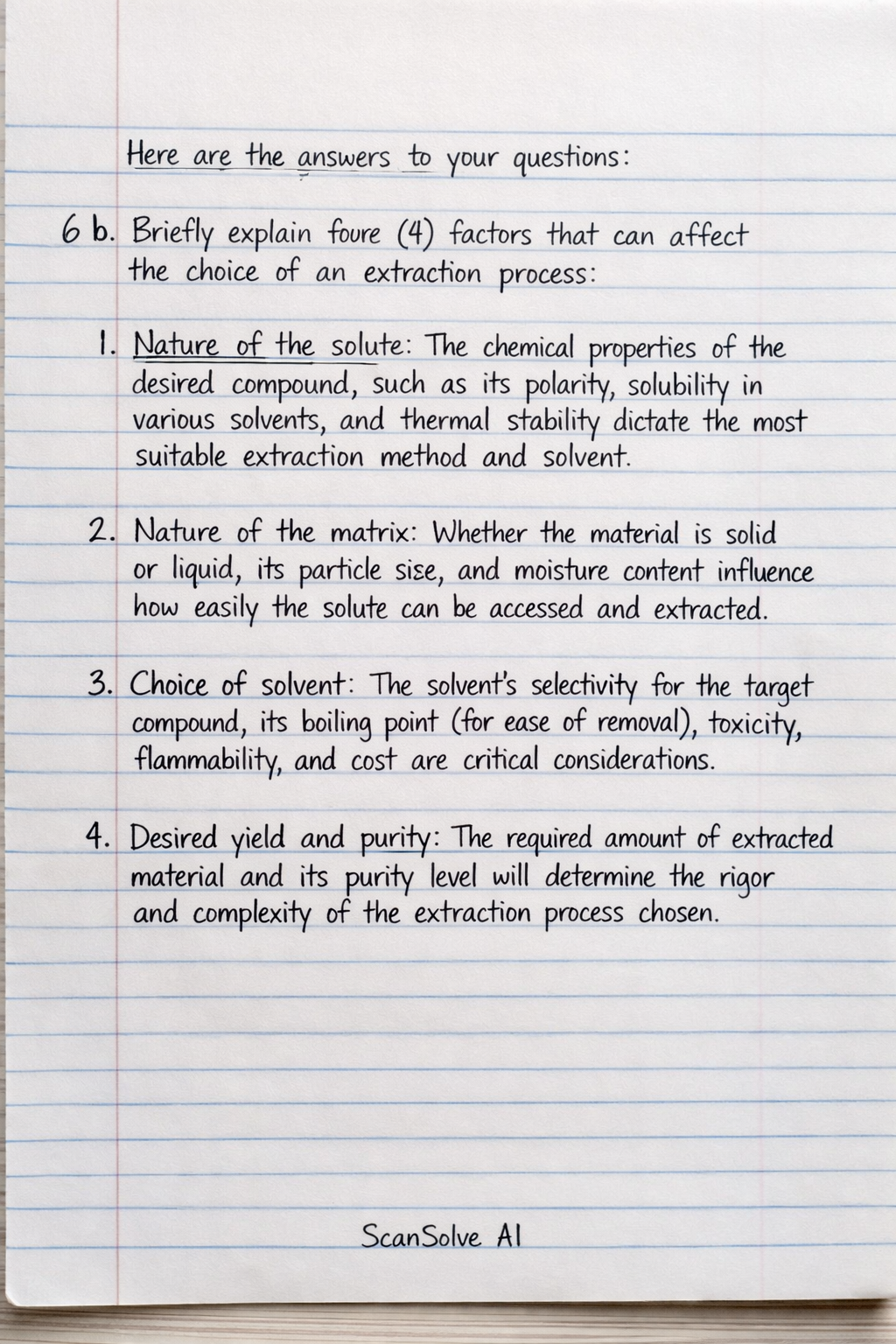
6 stepsHere are the answers to your questions:
6 b. Briefly explain four (4) factors that can affect the choice of an extraction process.
Factors affecting the choice of an extraction process include:
- Nature of the solute: The chemical properties of the desired compound, such as its polarity, solubility in various solvents, and thermal stability, dictate the most suitable extraction method and solvent.
- Nature of the matrix: Whether the material is solid or liquid, its particle size, and moisture content influence how easily the solute can be accessed and extracted.
- Choice of solvent: The solvent's selectivity for the target compound, its boiling point (for ease of removal), toxicity, flammability, and cost are critical considerations.
- Desired yield and purity: The required amount of extracted material and its purity level will determine the rigor and complexity of the extraction process chosen.
7 a. Mention five (5) Pharmaceutical applications of centrifugation.
Five pharmaceutical applications of centrifugation are:
- Separation of blood components (e.g., plasma from red blood cells).
- Harvesting of cells (e.g., bacteria, yeast) from fermentation broths.
- Clarification of fermentation broths or other liquid suspensions.
- Separation of emulsions (e.g., oil-in-water or water-in-oil).
- Concentration of suspensions or precipitates.
7 b. What is the maximum relative centrifugal force applied when starch suspension is sedimented at 2500 rpm in a rotor of maximum sample radius equal to 10 cm?
Use the formula for RCF
where is the radius in cm and is the revolutions per minute.
Substitute the given values
and .
Calculate the RCF.
The maximum relative centrifugal force is .
7 c. Determine the centrifugal effect if the rotor is operated at a rotational speed of 650 s⁻¹
Assuming the rotational speed of refers to the angular velocity in radians per second, and using the same radius from part b.
The acceleration due to gravity .Use the formula for RCF
Substitute the given values
, , and .
Calculate the RCF.
The centrifugal effect is approximately .
8 a. The fluidized bed dryer is a typical example of a dryer used in the pharmaceutical industry. Describe its features and explain how drying is achieved using the fluidized bed dryer.
- Features: A fluidized bed dryer consists of a drying chamber with a perforated bottom plate, a fan to supply hot air, and a filter to prevent particle entrainment. Key features include excellent heat and mass transfer, uniform drying, and the ability to handle heat-sensitive materials due to precise temperature control.
- Drying Mechanism: Wet solid particles are placed on the perforated plate. Hot air is blown upwards through the plate at a velocity sufficient to suspend the particles, causing them to behave like a fluid (fluidization). This creates intimate contact between the hot air and the entire surface of each particle, facilitating rapid heat transfer by convection. The heat causes moisture to evaporate from the particles, and the moist air is then exhausted. The continuous mixing of particles ensures uniform drying.
8 b. Highlight the advantages of the above-mentioned dryer over the tray dryer.
Advantages of a fluidized bed dryer over a tray dryer include:- Faster Drying Rate: Due to high heat and mass transfer coefficients and large surface area contact between the hot air and particles.
- Higher Thermal Efficiency: Better utilization of heat leads to more energy-efficient operation.
- More Uniform Drying: The constant movement and mixing of particles ensure even moisture removal throughout the batch.
- Reduced Labor Costs: Fluidized bed dryers can be automated and operated continuously, requiring less manual intervention.
- Better Temperature Control: Easier to maintain a uniform and precise temperature, which is crucial for heat-sensitive materials.
9. Define the concept of "solute migration" and suggest measures to minimize migration during drying.
- Solute Migration: During the drying process, as water evaporates from the surface of a material, any dissolved solutes (e.g., active pharmaceutical ingredients, salts, sugars) are carried along with the moving water towards the surface. As the water continues to evaporate, these solutes accumulate and concentrate on the material's surface, leading to an uneven distribution within the final dried product. This can result in issues like crust formation, reduced dissolution rates, and non-uniform drug content.
- Measures to minimize migration:
- Rapid Drying: Increasing the drying rate can sometimes reduce the time available for solute movement.
- Pre-treatment (e.g., Freezing): Freezing the material before drying (as in freeze-drying) immobilizes the solutes within the ice matrix, preventing their migration.
- Use of Binders/Excipients: Incorporating excipients that increase the viscosity of the liquid phase or form a solid matrix can physically trap solutes and restrict their movement.
- Microwave/Dielectric Drying: These methods heat the material volumetrically, causing internal evaporation and reducing the driving force for surface migration.
10. Describe the fractional distillation process and how can this be carried out under reduced pressure?
- Fractional Distillation Process: Fractional distillation is a separation technique used to separate components of a liquid mixture that have different boiling points. It involves heating the mixture to produce vapor, which then rises through a fractionating column. The column contains packing material or trays that provide a large surface area for repeated vaporization and condensation cycles. As the vapor ascends, it becomes progressively enriched in the more volatile (lower boiling point) component, while the less volatile component condenses and flows back down. The most volatile component eventually reaches the top of the column, condenses, and is collected as a purified fraction.
- Fractional Distillation under Reduced Pressure: This technique is employed for separating components of mixtures where one or more components have very high boiling points or are thermally unstable and would decompose at their normal boiling temperatures. By reducing the external pressure above the liquid mixture (using a vacuum pump), the boiling points of all components are significantly lowered. This allows the distillation process to occur at much lower temperatures, preventing thermal degradation. The principles of repeated vaporization and condensation in a fractionating column remain the same, but the entire system operates under sub-atmospheric pressure.
Still stuck on this one?
Ask a follow-up, and the answer starts from this question.
More Chemistry Questions
Handwritten Step-by-Step Solution
Get this as a handwritten image on WhatsApp — like a tutor wrote it for you.
Try on WhatsApp