
We read your photo as:
List sub-classes of ciliates with examples, name locomotory organelles, state zoological importance, and list diagnostic features of mastigophorans.
Biology
ScanSolve AI Answer
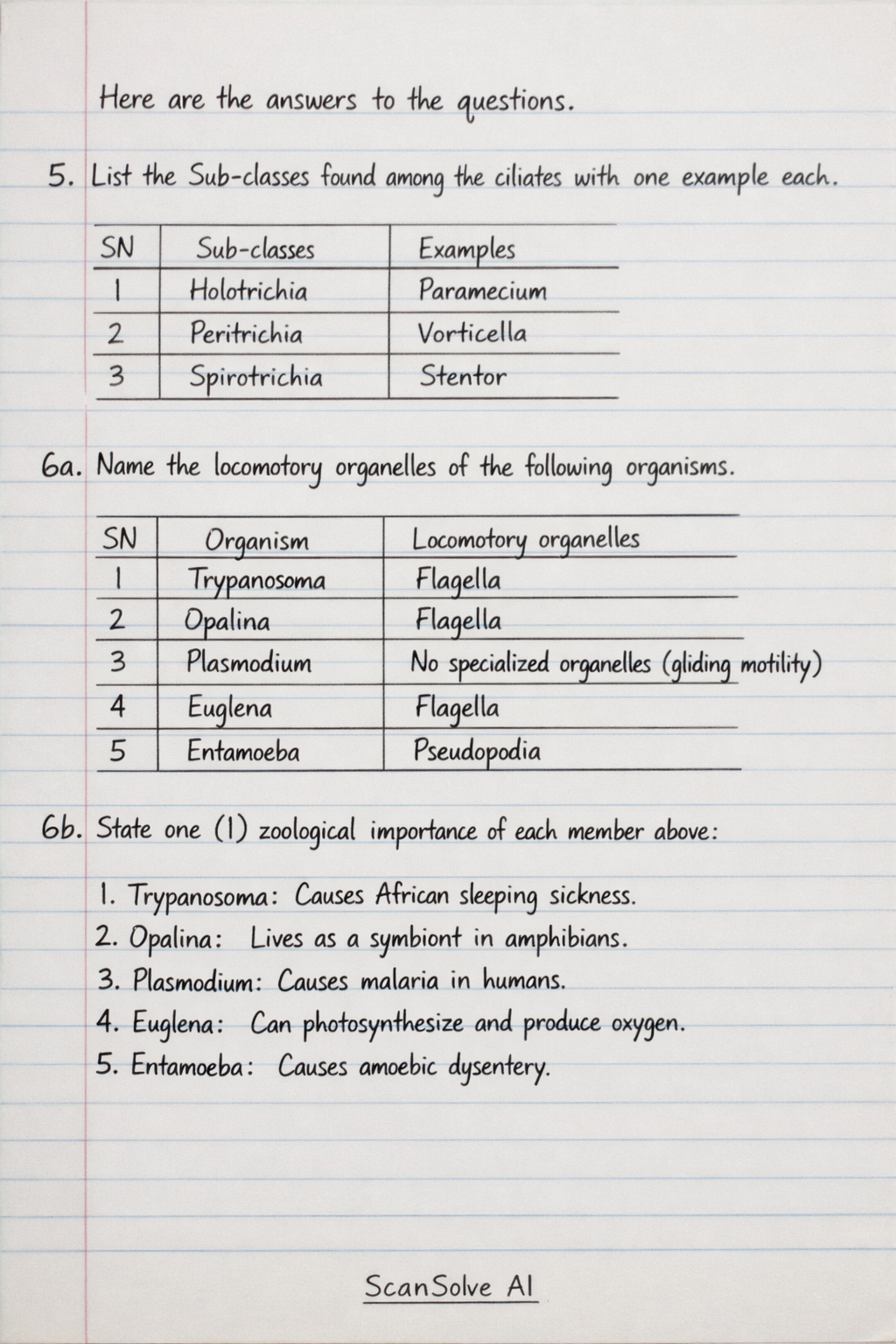
Here are the answers to the questions.
5. List the Sub-classes found among the ciliates with one example each.
| SN | Sub-classes | Examples |
|---|---|---|
| 1 | Holotrichia | Paramecium |
| 2 | Peritrichia | Vorticella |
| 3 | Spirotrichia | Stentor |
6a. Name the locomotory organelles of the following organisms.
| SN | Organism | Locomotory organelles |
|---|---|---|
| 1 | Trypanosoma | Flagella |
| 2 | Opalina | Flagella |
| 3 | Plasmodium | No specialized organelles (gliding motility) |
| 4 | Euglena | Flagella |
| 5 | Entamoeba | Pseudopodia |
6b. State one (1) zoological importance of each member above.
- Trypanosoma: Causes African sleeping sickness in humans and nagana in livestock.
- Opalina: Commensal in the intestines of amphibians like frogs.
- Plasmodium: Causes malaria in humans.
- Euglena: Important primary producer in aquatic food chains.
- Entamoeba: Entamoeba histolytica causes amoebic dysentery in humans.
6c. List three (3) diagnostic features of the mastigophorans.
- Possess one or more flagella for locomotion.
- Reproduce primarily by longitudinal binary fission.
- May be free-living, parasitic, or symbiotic; some are photosynthetic.
Was this helpful?
Still stuck on this one?
Ask a follow-up, and the answer starts from this question.
Got a different question?Ask your own question
More Biology Questions
QList the Sub-classes found among the ciliates with one example each. Name the locomotory organelles…QClassify Protozoa into subclasses and list diagnostic features of Apicomplexans. Name diseases and…QWhat are three sub-phyla of Sarcomastigophorans and their locomotory organelles?QDescribe ten characteristics of Phylum Rotifera, two unique morphological features, and list the…QDescription of classification of parasitic protozoans with examples
Handwritten Step-by-Step Solution
Get this as a handwritten image on WhatsApp — like a tutor wrote it for you.
Try on WhatsApp