
We read your photo as:
Classify Protozoa into subclasses and list diagnostic features of Apicomplexans. Name diseases and distinguish features of Opalina vs. Paramecium.
Biology
ScanSolve AI Answer
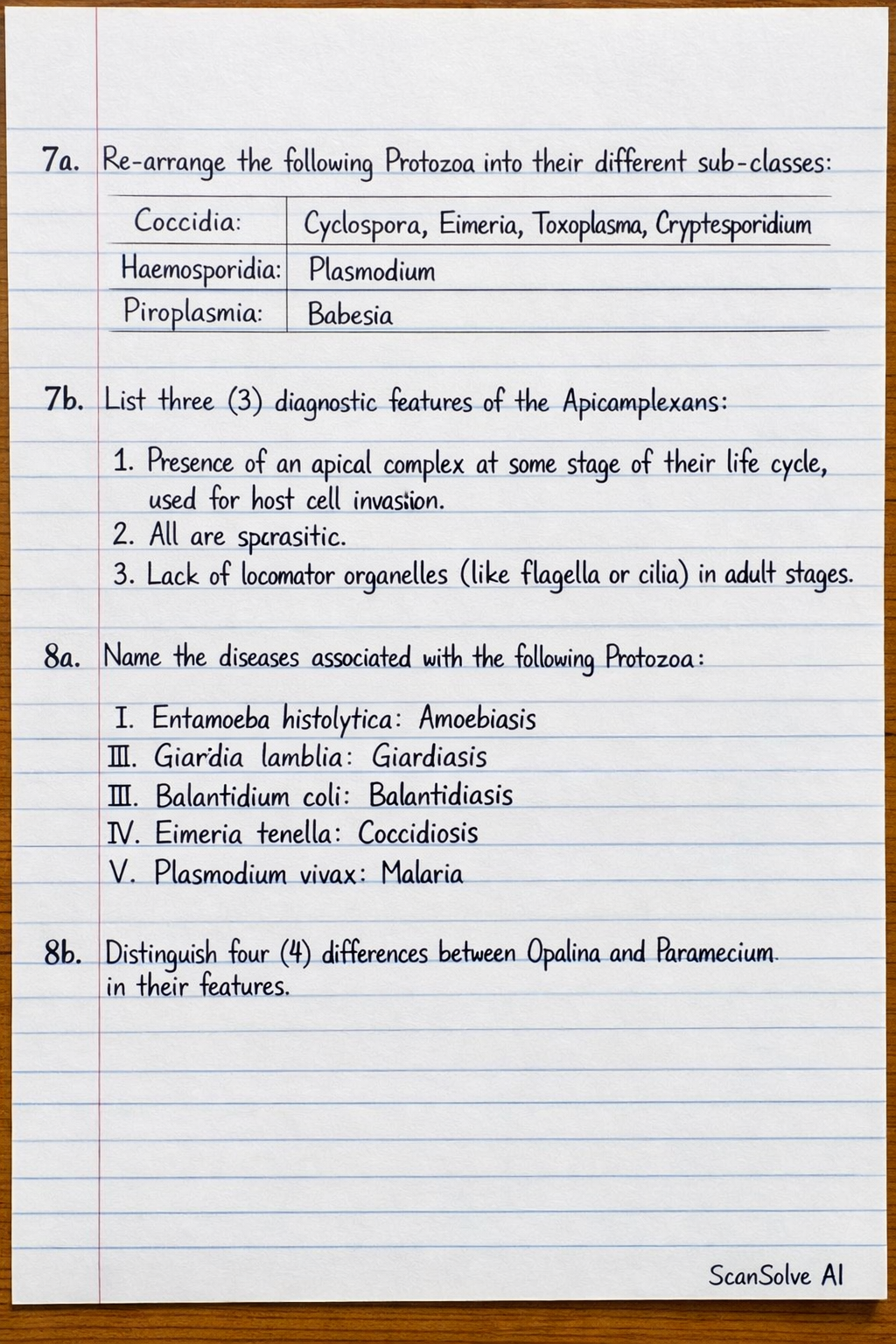
7a. Re-arrange the following Protozoa into their different sub-classes.
| Sub-class | Protozoa |
|---|---|
| Coccidia | Cyclospora, Eimeria, Toxoplasma, Cryptosporidium |
| Haemosporidia | Plasmodium |
| Piroplasmia | Babesia |
7b. List three (3) diagnostic features of the Apicomplexans.
- Presence of an apical complex at some stage of their life cycle, used for host cell invasion.
- All are parasitic.
- Lack of locomotor organelles (like flagella or cilia) in adult stages.
8a. Name the diseases associated with the following Protozoa.
- I Entamoeba histolytica: Amoebiasis
- Ii Giardia lamblia: Giardiasis
- Iii Balantidium coli: Balantidiasis
- Iv Eimeria tenella: Coccidiosis
- V Plasmodium vivax: Malaria
8b. Distinguish four (4) differences between Opalina and Paramecium in their features.
| Opalina | Paramecium |
|---|---|
| 1. Multinucleate (many identical nuclei). | 1. Binucleate (macronucleus and micronucleus). |
| 2. Lacks contractile vacuoles. | 2. Possesses contractile vacuoles. |
| 3. Lacks a cytostome (mouth). | 3. Possesses a distinct oral groove and cytostome. |
| 4. All cilia are uniform and cover the body. | 4. Cilia are often differentiated (e.g., oral cilia). |
| 5. Primarily found in amphibian intestines. | 5. Primarily found in freshwater. |
Was this helpful?
Still stuck on this one?
Ask a follow-up, and the answer starts from this question.
Got a different question?Ask your own question
More Biology Questions
QDescription of classification of parasitic protozoans with examplesQQuestion: In details description of parasitic protozoans with and examples. (protozoan groups)QDescription of parasitic protozoans with example (protozoan groups).QList sub-classes of ciliates with examples, name locomotory organelles, state zoological importance…QComplete the table about Paramecium, detailing its characteristics.
Browse by topic:Microbiology
Handwritten Step-by-Step Solution
Get this as a handwritten image on WhatsApp — like a tutor wrote it for you.
Try on WhatsApp