
We read your photo as:
Description of parasitic protozoans with example (protozoan groups).
Biology
ScanSolve AI Answer
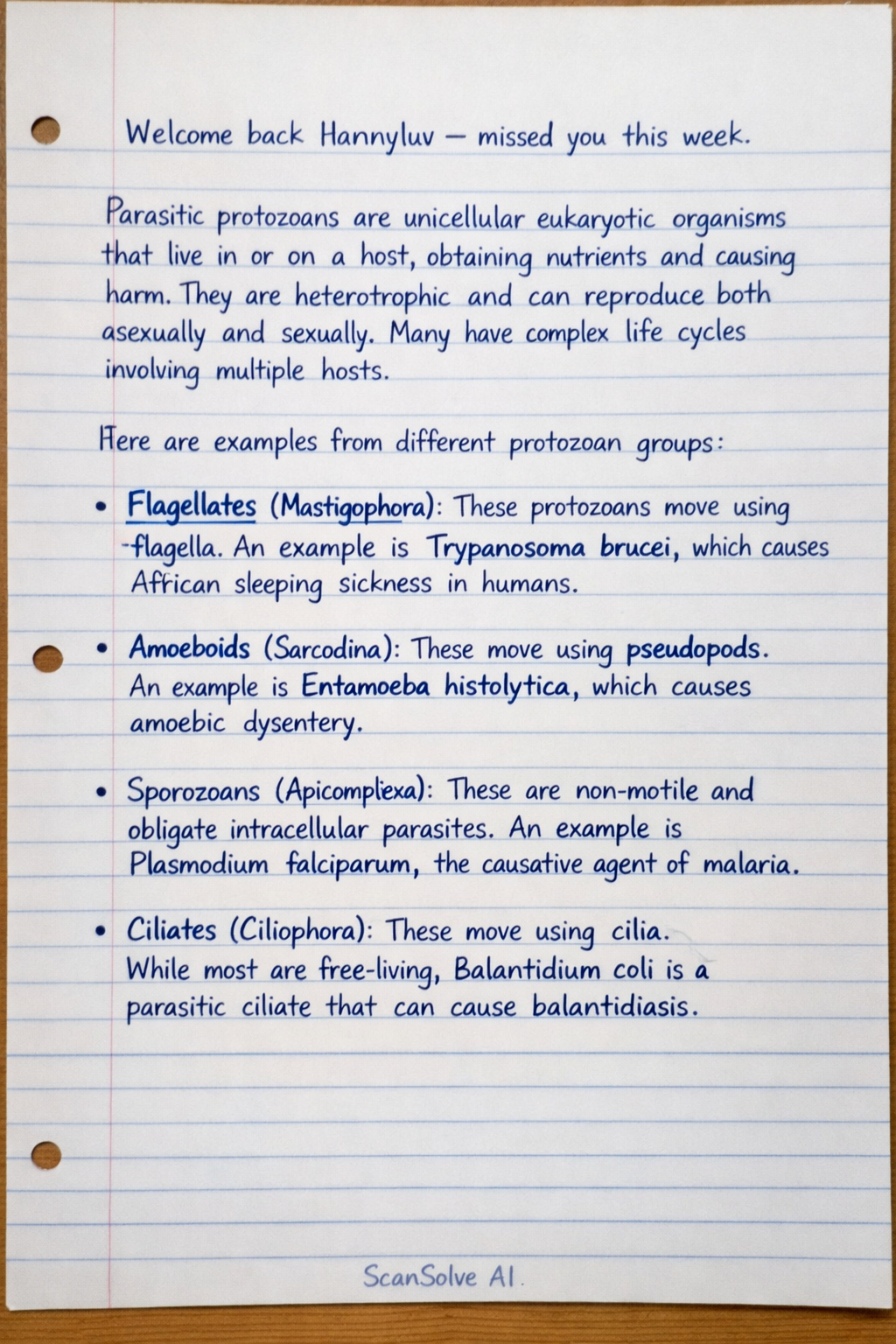
Parasitic protozoans are unicellular eukaryotic organisms that live in or on a host, obtaining nutrients and causing harm. They are heterotrophic and can reproduce both asexually and sexually. Many have complex life cycles involving multiple hosts.
Here are examples from different protozoan groups:
- Flagellates (Mastigophora): These protozoans move using flagella. An example is Trypanosoma brucei, which causes African sleeping sickness in humans.
- Amoeboids (Sarcodina): These move using pseudopods. An example is Entamoeba histolytica, which causes amoebic dysentery.
- Sporozoans (Apicomplexa): These are non-motile and obligate intracellular parasites. An example is Plasmodium falciparum, the causative agent of malaria.
- Ciliates (Ciliophora): These move using cilia. While most are free-living, Balantidium coli is a parasitic ciliate that can cause balantidiasis.
Was this helpful?
Still stuck on this one?
Ask a follow-up, and the answer starts from this question.
Got a different question?Ask your own question
More Biology Questions
QQuestion: In details description of parasitic protozoans with and examples. (protozoan groups)QDescription of classification of parasitic protozoans with examplesQList three (3) phyla in the Sub-kingdom Protozoa with two examples each.Q2.1 Malaria parasite belongs to the group of protozoa.QClassify Protozoa into subclasses and list diagnostic features of Apicomplexans. Name diseases and…
Handwritten Step-by-Step Solution
Get this as a handwritten image on WhatsApp — like a tutor wrote it for you.
Try on WhatsApp