
We read your photo as:
List two micronutrients and two macronutrients for plants. (b) Explain the function of blood plasma, white blood cells, and blood in temperature regulation. (c) Describe three health impacts of poor w
Biology
ScanSolve AI Answer
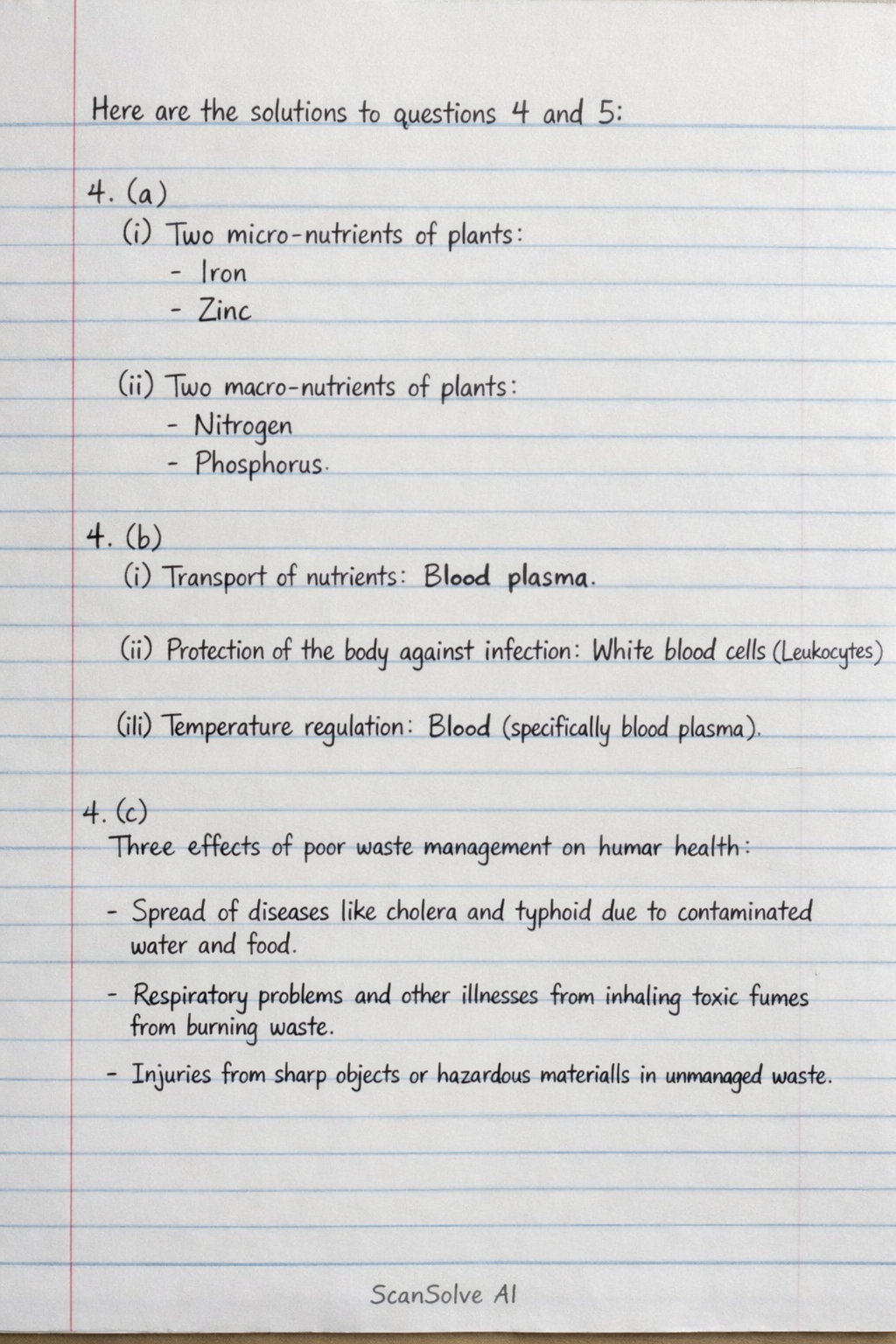
Here are the solutions to questions 4 and 5:
4. (a)
- (i) Two micro-nutrients of plants:
- Iron
- Zinc
- (ii) Two macro-nutrients of plants:
- Nitrogen
- Phosphorus
4. (b)
- (i) Transport of nutrients: Blood plasma
- (ii) Protection of the body against infection: White blood cells (Leukocytes)
- (iii) Temperature regulation: Blood (specifically blood plasma)
4. (c) Three effects of poor waste management on human health:
- Spread of diseases like cholera and typhoid due to contaminated water and food.
- Respiratory problems and other illnesses from inhaling toxic fumes from burning waste.
- Injuries from sharp objects or hazardous materials in unmanaged waste.
4. (d)
- (i) Differentiate between a colloid and a suspension:
- A colloid is a heterogeneous mixture where particles are larger than those in a solution but small enough not to settle out (e.g., milk). They often scatter light (Tyndall effect).
- A suspension is a heterogeneous mixture where particles are large enough to be seen with the naked eye, settle over time, and can be filtered out (e.g., muddy water).
- (ii) Classify the following mixtures:
- (α) Groundnut paste and water: Suspension
- (β) Milk and water: Colloid
- (γ) Sugar and water: Solution
4. (e)
- (i) Work output is the useful work done by a machine on its load.
- (ii) How work output affects the efficiency of a machine if work input is fixed:
- Efficiency is calculated as . If the work input is fixed, an increase in work output will lead to an increase in the machine's efficiency. Conversely, a decrease in work output will decrease the machine's efficiency.
5. (a)
- (i) An atom of an element is represented as .
- (α) Protons:
- (β) Electrons: (in a neutral atom)
- (γ) Neutrons:
- (ii) Position of the element X in (i) on the periodic table:
- (α) Group: (or VIA, as it has 6 valence electrons)
- (β) Period: (as it has 2 electron shells)
5. (b)
- (i) Explain briefly heat transfer by conduction:
- Conduction is the transfer of thermal energy through direct contact between particles. Heat flows from hotter regions to colder regions as more energetic particles collide with and transfer energy to less energetic particles, without the overall movement of the material itself.
- (ii) Two other methods of heat transfer:
- Convection
- Radiation
5. (c)
- (i) Two examples of water bodies:
- Rivers
- Lakes
- (ii) Two practices of humans that destroy water bodies:
- Dumping industrial waste and untreated sewage into them.
- Deforestation, which leads to soil erosion and increased sedimentation in water bodies.
- (iii) Two methods of conserving water bodies:
- Implementing strict regulations on industrial and domestic waste disposal to prevent pollution.
- Promoting afforestation and reforestation to reduce soil erosion and protect watersheds.
5. (d)
- (i) Three ways by which bacterial diseases are managed:
- Administering antibiotics to kill or inhibit the growth of bacteria.
- Vaccination to provide immunity against specific bacterial pathogens.
- Maintaining good sanitation and hygiene practices to prevent the spread of bacteria.
- (ii) Give an example of a bacterial disease:
- Cholera (Other examples include Tuberculosis, Typhoid, Tetanus)
Was this helpful?
Still stuck on this one?
Ask a follow-up, and the answer starts from this question.
Got a different question?Ask your own question
More Biology Questions
QA) i) State three (3) differences between macro nutrients and micro nutrients as used in crop…QAnswer the following questions in brief: 1. What are nutrients? Name the main nutrients. 2. Why are…QState three (3) differences between macro nutrients and micro nutrients as used in crop production…QDifferentiate between Macro-nutrients and Micro-nutrients, state two plant growth requirements and…QProvide answers to the following questions regarding plant nutrients, body functions, waste…
Handwritten Step-by-Step Solution
Get this as a handwritten image on WhatsApp — like a tutor wrote it for you.
Try on WhatsApp