
We read your photo as:
Describe the main parts of the human eye and ear and explain how they work. Discuss the differences and similarities in how the eye and ear function.
ScanSolve AI Answer
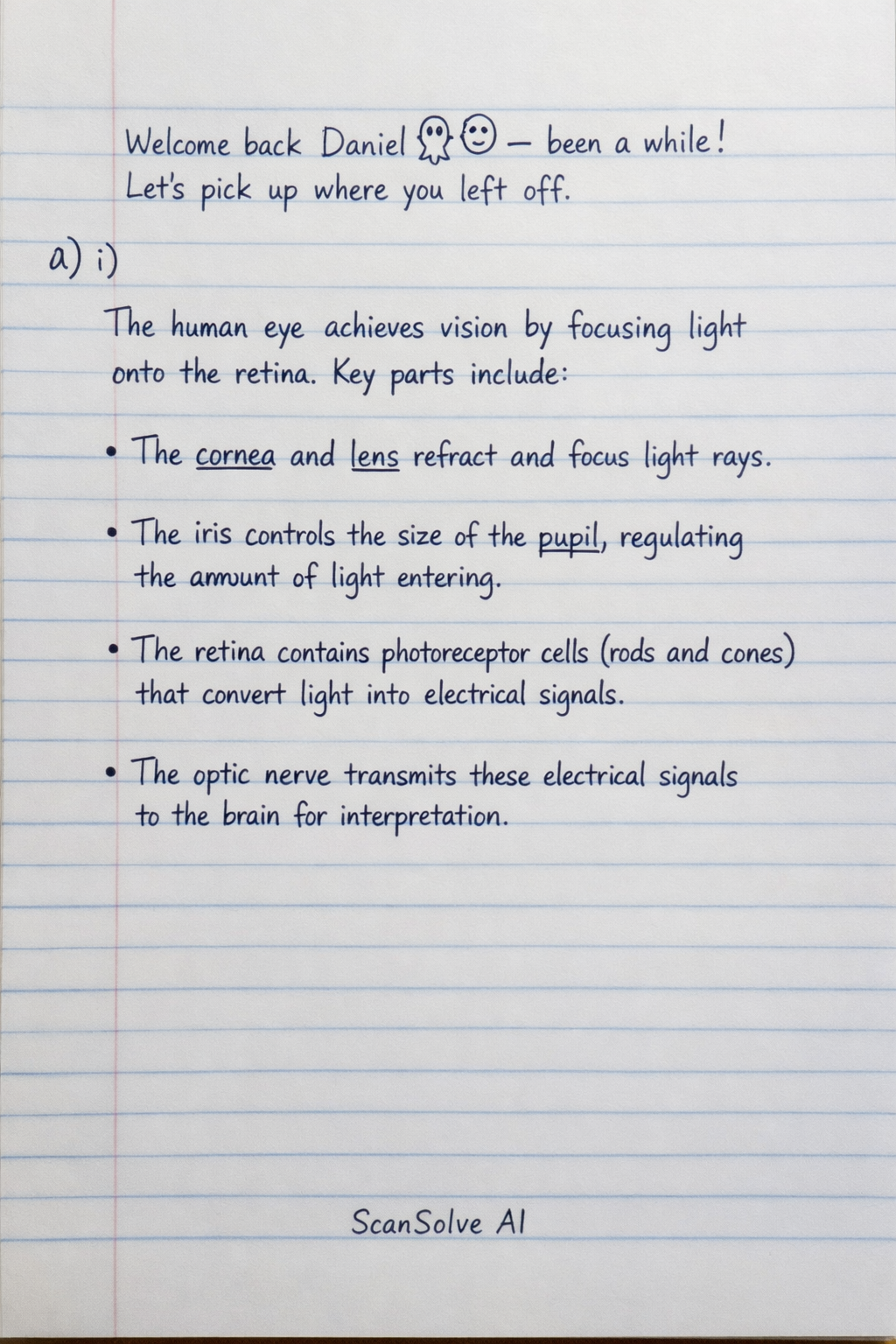
a) i)
The human eye achieves vision by focusing light onto the retina. Key parts include:
- The cornea and lens refract and focus light rays.
- The iris controls the size of the pupil, regulating the amount of light entering.
- The retina contains photoreceptor cells (rods and cones) that convert light into electrical signals.
- The optic nerve transmits these electrical signals to the brain for interpretation.
a) ii)
Here are two hearing defects:
- Conductive hearing loss: This occurs when sound waves cannot effectively reach the inner ear. It manifests as a reduction in sound intensity and clarity, often due to blockages (like earwax), a perforated eardrum, or issues with the ossicles (tiny bones) in the middle ear.
- Sensorineural hearing loss: This results from damage to the inner ear (cochlea) or the auditory nerve. It manifests as difficulty hearing faint sounds, muffled speech, and problems understanding speech in noisy environments, often caused by aging, loud noise exposure, or certain diseases.
b)
- Different: The eye detects electromagnetic waves (light) to enable vision, while the ear detects mechanical waves (sound vibrations) to enable hearing.
- Similar: Both the eye and the ear are sense organs that convert external physical stimuli (light or sound) into electrical nerve impulses that are then sent to the brain for processing.
c) i)
One reason why ultrasound may be chosen over X-rays for medical diagnosis is that ultrasound does not use ionizing radiation, making it safer for imaging sensitive tissues, pregnant women, and fetuses, as it avoids potential radiation exposure risks.
c) ii)
Medical diagnosis and treatment are always accompanied by measurements and recording of body temperature because body temperature is a vital sign that provides crucial information about a patient's physiological state. An elevated temperature (fever) often indicates infection or inflammation, while a low temperature can signal other serious conditions. Monitoring temperature helps assess the severity of an illness, track disease progression, and evaluate the effectiveness of treatment.
d)
An electrocardiogram (ECG) is a non-invasive test that records the electrical activity of the heart over a period of time. It works by placing electrodes on the skin to detect the tiny electrical changes that occur as the heart muscle depolarizes and repolarizes during each heartbeat.
An ECG can be used to diagnose malfunctioning of the heart by:
- Identifying abnormal heart rhythms (arrhythmias), such as too fast (tachycardia), too slow (bradycardia), or irregular beats.
- Detecting evidence of a heart attack (myocardial infarction) by showing changes in the ST segment or T waves, indicating damage to heart muscle.
- Revealing signs of heart enlargement or structural abnormalities by analyzing the amplitude and duration of the electrical waves.
- Indicating electrolyte imbalances or the effects of certain medications on heart function.
Still stuck on this one?
Ask a follow-up, and the answer starts from this question.
More Biology Questions
Handwritten Step-by-Step Solution
Get this as a handwritten image on WhatsApp — like a tutor wrote it for you.
Try on WhatsApp