
We read your photo as:
Describe major developmental events in the 9th and 10th lunar months of fetal life, the second week of embryonic life, and the third week of embryonic life.
Biology
ScanSolve AI Answer
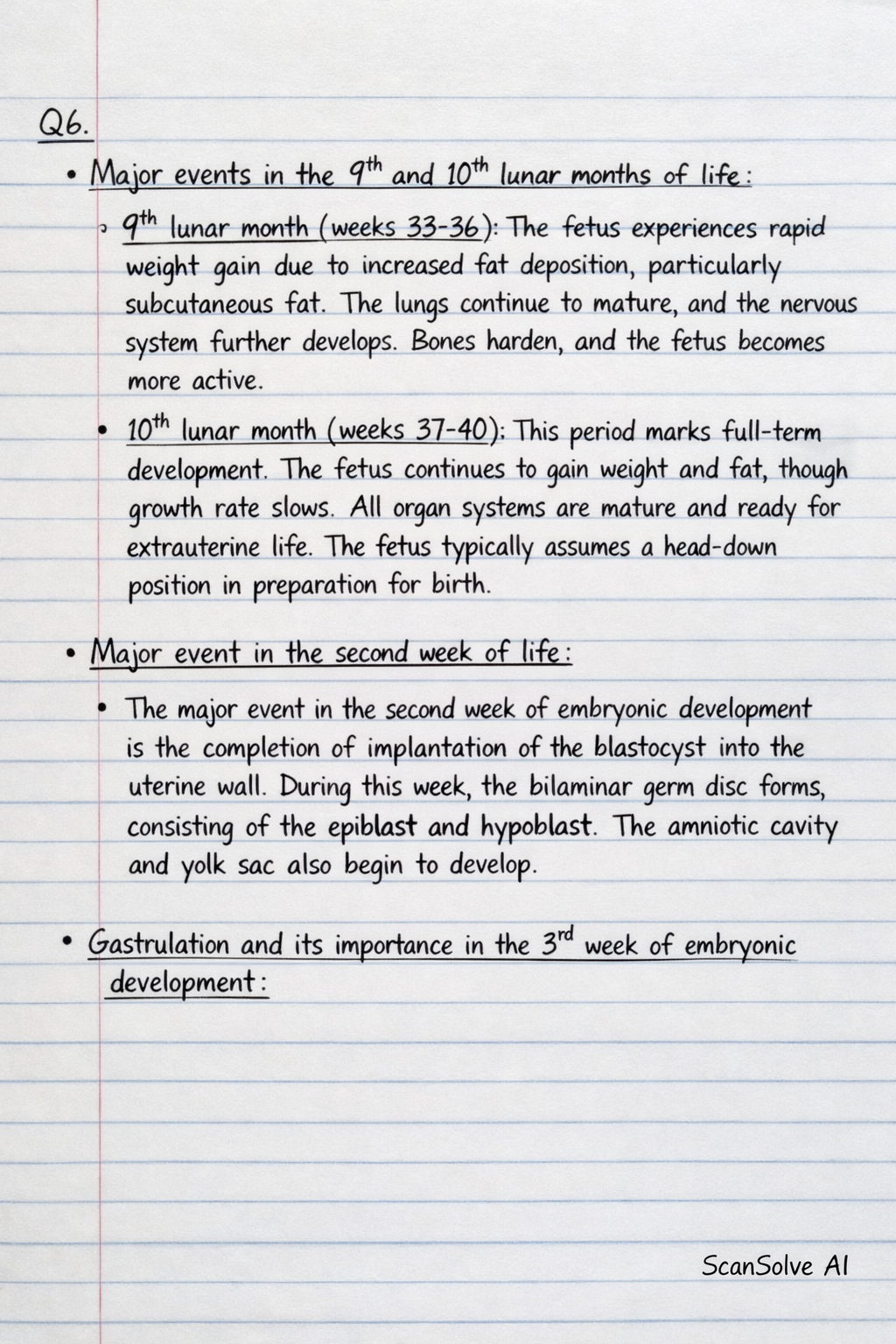
Q6.
- Major events in the 9th and 10th lunar months of life:
- 9th lunar month (weeks 33-36): The fetus experiences rapid weight gain due to increased fat deposition, particularly subcutaneous fat. The lungs continue to mature, and the nervous system further develops. Bones harden, and the fetus becomes more active.
- 10th lunar month (weeks 37-40): This period marks full-term development. The fetus continues to gain weight and fat, though growth rate slows. All organ systems are mature and ready for extrauterine life. The fetus typically assumes a head-down position in preparation for birth.
- Major event in the second week of life:
- The major event in the second week of embryonic development is the completion of implantation of the blastocyst into the uterine wall. During this week, the bilaminar germ disc forms, consisting of the epiblast and hypoblast. The amniotic cavity and yolk sac also begin to develop.
- Gastrulation and its importance in the 3rd week of embryonic development:
- Gastrulation is a fundamental process occurring in the 3rd week of embryonic development where the bilaminar germ disc transforms into a trilaminar germ disc. This involves the formation of three primary germ layers: the ectoderm, mesoderm, and endoderm.
- Its importance lies in the fact that these three germ layers are the foundational tissues from which all organs and tissues of the body will differentiate and develop during organogenesis.
Q7.
- Layers of the abdominal wall from superficial to Deep:
- Skin
- Superficial fascia (Camper's fascia and Scarpa's fascia)
- External oblique muscle
- Internal oblique muscle
- Transversus abdominis muscle
- Transversalis fascia
- Extraperitoneal fat
- Parietal peritoneum
- Two functions of the anterior abdominal wall:
- Protects the abdominal viscera from external trauma.
- Maintains intra-abdominal pressure, which is crucial for functions like defecation, urination, and childbirth.
- Muscles of the abdominal wall:
- External oblique
- Internal oblique
- Transversus abdominis
- Rectus abdominis
- Pyramidalis
- Definition of the peritoneum:
- The peritoneum is a serous membrane that lines the abdominopelvic cavity and covers the surfaces of most abdominal organs. It consists of two continuous layers: the parietal peritoneum (lining the cavity walls) and the visceral peritoneum (covering the organs).
Q8.
- Differentiation between parietal and visceral peritoneum:
- The parietal peritoneum is the outer layer of the peritoneum that lines the internal surface of the abdominopelvic cavity walls.
- The visceral peritoneum is the inner layer that covers the external surfaces of most abdominal organs.
- Definition of peritoneal cavity and retroperitoneal organs, with two examples for retroperitoneal:
- The peritoneal cavity is a potential space between the parietal and visceral layers of the peritoneum, containing a small amount of serous fluid that allows organs to move freely.
- Retroperitoneal organs are organs located posterior to the peritoneum, meaning they are only covered by peritoneum on their anterior surface.
- Examples of retroperitoneal organs: Kidneys, Pancreas.
- Two functions of the diaphragm:
- It is the primary muscle of inspiration, contracting to increase the volume of the thoracic cavity and draw air into the lungs.
- It helps to increase intra-abdominal pressure, assisting in actions such as defecation, urination, vomiting, and childbirth.
- Contents of the inguinal canal in male:
- Spermatic cord (containing the vas deferens, testicular artery, pampiniform plexus, nerves, and lymphatics)
- Ilioinguinal nerve
Q9.
- Nerves that supply the lower limb:
- Femoral nerve
- Obturator nerve
- Sciatic nerve (which branches into the tibial nerve and common fibular nerve)
- Superior gluteal nerve
- Inferior gluteal nerve
- Bones of the lower limb:
- Pelvic girdle (ilium, ischium, pubis)
- Femur
- Patella
- Tibia
- Fibula
- Tarsals (7 bones)
- Metatarsals (5 bones)
- Phalanges (14 bones)
- Bones of the vertebrae:
- Cervical vertebrae (7)
- Thoracic vertebrae (12)
- Lumbar vertebrae (5)
- Sacrum (5 fused vertebrae)
- Coccyx (3-5 fused vertebrae)
- Carpal and tarsal bones:
- Carpal bones (wrist): Scaphoid, Lunate, Triquetrum, Pisiform, Trapezium, Trapezoid, Capitate, Hamate.
- Tarsal bones (ankle/foot): Talus, Calcaneus, Navicular, Cuboid, Medial cuneiform, Intermediate cuneiform, Lateral cuneiform.
Q10.
- Five functions of the eye:
- Vision (detecting light and forming images).
- Light perception (distinguishing between light and dark).
- Color discrimination (perceiving different wavelengths of light as colors).
- Depth perception (judging distances).
- Accommodation (adjusting focus for near or far objects).
- Parts of a typical tooth:
- Crown (the visible part above the gum line)
- Neck (the constricted area where the crown meets the root)
- Root (the part embedded within the jawbone)
- Enamel (outermost layer of the crown)
- Dentin (main bulk of the tooth, beneath enamel and cementum)
- Pulp cavity (innermost chamber containing nerves and blood vessels)
- Cementum (outer layer of the root)
- Four main types of teeth in the permanent dentition:
- Incisors
- Canines
- Premolars
- Molars
- Anatomy of the eye:
The human eye is a spherical organ responsible for vision, located in the bony orbit. It has three main layers:
- The fibrous layer (outermost) includes the tough, white sclera posteriorly and the transparent cornea anterior
Was this helpful?
Still stuck on this one?
Ask a follow-up, and the answer starts from this question.
Got a different question?Ask your own question
More Biology Questions
QFrom 11:00 to 14:22 the video explains the moment from conception to 16 weeks. Please summarize some…QResearch & Presentation TOPICS GROUP 1: Discuss the process involved in: Menstruation Conception…QDiscuss the role of extra embryonic membranes in the development of the foetus and describe the…QDescribe the functions of the placenta, the structure of the umbilical cord, and the early…QDescribe the placenta, umbilical cord, and fetal development stages.
Handwritten Step-by-Step Solution
Get this as a handwritten image on WhatsApp — like a tutor wrote it for you.
Try on WhatsApp