
We read your photo as:
Match the terms in Column II with the descriptions in Column I. Also, state the importance of DNA replication and the monomers of DNA.
ScanSolve AI Answer
Answer
ONLY
Step-by-step solution
10 stepsQuestion 1.3.1
Define the terms in Column II.
- Altricial refers to young that are born or hatched helpless and require extensive parental care.
- Precocial refers to young that are relatively mature and mobile at birth or hatching, requiring less parental care.
Match the description in Column I to the definitions.
The description "A reproductive strategy where the young is independent of their parents" directly matches the definition of precocial.
The correct answer is B ONLY.
Question 1.3.2
Define DNA replication.
DNA replication is the biological process of producing two identical replicas of DNA from one original DNA molecule.
Evaluate the options in Column II.
- A: "Doubles genetic material" is a direct outcome and importance of DNA replication, ensuring that each daughter cell receives a complete set of chromosomes during cell division.
- B: "Formation of mRNA" is the process of transcription, where DNA is used as a template to synthesize mRNA, which is distinct from DNA replication.
Match the description in Column I to the options.
The importance of DNA replication is to double the genetic material.
The correct answer is A ONLY.
Question 1.4.1
a) The monomers (building blocks) of a DNA strand are nucleotides.
b) The type of sugar found in an mRNA strand is ribose.
Question 1.4.2
To answer this, we first need to complete the table using the given information that both the DNA strand and mRNA strand are 18 nitrogenous bases long, and applying base pairing rules (A-T in DNA, A-U in mRNA, C-G in both).
Given:
- Total bases in DNA strand = 18
- Total bases in mRNA strand = 18
Initial table:
BASES DNA STRAND mRNA STRAND Adenine - - Cytosine - - Thymine 2 - Uracil - - Guanine 5 8 Use base pairing rules between the DNA template strand and the mRNA strand.
- If DNA Guanine (G) = 5, then mRNA Cytosine (C) = 5.
- If DNA Thymine (T) = 2, then mRNA Adenine (A) = 2.
- If mRNA Guanine (G) = 8, then DNA Cytosine (C) = 8.
Fill in the known values into the table.
BASES DNA STRAND mRNA STRAND Adenine - 2 Cytosine 8 5 Thymine 2 - Uracil - - Guanine 5 8 Calculate the remaining bases for each strand to reach a total of 18.
For the DNA STRAND:
- Known bases: Thymine (2) + Guanine (5) + Cytosine (8) = 15
- Remaining bases for Adenine = 18 - 15 = 3
- So, DNA Adenine = 3
For the mRNA STRAND:
- Known bases: Adenine (2) + Cytosine (5) + Guanine (8) = 15
- Remaining bases for Uracil = 18 - 15 = 3
- So, mRNA Uracil = 3
Completed table:
BASES DNA STRAND mRNA STRAND Adenine 3 2 Cytosine 8 5 Thymine 2 - Uracil - 3 Guanine 5 8 a) From the completed table, the number of Adenine bases present in the DNA strand is 3.
b) From the completed table, the number of Cytosine bases present in the mRNA strand is 5.
Question 1.4.3
Recall the composition of DNA.
DNA contains the nitrogenous bases Adenine, Guanine, Cytosine, and Thymine. Uracil is found in RNA, replacing Thymine.
Determine the presence of uracil in the DNA strand.
Based on the composition of DNA, uracil is not present in a DNA strand.
The percentage of uracil in the DNA strand is 0%.
Try one yourself
A new problem that tests the same skill.
Still stuck on this one?
Ask a follow-up, and the answer starts from this question.
More Biology Questions
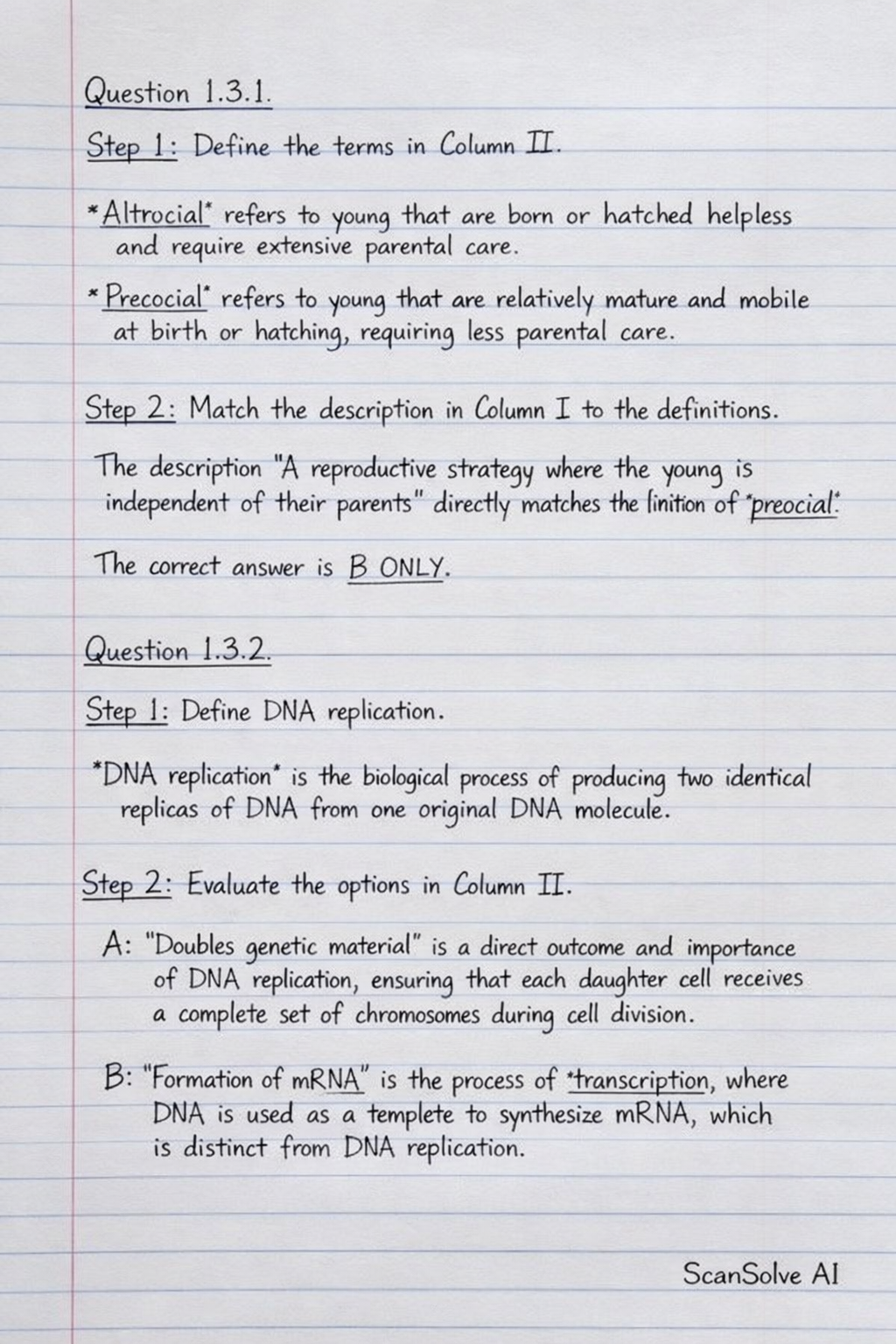
Handwritten Step-by-Step Solution
Get this as a handwritten image on WhatsApp — like a tutor wrote it for you.
Try on WhatsApp